

















When they land in Hanoi or Ho Chi Minh City, many travellers ask the same first question, and it is not about visas or the weather: how do I get mobile data on my phone as soon as I leave the airport? We have been welcoming travellers to Vietnam since 2005, and every week we see the same hesitation between a local SIM card, an eSIM bought before departure and simply relying on hotel Wi-Fi. Here is what you need to know to choose with confidence, with indicative prices observed in 2026 and the registration rules currently applied.
Do you really need a SIM card to travel in Vietnam?
A local SIM card is not mandatory, but it makes travelling far easier for booking a Grab, finding your way or calling your guide.
In Vietnam your phone does far more than check messages. Ride-hailing apps such as Grab or Xanh SM often replace taxis, Google Maps guides you through the lanes of the Old Quarter, and most Vietnamese people, including hotels, restaurants and drivers, communicate through the Zalo messaging app. To find the tools that genuinely help on the ground, see our selection of useful websites and apps for planning and enjoying your trip to Vietnam.
Without mobile data, you depend on the Wi-Fi wherever you stop. That works well in cities, far less on a long drive to Ha Giang, in the rice terraces of Mu Cang Chai or aboard a junk in Lan Ha Bay. Even on a private tour with a guide and driver, a connection remains valuable for your free time, for reaching your guide or for sending a few photos home.
Your home mobile plan may work in roaming, but Vietnam is outside the European Union and the rates are usually high. Check the conditions before leaving and switch off data roaming if you plan to use another option: a few minutes of video can be enough to cause an unpleasant surprise on your bill.
SIM card or eSIM: which option suits your trip?
For a two to four week stay, a local SIM card remains the cheapest choice, while an eSIM gets you online the moment you land.
Both options work very well in Vietnam. The choice depends mainly on your phone, the length of your stay and whether or not you need a Vietnamese number.
A local SIM card, the cheapest solution
A physical SIM card from a Vietnamese operator costs a few dollars for a month of generous data, often several gigabytes per day. It gives you a Vietnamese +84 number, handy for receiving a confirmation code, being called by a driver or creating a Zalo account. Your phone simply needs to be unlocked, and you will have to remove your usual SIM card during the trip unless your device takes two cards. Keep it somewhere safe: losing it would complicate your return, especially for bank codes sent by text message.
An eSIM, convenient from the moment you land
An eSIM is a virtual card installed by scanning a QR code. You can buy it before departure from an international provider such as Airalo, Holafly or Saily and activate it on arrival: you are online from the jet bridge, with no queue at the counter. Your usual line can stay active alongside it for your bank’s text messages. On the other hand, it costs more than a local SIM, and most of these plans are data only, without a Vietnamese number. Vietnamese operators also sell their own eSIMs, in official stores or online, with a local number.
Before buying an eSIM, check that your phone is compatible, which is the case for most recent iPhones and high-end Android smartphones, and that it is not locked by your carrier. If in doubt, each provider publishes a list of compatible devices on its website.
| Option | Indicative price | Vietnamese number | Best for |
|---|---|---|---|
| Local SIM card | About 5 to 15 USD for 30 days | Yes | Stays of a week or more, tight budgets |
| eSIM from a Vietnamese operator | About 13 to 20 USD | Yes | Compatible phone, need for a local number |
| International eSIM | 10 to 30 USD depending on data, 40 USD and up for unlimited | Rarely | Short stays, multi-country trips |
| Roaming with your home carrier | Variable, often expensive | No | Very occasional use |
| Wi-Fi only | Free | No | Minimal use, fully guided tours |
If you are combining Vietnam with Laos or Cambodia, a regional Southeast Asia eSIM saves you from changing cards at every border. For a trip to Vietnam alone, a local SIM card remains unbeatable on price.
Which operator should you choose: Viettel, Vinaphone or Mobifone?
Viettel has the widest coverage in the country, northern mountains included, while Vinaphone is often faster in the big cities.
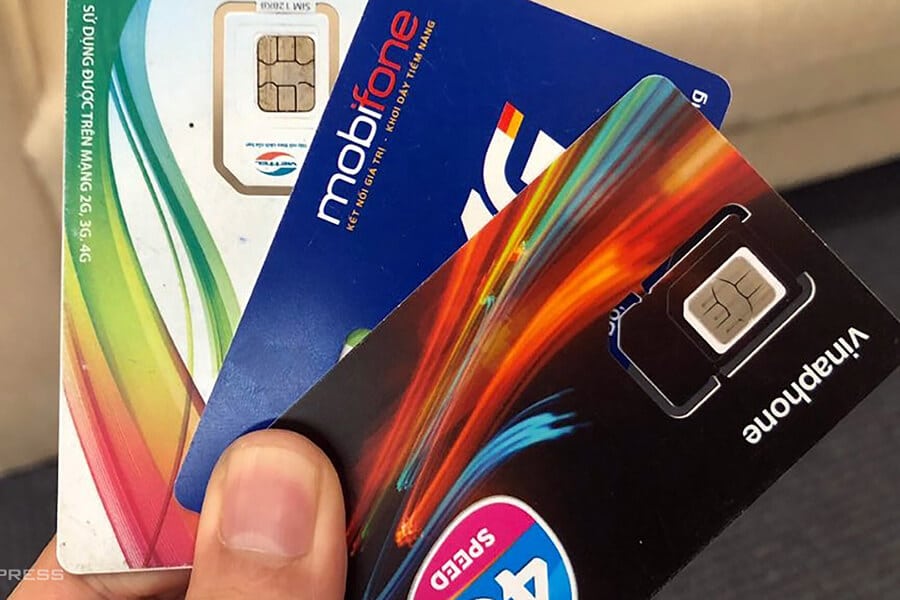
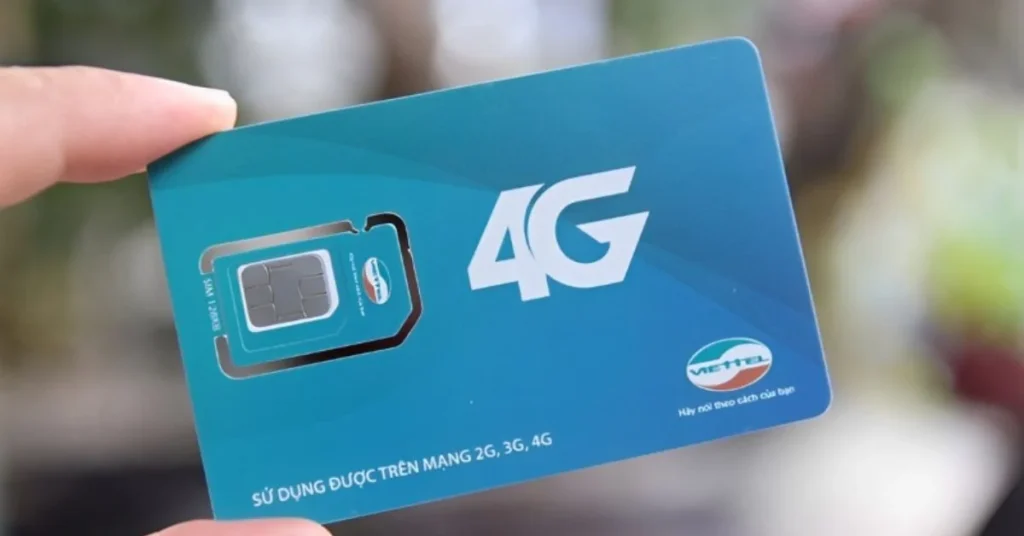
Three operators share most of the market. Viettel, linked to the Ministry of Defence, runs the most extensive network: it is the one we recommend if your route takes in the Ha Giang loop, Cao Bang or the villages around Sapa. Vinaphone, part of the state-owned VNPT group, often posts the best 5G speeds in major cities. Mobifone covers cities and tourist routes well, sometimes with generous data offers. Vietnamobile is cheaper but largely limited to urban areas.
In practice, for a classic route through Hanoi, Halong Bay, Hue, Hoi An and Ho Chi Minh City, any of the three main operators will do. The difference shows in rural and mountain areas, where Viettel keeps a clear edge. It is also the operator most of our guides and drivers use on the roads of the north.
Where can you buy a SIM card in Vietnam, and how much does it cost?
The easiest option is to buy your SIM card at the official airport counters, for a few dollars more than in a city store.
At the airport, as soon as you arrive
Noi Bai International Airport in Hanoi and Tan Son Nhat in Ho Chi Minh City, like most major airports in the country, have operator counters in the arrivals hall after passport control. Staff insert the card, register the line and check that data is working before you leave. Allow 10 to 30 minutes depending on the crowds, longer when several flights land together. Opening hours vary from one counter to another: many stay open late into the evening, but there is no guarantee of finding one open at 3 a.m. Payment is in cash, in dong, and increasingly by bank card.
In an official store in town
Official Viettel, Vinaphone and Mobifone stores, found in every city, charge public rates that are often 10 to 30 percent cheaper than at the airport. They are the right choice if you arrive at night or prefer to take time to compare plans. Avoid street resellers and pre-activated cards sold without an ID check: since they are not registered in your name, they may be cut off after a few days.
As a guide, here are the price ranges observed in 2026 for a tourist SIM card:
- 7 days: about 60,000 to 180,000 VND, or 2.50 to 7 USD
- 15 days: about 200,000 to 300,000 VND, or 8 to 12 USD
- 30 days: about 125,000 to 400,000 VND, or 5 to 16 USD, usually with several gigabytes per day
Offers change often, and the cheapest plans do not always include calls. Ask what is included before paying, especially if you need to call Vietnamese numbers to book a restaurant or contact your accommodation.
What documents do you need to buy a SIM card in Vietnam?
Your original passport is enough, as the seller must register the line in your name and often takes a photo of you at the counter.
Vietnamese law requires every line to be registered to its user. For foreigners, this means presenting your original passport: a photocopy or a picture on your phone is usually not accepted. Identification rules were tightened in 2025 and 2026, with facial verification becoming increasingly standard. The process only takes a few minutes and the line is active almost immediately.
If the card has not been registered correctly, the operator may restrict the line, often starting with outgoing calls, before cutting it off. That is one more reason to buy from an official outlet rather than an intermediary. No special visa is needed: whether you enter under the 45-day exemption granted to French, Belgian and Swiss citizens or with an e-visa, the process is the same.
How do you top up and avoid unpleasant surprises?
Topping up takes just a few minutes with a scratch card sold in convenience stores or directly through your operator’s mobile app.
- Top-up cards are sold in convenience stores such as Circle K, 7-Eleven, GS25 or WinMart+, and by many small shops displaying the operator’s logo.
- Your operator’s app, for example My Viettel, lets you track usage and sometimes top up by bank card.
- Note the name of your plan: if something goes wrong, store staff can reactivate it in moments.
- If you are travelling as a couple, a mobile hotspot often saves buying two cards, provided your plan allows it.
- Be wary of unlimited plans, whose speed is often reduced beyond a certain daily volume.
It is also worth downloading Google Maps offline maps for mountain regions, where the signal can vanish over a pass or in a valley, even with Viettel.
Is hotel and café Wi-Fi enough?
Free Wi-Fi is available in almost every hotel, café and restaurant, but it will not help you on the road or out in the villages.
In cities, connections are generally good: almost every hotel, café and restaurant displays its password at the counter or on the table, and speeds easily handle video calls. In mountain village homestays or on some junks in Halong Bay, Wi-Fi is slower and sometimes intermittent. In the evening, when every guest logs on at once, do not count on it to upload large videos.
Our advice, after years of accompanying travellers all over the country: get a SIM card or an eSIM even if your tour is fully organised. The cost is modest, and the freedom to order a Grab, translate a menu or call your guide at any time makes a real difference to the comfort of your trip.
FAQ: SIM cards and internet in Vietnam
What is the best SIM card for Vietnam?
Viettel has the widest coverage, including in the northern mountains. Vinaphone is often faster in cities. For a classic itinerary, either works very well.
How much does a SIM card cost in Vietnam?
Expect about 125,000 to 400,000 VND, or 5 to 16 USD, for a 30-day tourist SIM card, slightly more at the airport than in an official city store.
Can you buy a SIM card at Hanoi airport?
Yes, Viettel, Vinaphone and Mobifone counters are located in the international arrivals hall at Noi Bai, after passport control. Their opening hours vary.
Do you need a passport to buy a SIM card in Vietnam?
Yes, your original passport is required to register the line in your name, and the seller usually takes a photo of you at the counter.
Does an eSIM work well in Vietnam?
Yes, as long as your phone is compatible and unlocked. It costs more than a local SIM card, but it connects you as soon as you land and keeps your usual line active.
Can you manage without a SIM card in Vietnam?
It is possible thanks to widespread Wi-Fi in cities, but you will have no connection on the road or in villages, and ordering a Grab becomes difficult.