




Located in the heart of Hanoi, the Ho Chi Minh Presidential Memorial Complex is far more than a historical site; it is a powerful symbol that tells the story of a leader and the nation he guided. From the Presidential Palace, a symbol of authority and diplomatic encounters, to the modest residences where Ho Chi Minh lived and worked, every corner of the complex reflects the simplicity, determination, and vision of this great man. As visitors wander through these serene and meaningful places, they discover a unique legacy—one that bears witness to the key stages of the Vietnamese revolution and the unbreakable bond between the President and his people.
Follow the guide!
The Presidential Palace
The Ho Chi Minh Presidential Memorial Complex, located within the grounds of the Presidential Palace, notably includes the impressive Presidential Palace itself. This majestic four-story building, facing Hùng Vương Street, stands out for its imposing architecture and elegant Renaissance style. Built between 1900 and 1906 by the Franco-German architect Lichtenfelder, it covers a usable area of nearly 1,300 square meters and contains more than 30 rooms, each decorated in a distinct style and meticulously designed.
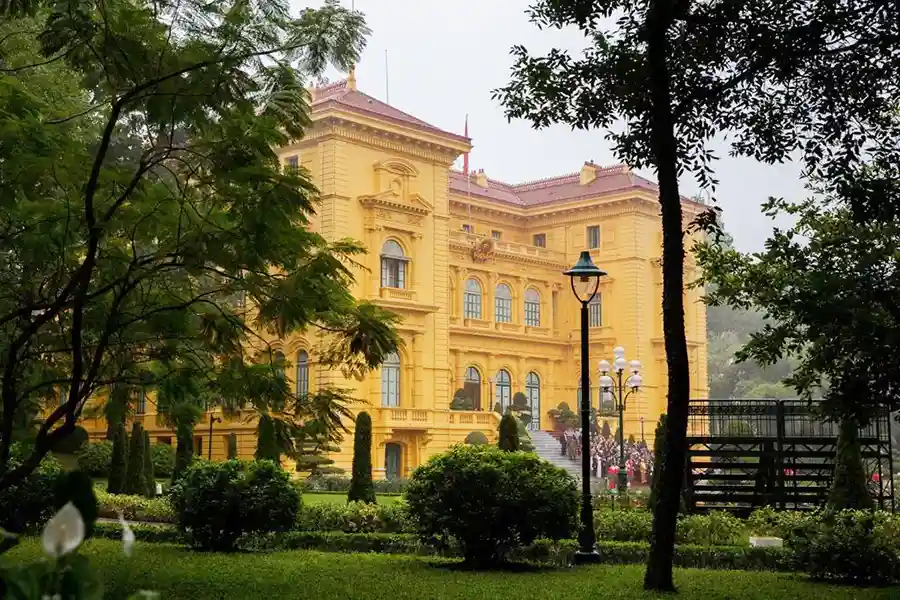
View of the Presidential Palace from its gardens, Hanoi
Under French colonial rule, this building was known as the “Palace of the Governor-General of Indochina.” From its completion until the victory of the August Revolution in 1945, 29 governors and acting governors lived and worked there.
Between 1945 and 1946, the building successively came under the control of Japanese forces and then the Chinese Nationalist Army. When the French returned for the second invasion of Vietnam, the palace once again became the seat of colonial power, a role it retained until the liberation of Hanoi in October 1954, following Vietnam’s victory in the war of independence against France. From that point on, it was renamed the Presidential Palace and became a powerful symbol of national authority.
Historical role and memorable encounters
Under the presidency of Ho Chi Minh, the building served as the setting for major national and international events. It was here that the President chaired meetings of the Government Council, making crucial decisions for the country’s future. The site also welcomed numerous distinguished guests, including heads of state, leaders of brother parties, ambassadors presenting their credentials, as well as artistic, sporting, and scientific delegations from around the world.
For the Vietnamese people, the Presidential Palace was a place of encounter between Ho Chi Minh and representatives of all social classes, without distinction of religion, political affiliation, or profession. Between 1945 and 1969, Ho Chi Minh received more than 1,000 national and international delegations there. He also recited his Lunar New Year greeting poems at this site, marking the beginning of each year with a note of hope and inspiration.
A place of remembrance and a major historical site
After the death of Ho Chi Minh on September 2, 1969, the Presidential Palace was classified by the State as a historical site of exceptional importance. It is an integral part of the Ho Chi Minh Memorial Complex. Even today, the building remains the workplace of the President of the Socialist Republic of Vietnam and hosts major official events for the Party and the State.
Both a witness to and an actor in the great milestones of Vietnamese history, the Presidential Palace remains a vibrant symbol of patriotism, wisdom, and the vision of a great leader. It invites every visitor to relive the defining moments of the past while discovering the legacy it embodies.
House No. 54 – a testament to the simple life of President Ho Chi Minh
After deciding to dedicate the former Palace of the Governor-General to official state activities and receptions, President Ho Chi Minh chose a small tiled-roof house near a pond as his residence and workplace. This house, once used as living quarters by an electrician working for the Palace of the Governor-General, became his home in December 1954.
A house steeped in history
Known as “House No. 54” after the year Ho Chi Minh moved in, this residence served as his living and working space for nearly four years, from December 1954 to May 1958. Later, the President moved to a stilt house built in the garden of the Presidential Palace, on the other side of the pond. However, he regularly returned to House No. 54 to have his meals and undergo medical check-ups.
House No. 54 thus remains deeply connected to Ho Chi Minh’s daily life during the last 15 years of his life, symbolizing his simplicity and humility.
A modest and functional layout
House No. 54 consists of three rooms:
# A workspace: Located on the pond side, it also serves as a reception room for welcoming guests.
# A dining room: Positioned at the center of the house, where a collection of utensils used daily by Ho Chi Minh is on display.
# A bedroom: Situated at the far end of the house, furnished with a table and chair for reading, a simple bed, and a small wardrobe containing only a few items of clothing.
The President’s personal belongings, books, documents, as well as souvenir gifts offered by his international friends, have all been carefully preserved. Everything remains neatly arranged, faithfully reflecting the organization of Ho Chi Minh’s final days.
A heritage rich in artifacts
House No. 54 now houses a valuable collection of nearly 400 artifacts, more than 300 of which are paper documents. These unique items provide a moving testimony to the daily life of President Ho Chi Minh, illustrating not only his simple lifestyle but also his key role in Vietnam’s history. Among these artifacts are letters, manuscripts, newspapers, and personal objects, shedding light on the relationships he maintained with leaders from around the world and his lasting influence on the international stage.
The vehicles used by President Ho Chi Minh
Next to House No. 54 is an exhibition hall displaying three vehicles used by President Ho Chi Minh.
The first is a ZIS (Zit) car, license plate HN 481. It measures 5.92 m in length, 1.82 m in width, and 1.75 m in height, weighs 4,280 kg, and is black. This vehicle was presented to President Ho Chi Minh by the Communist Party of the Soviet Union in 1954. During the period when he lived and worked at the Presidential Palace, the car was used on special occasions, such as welcoming important delegations. It was reserved for situations requiring the highest level of security for international visitors and heads of state.
During the U.S. air war against North Vietnam (1964–1965), the vehicle was assigned to permanent air-defense duties in service of President Ho Chi Minh. The total distance covered by this car is 15,788 km.
The second vehicle is a Pobeda car, license plate HN 158. It measures 4.58 m in length, 1.45 m in width, and 1.44 m in height, weighs 1,640 kg, and is gray.
Offered by the Soviet Union to the Vietnamese government in 1955, this car was used by President Ho Chi Minh from March 3 to the end of August 1957. The Pobeda was the vehicle he used most frequently during that period. With its raised chassis, it was well suited for long journeys, making it particularly practical for travel to remote areas. The vehicle covered a total distance of 39,436 km.
The third vehicle is a Peugeot 404, license plate HNC 232. It measures 4.25 m in length, 1.40 m in width, and 1.40 m in height, weighs 2,300 kg, and is silver-gray. This car was used to serve President Ho Chi Minh during the 1960s. In 1969, when his health had declined, he often used a 1967 Peugeot, as its lower chassis made it easier for him to get in and out of the vehicle. The total distance covered by this car is 16,575 km.
Stilt house – A modest life at the heart of history
The stilt house is built of wood with a tiled roof. In front of the house lies a small flower garden filled with various fragrant plants. Outside, a hibiscus hedge evokes the image of the house where President Ho Chi Minh was born, in his native village of Nghệ An.
On the ground floor, a large set of tables and chairs is arranged. This space served as President Ho Chi Minh’s workplace during the summer, where he held meetings and discussions with members of the Politburo, leaders of key sectors or localities, as well as cadres and soldiers.
On the worktable, several objects once belonging to the President are still preserved, including books he read during his final days. There is also a black stone pen holder shaped like a boat, presented in 1967 by Osvaldo Dorticós Torrado, then President of the Republic of Cuba.
At the back of the room stands a rattan rocking chair where the President would rest at noon, after work, or following meetings with guests.
Around the house, a cement bench covered with wooden planks was designed at President Ho Chi Minh’s suggestion. It was intended to welcome children who came to visit him. He also asked his assistants to install a goldfish pond to delight the children.
House 67
The light green house located behind the stilt house, near a small hill, is known as “House 67”, named after the year it was built.
In 1967, as the United States intensified its aerial and naval bombardment of northern Vietnam, the Politburo decided to construct this solid house behind the stilt house to ensure President Ho Chi Minh’s safety. However, the President refused to use it as his personal residence. Instead, he suggested that it be used as a meeting venue for the Politburo, working sessions with members of the Central Committee, and meetings with leaders of key sectors.
The Carp Pond
The small pond, bordered by House 54 on one side and the stilt house on the other, is home to numerous carp, symbols of longevity. Once abandoned and overgrown with weeds, the pond was transformed into a fish-farming pond at Ho Chi Minh’s initiative, helping to improve both living conditions and the environment.
Each year, during festivals or the traditional Tết holiday, President Ho Chi Minh asked staff to catch fish from the pond to offer as gifts to Party and State leaders. The fish were also distributed to members of the security unit and to the families of administrative staff.
After President Ho Chi Minh’s passing, this beautiful and moving tradition has been preserved and continued every year on his birthday, May 19.
Take the time to discover this exceptional site in Hanoi. Its serene gardens offer a soothing beauty, and the grounds are impeccably maintained. This iconic place is a must-see, deeply imbued with Vietnamese history.
You now have all the essential information about the sites that honor the memory and life of Ho Chi Minh in Hanoi. All that remains is to explore them through our tour with our French-speaking guides! Feel free to contact us for a quote.
FAQ: Ho Chi Minh Presidential Complex
What is the Ho Chi Minh Presidential Complex?
The Ho Chi Minh Presidential Complex in Hanoi is a group of historic buildings where Ho Chi Minh lived and worked from 1954 to 1969. It includes the Presidential Palace (built by the French in 1906), Ho Chi Minh’s simple stilt house built over a fish pond, his bomb shelter and personal garden.
Can tourists visit Ho Chi Minh’s stilt house?
Yes, Ho Chi Minh’s stilt house is open to visitors and is one of the most moving sites in Hanoi. The simple wooden house on stilts contrasts with the grand Presidential Palace, reflecting Ho Chi Minh’s legendary modesty. The interior is preserved as it was during his lifetime.
How much does it cost to visit the Presidential Complex?
Entry to the Ho Chi Minh Presidential Complex costs about 40,000 VND. Opening hours are typically 7:30-11am and 2-4pm (closed Mondays and Fridays). The complex is adjacent to the Ho Chi Minh Mausoleum and One Pillar Pagoda, so all three can be visited in one morning.
Why did Ho Chi Minh refuse to live in the Presidential Palace?
Ho Chi Minh refused to live in the grand French colonial Presidential Palace as he felt it was inappropriate for a leader of a country at war. He chose instead to live in a simple gardener’s house and later in his modest stilt house, symbolizing his connection to ordinary Vietnamese people.