















Combining Vietnam, Laos and Cambodia in a single trip is one of the requests we receive most often at our Hanoi office. It is easy to see why: the karst bays of northern Vietnam, the gentle pace of Luang Prabang, the temples of Angkor and the canals of the Mekong Delta fit together naturally, tracing the map of former Indochina. But three weeks go by quickly, and a poorly planned route soon turns into a string of airport transfers.
We have been designing this kind of trip since 2005. Below we share the itinerary we recommend most often, a few useful variations, how to travel between the three countries and the entry formalities to plan for, so you can build a balanced journey without giving up the pleasure of taking your time.
Is 3 weeks enough to visit Vietnam, Laos and Cambodia?
Yes, three weeks is enough to combine all three countries, as long as you limit the number of stops and fly between the main ones.
Twenty-one days lets you see the highlights of each country, but not everything. Our rule of thumb is simple: allow at least three nights for each major stop and never schedule two travel days in a row. Every border crossing costs roughly half a day once you add the drive to the airport, formalities and checking in at your hotel.
In practice, a three-week trip gives the largest share to Vietnam, still the most varied of the three, while allowing four days in Laos and five to six days in Cambodia. That balance works best for a first visit to the region. If you also want Hue, Hoi An, the Bolaven Plateau or the 4,000 Islands, you will need to make choices or plan for four weeks.

What is the best Vietnam, Laos and Cambodia itinerary for 21 days?
We suggest starting in northern Vietnam, flying to Luang Prabang and then to Angkor, and ending the trip in the Mekong Delta and Saigon.
This route avoids backtracking and follows the region from north to south. It reflects the logic of our Vietnam and Laos tours with English-speaking guides, which we often extend into Cambodia. Here is the outline we propose most often.
| Days | Stops | Nights | Getting there |
|---|---|---|---|
| 1 to 3 | Hanoi and Ninh Binh | 3 | International flight |
| 4 to 5 | Halong Bay or Lan Ha Bay | 1 to 2 | Road, about 2.5 hours from Hanoi |
| 6 to 9 | Luang Prabang | 4 | Flight from Hanoi, about 1 hour |
| 10 to 13 | Siem Reap and Angkor | 4 | Flight, direct or with a connection |
| 14 to 15 | Phnom Penh | 2 | Road, about 5 to 6 hours, or short flight |
| 16 to 17 | Mekong Delta | 2 | Speedboat to Chau Doc or road |
| 18 to 21 | Ho Chi Minh City | 3 | Road, then flight home |
Days 1 to 5: Hanoi, Ninh Binh and Halong Bay
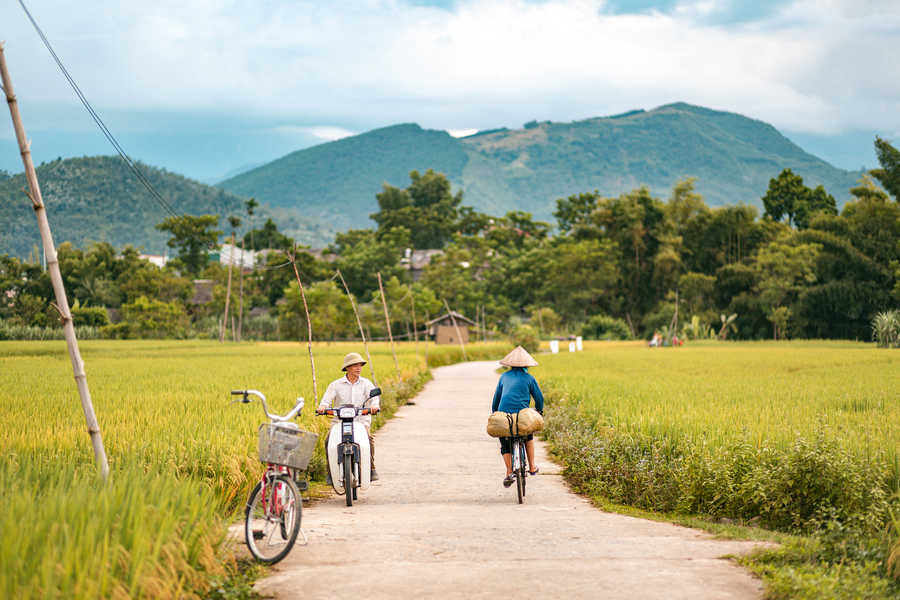
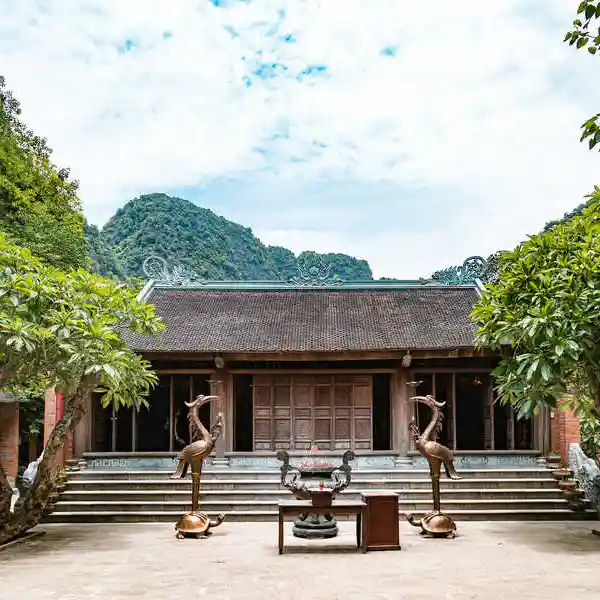
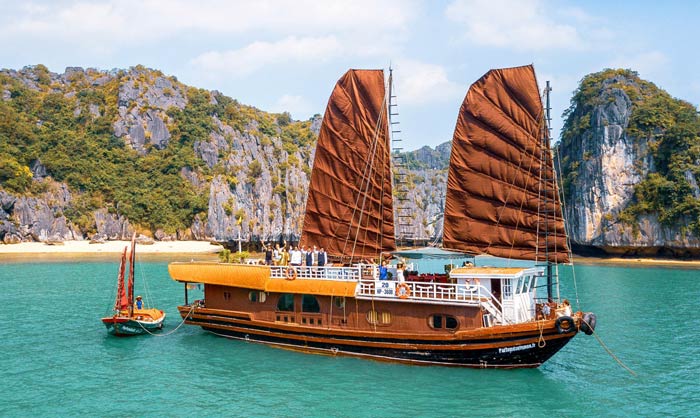
The journey starts in Hanoi, with the lanes of the Old Quarter, the Temple of Literature and its street food stalls. We recommend at least one full day there to get over jet lag. Ninh Binh province, about two hours by road, comes next for its rice fields and limestone peaks, ideally with one night on site to enjoy the quiet evenings. Then comes Halong Bay or its calmer neighbour, Lan Ha Bay, aboard a junk with a night on the water.
Days 6 to 9: Luang Prabang
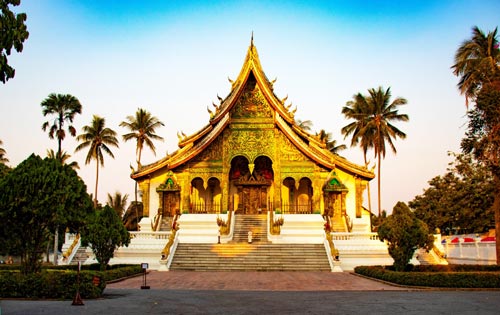
After Vietnam, Luang Prabang sets a very different pace. Four days give you time to explore the temples of the UNESCO-listed old town, watch the monks’ alms round at dawn, travel up the Mekong to the Pak Ou caves and swim at the Kuang Si waterfalls. It is often the stop our travellers talk about most when they get home, precisely because it makes them slow down.
Days 10 to 15: Angkor and Phnom Penh
Siem Reap is the gateway to the temples of Angkor. Three days of sightseeing is a good balance, leaving time for Angkor Wat, the Bayon, Ta Prohm and more distant sites such as Banteay Srei, while avoiding the hottest hours. Phnom Penh, two nights later, offers essential insight into the country’s recent history, with the Tuol Sleng museum and the Royal Palace.
Days 16 to 21: Mekong Delta and Ho Chi Minh City
You can return to Vietnam by river, on a speedboat to Chau Doc in An Giang province. From there you travel down the delta through Can Tho and its floating markets before reaching Ho Chi Minh City. The last days are for discovering former Saigon and keeping a buffer before your flight home, which we always recommend.
Can you include Hue and Hoi An in a 3-week trip?
Yes, but you will need to drop the Mekong Delta or Phnom Penh, because three weeks is not enough to see everything without rushing.
Central Vietnam, with the imperial city of Hue and the old town of Hoi An, deserves at least three nights. To fit it in, these are the variations we suggest most often:
- Central Vietnam and Angkor: northern Vietnam, Luang Prabang, Hue and Hoi An, then Siem Reap, flying home from Cambodia or via Ho Chi Minh City.
- Skip Phnom Penh: keep the main route but fly straight from Siem Reap to Ho Chi Minh City, freeing two days for Hoi An.
- A shorter stay in Laos: three nights in Luang Prabang instead of four, which is still enough for the town and the waterfalls.
Our advice is not to try to do it all. Travellers who see five places in depth usually come home with far better memories than those who tick off eight in a hurry.
How do you travel between Vietnam, Laos and Cambodia?
Flying is the most practical way to travel between the three countries, complemented by boats on the Mekong and roads for shorter distances.
Overland routes between northern Vietnam and Laos do exist, but they involve long bus rides on mountain roads. On a three-week trip, we advise against them. These are the connections we use most often:
| Route | Recommended mode | Approximate time |
|---|---|---|
| Hanoi – Luang Prabang | Flight | About 1 hour |
| Luang Prabang – Siem Reap | Flight, direct in some seasons or with a connection | From 1.5 hours to half a day |
| Siem Reap – Phnom Penh | Road or short flight | About 5 to 6 hours by road |
| Phnom Penh – Chau Doc | Speedboat on the Mekong | About 5 hours, depending on water levels |
| Phnom Penh – Ho Chi Minh City | Road or flight | About 6 to 7 hours by road, 1 hour by air |
Direct flights between Luang Prabang and Siem Reap are not always scheduled year-round. When they are not, you connect through Vientiane, Bangkok or Hanoi, which makes for a longer day. We always check this before finalising an itinerary. Note also that the high-speed train now links Luang Prabang and Vientiane in under two hours, which makes it easy to add Vang Vieng and the Lao capital if you have a few extra days.

Which visas do you need for Vietnam, Laos and Cambodia?
Visa rules depend on your passport: Vietnam exempts many Europeans, while most travellers need a paid visa for both Laos and Cambodia.
Formalities are not complicated, but they differ from one country to the next and from one nationality to another. Always check the rules for your own passport before you go. As a general guide:
- Vietnam: many European passports, including French, Belgian, Swiss, British and German ones, are visa-exempt for 45 days. Other travellers apply for an e-visa on the official site evisa.gov.vn, at 25 USD for a single entry or 50 USD for multiple entries. As the main route enters Vietnam twice, the multiple-entry e-visa is often the simplest option.
- Laos: most Western visitors need a 30-day tourist visa, around 40 USD on arrival in cash, or slightly more as an e-visa. A free digital arrival form must also be completed online before travelling.
- Cambodia: the 30-day tourist visa costs 30 USD, as an e-visa or on arrival at the airport. A free electronic arrival card must also be filled in a few days before entry.
Your passport should be valid for at least six months after your return date and have several blank pages. Bring some US dollars in small notes, which always come in handy in Laos and Cambodia.
When is the best time to combine the three countries?
The best time to combine the three countries is from November to March, when the weather is dry and temperatures are still pleasant.
Laos and Cambodia follow a similar monsoon pattern: dry season from November to April, rainy season from May to October. Vietnam is more complex, as it stretches over 1,600 kilometres from north to south. In December and January, Hanoi and Halong Bay can feel cool while Siem Reap is hot, so pack a light sweater.
March and April are hotter, especially in Cambodia, where afternoons at Angkor become tiring. The rainy season does not stop you travelling: showers are often short, the landscapes are lush and the sites are quieter. You simply need some flexibility in your schedule, particularly for cruises and river journeys.

FAQ: Vietnam, Cambodia and Laos itinerary
How many days do you need for Vietnam, Laos and Cambodia?
Three weeks is a comfortable minimum for a first trip combining all three countries. With four weeks, you can add central Vietnam, Vientiane or southern Laos.
In which order should you visit Vietnam, Laos and Cambodia?
We suggest starting in northern Vietnam, then Luang Prabang, Angkor and Phnom Penh, ending in the Mekong Delta and Ho Chi Minh City to follow the map without backtracking.
How many days should you spend in Laos on a 3-week trip?
Three to four days in Luang Prabang are enough to discover the town, the monks’ alms round, the Pak Ou caves and the Kuang Si waterfalls.
Can you travel from Cambodia to Vietnam by boat?
Yes, speedboats link Phnom Penh to Chau Doc in the Mekong Delta in about five hours, depending on water levels. It is a scenic way to cross the border.
Do you need a visa for Laos and Cambodia?
Most Western travellers need a visa for both countries: around 40 USD for Laos and 30 USD for Cambodia, available online or on arrival. Check the rules for your passport.
When is the best time for a 3-week Indochina trip?
From November to March, the dry season covers all three countries. Northern Vietnam is cool, while Cambodia and Laos are warm but comfortable.