



















One month in Vietnam is the time it takes to cross the country from north to south without rushing: more than 1,600 kilometres between the mountains of the far north and the canals of the Mekong Delta, by way of the old imperial and merchant towns of central Vietnam. From our office in Hanoi, where we have been organising trips since 2005, we meet travellers every year who arrive with a list far too long for four weeks. Here is the itinerary we recommend most often, stage by stage, with realistic travel times, the best season and the variations that suit different travellers.
Is one month enough to see Vietnam from north to south?
Yes, four weeks let you travel the whole of Vietnam from north to south at a comfortable pace, with two to four nights per stop.
With two weeks, you have to choose between the North and the South, or rely on a string of domestic flights. With three weeks, you see the highlights, but the northern mountains are often left out. A month gives you three extra things: time to head up to Ha Giang or Sapa, a real pause in central Vietnam, and a few days on the beach at the end. We suggest keeping to around ten stops: beyond that, you spend more time in transit than in the places themselves.
Keep in mind, too, that Vietnam is long and narrow. Every change of region takes half a day of travel, sometimes more. A well-built month therefore alternates active stages, such as hiking in the North, with slower days, such as a morning cycling through the countryside around Hoi An or an afternoon by the water.
Which route should you follow for a month in Vietnam?
We recommend starting in Hanoi, heading up to the northern mountains, then travelling south via Hue and Hoi An to the Mekong Delta.
This route follows the geography of the country and keeps backtracking to a minimum. If you have a little less time, our 21-day Vietnam tours from north to south follow the same outline over three weeks. Here is how we suggest dividing 30 days and 29 nights:
| Days | Stop | Nights | Getting there |
|---|---|---|---|
| Days 1–3 | Hanoi | 3 | International arrival at Noi Bai airport |
| Days 4–7 | Ha Giang | 3 + 1 in Hanoi | 6 to 7 hours by road from Hanoi, each way |
| Days 8–9 | Halong Bay or Lan Ha Bay | 1 on board | About 2.5 to 3 hours by road from Hanoi |
| Days 9–11 | Ninh Binh | 2 | About 3 hours by road from the harbour |
| Days 11–14 | Hue | 2 + 1 on the train | Overnight train from Ninh Binh |
| Days 14–18 | Hoi An | 4 | Hai Van Pass road, 3 to 4 hours with stops |
| Days 18–20 | Dalat | 2 | Domestic flight from Danang |
| Days 20–22 | Ho Chi Minh City | 2 | Short flight or about 7 hours by bus |
| Days 22–24 | Mekong Delta | 2 | 2 to 4 hours by road depending on the stop |
| Days 24–29 | Phu Quoc or Con Dao | 5 | Flight from Ho Chi Minh City or Can Tho |
| Days 29–30 | Ho Chi Minh City | 1 | Return flight, then international departure |
Week 1: Hanoi and the northern mountains
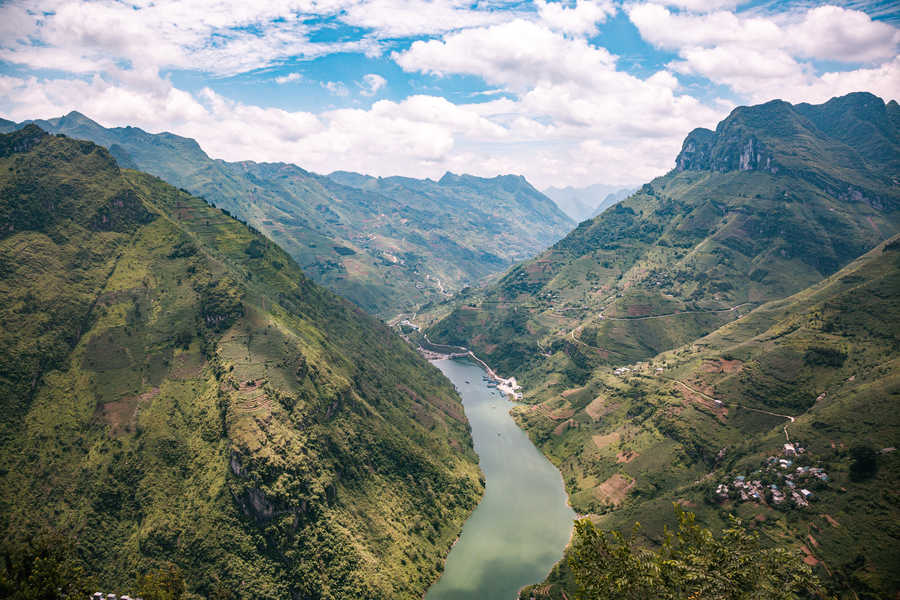
Three nights in Hanoi are not too many to get over the jet lag. The Old Quarter, the Temple of Literature, Hoan Kiem Lake early in the morning and a dinner of bun cha are enough to take the pulse of the capital. Then head north to Ha Giang, which has been part of Tuyen Quang province since 2025. The loop crosses the Ma Pi Leng Pass, Dong Van and the markets of the Hmong and Dao minorities. Allow three nights there, then one night back in Hanoi. If mountain roads worry you, Sapa, now in Lao Cai province, is a more accessible alternative.
Week 2: Halong Bay, Ninh Binh and Hue
From Hanoi, Halong Bay or its quieter neighbour, Lan Ha Bay, is a little under three hours away by motorway. A night on board a junk lets you see the bay at sunset and sunrise, the two moments when it is most beautiful. The next day, the road runs south to Ninh Binh, often called Halong Bay on land: rice fields, limestone peaks and rowing-boat trips at Tam Coc or Trang An. After two nights, the overnight train drops you in Hue early in the morning, saving a hotel night and a day of travel.

Week 3: Hoi An and the Dalat highlands
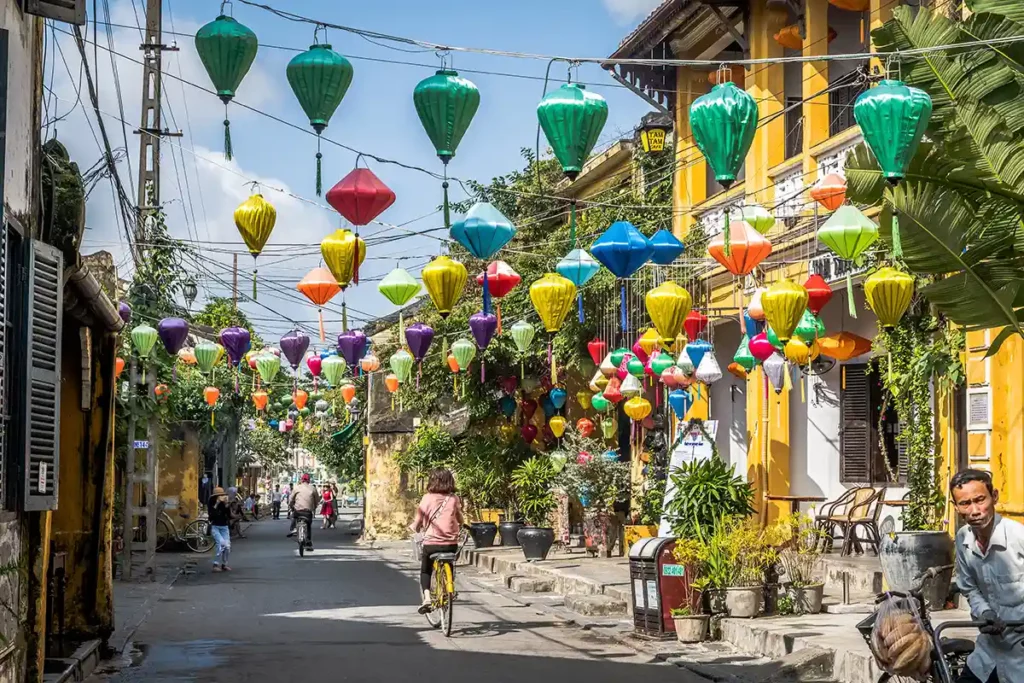
Hue deserves two days for the Imperial Citadel, the tombs of the Nguyen emperors along the Perfume River and Thien Mu Pagoda. To reach Hoi An, we prefer the road over the Hai Van Pass, with a stop at Lang Co lagoon. Hoi An, now part of Danang city, is the perfect place to slow down: four nights give you time to wander the old town, cycle to the vegetable village of Tra Que and spend half a day on An Bang beach. A flight then takes you to Dalat in the Central Highlands, where cool air, coffee plantations and waterfalls change the mood completely.

Week 4: the South, the Mekong Delta and the beach
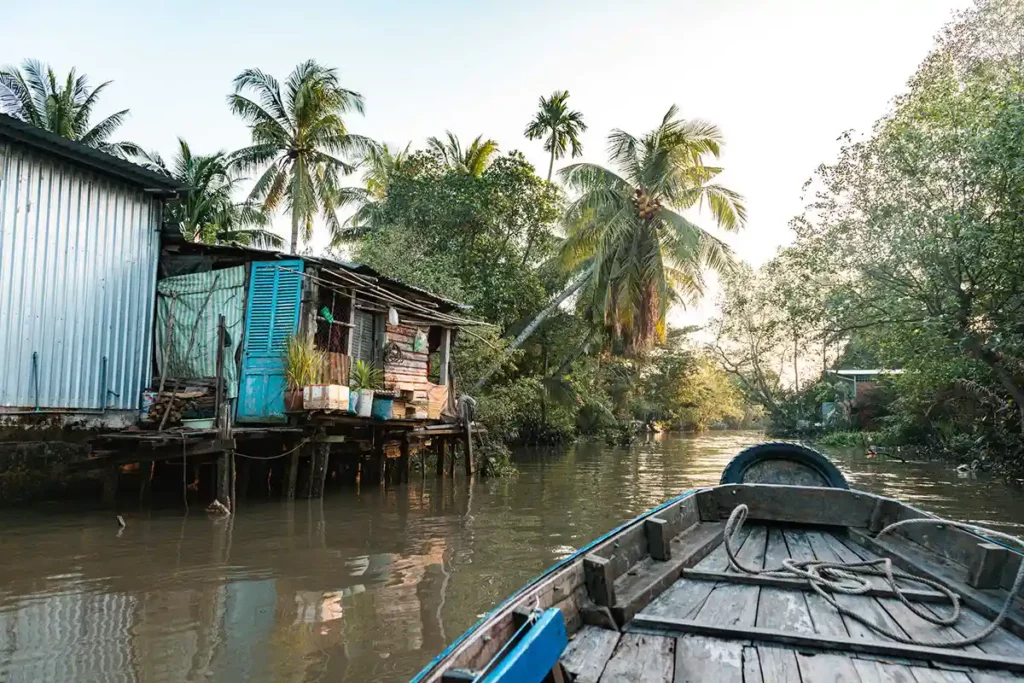
Ho Chi Minh City, the former Saigon, can be explored in two days: the War Remnants Museum, Ben Thanh Market, the Chinese district of Cholon and, if you wish, the Cu Chi tunnels. The Mekong Delta is best experienced by staying overnight, in a homestay at Ben Tre or Can Tho, so you can visit the Cai Rang floating market at dawn. Finish with five nights on the beach in Phu Quoc, now in An Giang province, or on Con Dao, now part of Ho Chi Minh City, for a wilder feel. Return to Ho Chi Minh City the day before your international flight.
How do you get around between stops in four weeks?
Combine road travel, an overnight train and two or three domestic flights to cover the long distances without losing whole days.
- A private car with driver for the North, Halong Bay, Ninh Binh and the Hai Van Pass: the most flexible option, with stops wherever you like.
- The overnight train to Hue: from Hanoi, allow roughly 12.5 to 15 hours depending on the train, ideally in a four-berth sleeper.
- Domestic flights for the long distances from central Vietnam to the South and the islands: Vietnam Airlines and Vietjet serve these routes, with schedules that vary by season.
- Sleeper buses and limousine minivans: cheap, but more tiring on long journeys.
Our advice: avoid back-to-back long journeys. After a day on the road to Ha Giang or a night on the train, plan a quiet morning before resuming your visits.
When is the best time to spend a month in Vietnam?
March and April are the most balanced months for a one-month trip, with pleasant weather from north to south and very little rain overall.
Vietnam has three main climate zones, which makes a four-week trip trickier to time than a stay in a single region:
- The North: cool and often grey from December to February, hot and humid from May to September, very pleasant in October-November and March-April.
- Central Vietnam: mostly dry from February to August, rainy from September to December, with a risk of typhoons mainly in October and November.
- The South: dry season from December to April, rainy season from May to October, with showers that are often short and fall late in the day.
From October to December, you can keep the same itinerary but build in some slack in central Vietnam, where heavy rain sometimes cuts roads. From December to February, pack a proper jacket for Hanoi and the mountains, where nights can drop below 10 °C. Finally, avoid the week of Tet, in late January or February depending on the year, when transport and hotels are fully booked: in 2027, the Lunar New Year falls on 6 February.
Do you need a visa for a month in Vietnam?
Many Europeans, including French, British and Swiss citizens, can stay 45 days visa-free, while other travellers apply online for a 90-day e-visa.
The exemption applies with a passport valid for at least six months after your date of entry. For other nationalities, such as travellers from the United States, Canada or Australia, or if you want to stay longer than 45 days, the 90-day e-visa is available on the official website evisa.gov.vn: 25 USD for a single entry and 50 USD for multiple entries. These rules change regularly, so check them a few weeks before you leave.
Which variations suit your travel style?
The itinerary above is a starting point. These are the adjustments we suggest most often to our travellers:
- More nature: swap Dalat for Phong Nha and its caves, between Ninh Binh and Hue.
- More beach, fewer crowds: Quy Nhon, on the central coast, is a lovely alternative to Phu Quoc.
- More encounters: add two nights in a homestay in the Mai Chau valley or among the rice terraces of Hoang Su Phi.
- A gentler pace: drop Dalat and add one night in Hoi An and one in the Mekong Delta.
- A neighbouring country: a week in Cambodia for the temples of Angkor, or in Laos for Luang Prabang, instead of the beach.
What mistakes should you avoid on a four-week itinerary?
The main mistake is trying to see everything: ten well-paced stops are better than fifteen towns glimpsed between long journeys.
- Combining Sapa and Ha Giang in the same week, or Phu Quoc and Con Dao: it is too much for a month.
- Underestimating mountain journeys, where winding roads keep average speeds low.
- Booking overnight trains and junks too late in the high season, from November to April.
- Forgetting a buffer day before your international flight, especially when returning from an island.
On the ground, our guides often adapt the programme from day to day: a rainy morning in Hue becomes a museum visit, and a closed road in the North is bypassed through another valley. This flexibility matters far more over a month than over a week.
FAQ: your questions about one month in Vietnam
Is one month enough to see all of Vietnam?
Yes. Four weeks let you cross the country from Hanoi to the Mekong Delta with two to four nights per stop, and finish with a few days on the beach.
Which direction should you travel in Vietnam for one month?
Usually north to south: Hanoi and the mountains first, then central Vietnam, the South and the beach. The reverse also works, depending on your international flights.
What is the best time for a one-month trip to Vietnam?
March and April offer the best balance across the three regions. From October to December, allow some slack in central Vietnam because of the rain.
Do you need a visa for a month in Vietnam?
Citizens of France, Belgium, Switzerland and the United Kingdom, among others, can stay 45 days visa-free. Other travellers can apply for a 90-day e-visa at evisa.gov.vn.
How many domestic flights should you plan in one month?
Usually two or three: from central Vietnam to Dalat or Ho Chi Minh City, then to your chosen beach island. The rest is done by car and overnight train.
Can you add Cambodia or Laos to one month in Vietnam?
Yes, by replacing the beach week or shortening the North. Allow at least two full days for Angkor and two to three days for Luang Prabang.