









Angkor is not a museum you walk through in an afternoon. The site covers more than 400 km² of forest, rice fields and reservoirs, with several hundred monuments built by Khmer kings between the 9th and 13th centuries. We have been taking French- and English-speaking travellers from Hanoi to Siem Reap since 2005, and the same questions come up before almost every trip: how long should we stay, and how do we make sure we see what matters?
Here is our field-tested advice on how many days to plan, which Angkor Pass to buy, the order in which to see the temples and the times of day when the site is at its best, without the crowds and without exhausting yourself.
How many days do you need to visit Angkor?
Three days let you see the major Angkor temples without rushing, including a sunrise, Banteay Srei and a few quieter sites off the main loops.
For a first visit, this is the length we suggest most often, for example in our Essential Angkor Temples tour, which also leaves time to enjoy Siem Reap and its surroundings.
One day is enough to see Angkor Wat, Angkor Thom and Ta Prohm, but it means a fast pace in what is often fierce heat. Two days strike a first balance. Beyond four days, you enter enthusiast territory: remote temples, outlying sites and return visits at different hours to see a facade in another light.
- 1 day: Angkor Wat, Angkor Thom with the Bayon and the Terrace of the Elephants, then Ta Prohm, for a first overview.
- 2 days: the Small Circuit on day one, then the Grand Circuit with Preah Khan, Neak Pean and Pre Rup.
- 3 days: both circuits, Banteay Srei and the Roluos group, with at least one sunrise.
- 4 to 5 days: add Beng Mealea, Phnom Kulen or Kbal Spean, and a morning on Tonle Sap Lake.
Bear in mind that nobody visits temples all day long. Between 11 am and 3 pm, the heat and harsh light make sightseeing hard work, so we suggest heading back to your hotel for a relaxed lunch and a rest before setting off again around 3 pm. In practice, three days on site means three mornings and three late afternoons of visits, which is far from excessive for a site of this scale.

Which Angkor Pass should you buy, and how much does it cost?
Angkor ticket prices are 37 USD for one day, 62 USD for three days and 72 USD for a week, with no need for consecutive days.
As soon as you stay more than one day, the three-day pass is the best value: it costs barely more than two separate one-day passes. The seven-day pass only makes sense if you plan to return to the site often or spend a long time in Siem Reap.
| Pass | Price | Validity | Best for |
|---|---|---|---|
| 1 day | 37 USD, about 31 € | The date printed on the ticket | Short stopover, first overview |
| 3 days | 62 USD, about 52 € | 3 visiting days, consecutive or not, within 7 to 10 days depending on the ticket | First visit, balanced pace |
| 7 days | 72 USD, about 60 € | 7 visiting days within one month | Enthusiasts, long stays |
Children under 12 enter free of charge; bring their passport, as age may be checked. Multi-day passes carry your photo, taken at the counter or uploaded when you buy online. Sources disagree on how long the three-day pass remains valid: some guides still say ten days, while recently issued tickets state seven days. Check the date printed on your pass and plan your three days within the week after purchase.
Where and how do you buy the Angkor Pass?
The pass is sold only through official Angkor Enterprise channels: at the ticket centre about 4 km from central Siem Reap, open from 4:30 am to 5:30 pm, or online at angkorenterprise.gov.kh. Online purchases are paid by card and give you a QR code to show on your phone at each checkpoint. Avoid resellers and tickets offered in the street: they are not valid, and checks at temple entrances are frequent.
A useful tip: if you buy a pass starting the next day in the late afternoon, from around 4:45 or 5 pm depending on current rules, you can usually enter that same evening for sunset without using up a visiting day. The details change from time to time, so ask at the counter.
Which sites are not covered by the pass?
Phnom Kulen, the sacred hill where the Khmer empire is said to have been founded, requires a separate ticket of around 20 USD. Koh Ker, a former capital about two and a half hours away by road, costs around 15 USD. Beng Mealea has its own ticket of around 10 USD, and information differs on whether the Angkor Pass is accepted there, so check before you go.
Inside the temples, shoulders and knees must be covered, especially to climb to the upper sanctuary of Angkor Wat, the Bakan, which is closed to children under 12. A light scarf in your bag usually solves the problem.
Which itinerary should you follow at Angkor?
We recommend starting with the Small Circuit, keeping the Grand Circuit for the second day and saving Banteay Srei and Roluos for the third.
The two historic circuits, mapped out in the days of the first European visitors, remain the most logical way to organise your visit. The Small Circuit is about 17 km long, the Grand Circuit about 26 km. Here is how we usually split them with our travellers.
Day 1: Angkor Wat, Angkor Thom and Ta Prohm
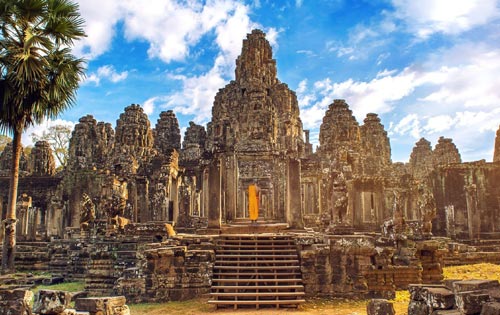
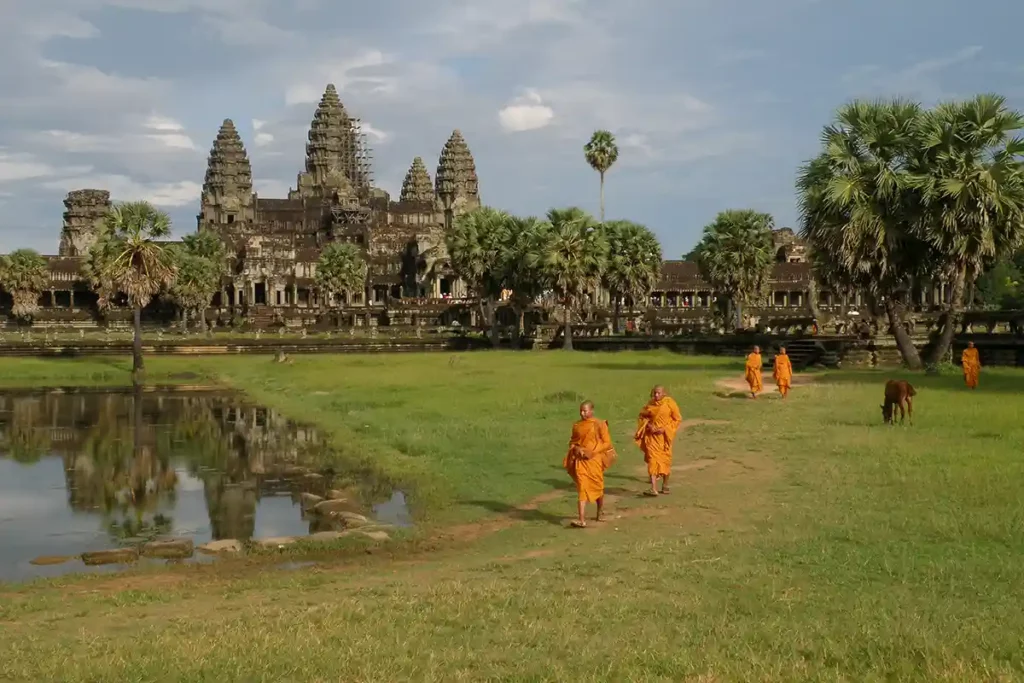
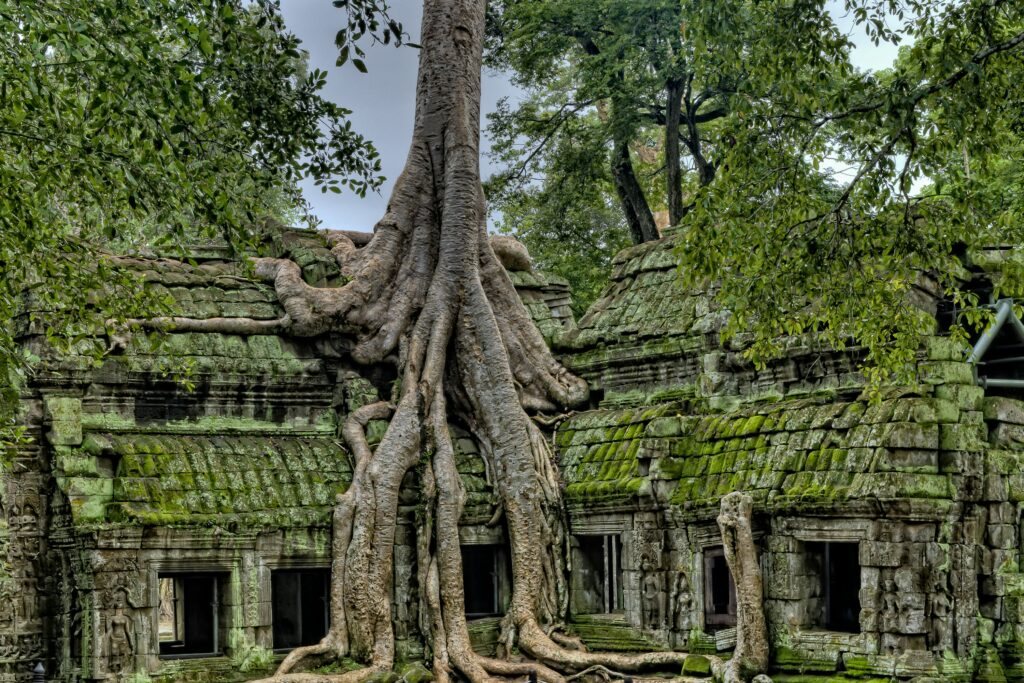
Watch the sunrise over Angkor Wat from the northern ponds, then explore the temple while most groups head back for breakfast. Take your time along the gallery of bas-reliefs, more than 700 metres long. Then enter Angkor Thom through the South Gate and its causeway lined with giants, and continue to the Bayon and its smiling faces, the Baphuon, the Terrace of the Elephants and the Terrace of the Leper King. In the late afternoon, Ta Prohm, the temple gripped by silk-cotton trees, is at its most atmospheric as the light softens.
Day 2: the Grand Circuit
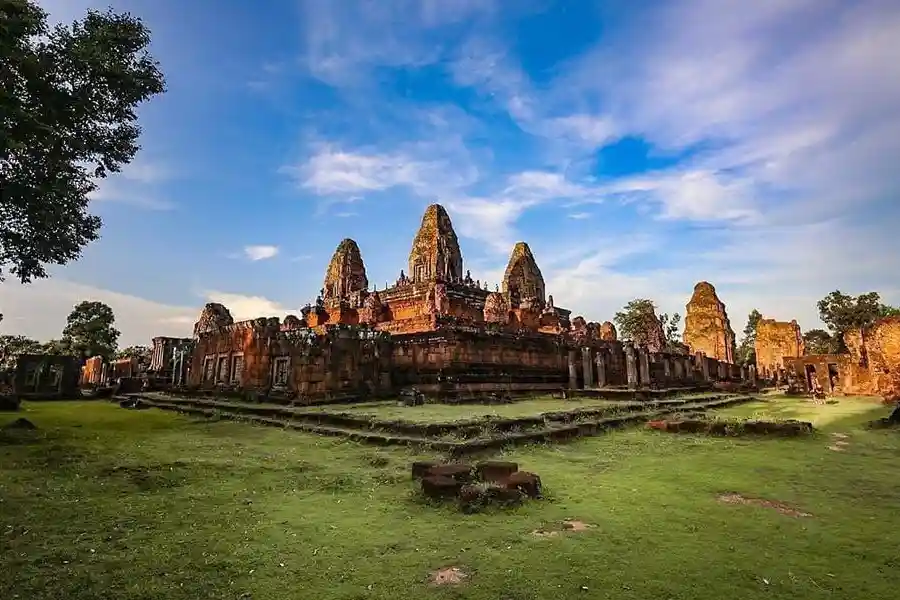
Preah Khan, a vast maze of corridors and courtyards, is best explored in the cool of the morning. Continue to Neak Pean, a small shrine in the middle of a pool, Ta Som and its gate wrapped in tree roots, then the East Mebon. End the day at Pre Rup, whose red-brick terraces offer one of the finest sunsets on the site, usually calmer than Phnom Bakheng.
Day 3: Banteay Srei and the Roluos group
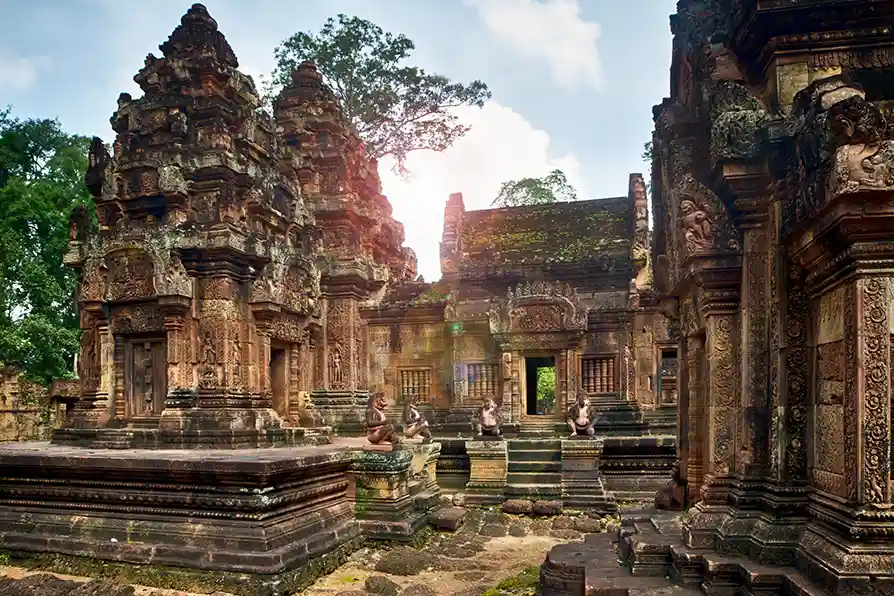
Banteay Srei, about 35 km north-east, is a small pink sandstone temple with remarkably delicate carvings. Leave early to arrive before the groups, then combine it with Banteay Samre, which is almost always peaceful. In the afternoon, the Roluos group, with Preah Ko, Bakong and Lolei, reveals the earliest Angkorian capitals, built nearly three centuries before Angkor Wat.
With a fourth day, we recommend Beng Mealea, a temple still largely swallowed by the jungle about 65 km from Siem Reap, or Phnom Kulen, with its river of a thousand lingas and its waterfall. The two are hard to combine in a single day.
How can you avoid the crowds at Angkor?
To avoid the crowds, visit the major temples early in the morning or late in the day and reverse the order followed by tour groups.
- After sunrise, stay at Angkor Wat: the temple partly empties as visitors return to their hotels.
- Visit the Bayon at opening time or around 4 pm, when the low light brings the stone faces to life.
- Do the Grand Circuit in the opposite direction to the groups.
- Choose Pre Rup or Srah Srang over Phnom Bakheng for sunset: access to the top of Bakheng is capped and in high demand.
- Keep a morning for lesser-known temples such as Ta Nei, Banteay Kdei or Ta Keo, which are often almost deserted.
High season, from November to March, and the main Asian holidays, especially Chinese New Year and Khmer New Year in mid-April, are the busiest periods. Rainy-season mornings, on the other hand, sometimes offer near-empty temples.
How do you get around between the temples?
A tuk-tuk with a driver for the day remains the most practical option, while an air-conditioned car is more comfortable when the heat is intense.
Distances are too long to walk: Angkor Wat is about 6 km from central Siem Reap and Banteay Srei more than 30 km away. These are the most common options.
- Tuk-tuk: allow around 15 to 25 USD per day for the Small Circuit, more for the Grand Circuit or Banteay Srei. Your driver waits outside each temple.
- Car with driver: air-conditioned and better suited to outlying sites such as Beng Mealea or Phnom Kulen, and to travellers who struggle with the heat.
- Bicycle or e-bike: pleasant on the Small Circuit in the dry season, provided you start early and drink plenty of water.
- Ride-hailing apps such as Grab or PassApp: handy for trips around town, less suited to a full day among the temples.
Since late 2023, Siem Reap has been served by the new Siem Reap-Angkor International Airport, located more than 40 km from town: allow about an hour by road to reach your hotel.

When is the best time to visit Angkor?
The best time to visit Angkor is from November to February, when the air is dry and mild, although the site is at its busiest.
From March to May, the heat becomes intense, often above 35 °C in the afternoon, so visits are best kept to the early hours. The rainy season, from June to October, brings mostly short downpours, lush vegetation and full moats that reflect the temples. It is also the quietest period, and one we happily recommend to travellers who do not mind a little humidity and a few muddy paths.
Do you need a guide to visit Angkor?
A licensed guide is not compulsory, but brings the bas-reliefs to life and adjusts the order of visits to keep you away from crowds.
Without a guide, Angkor is still breathtaking, but much goes unnoticed: the story of the Churning of the Ocean of Milk, the symbolism of Mount Meru, how to read a lintel or date a temple by its style. Official guides hold a licence issued by the Cambodian authorities and are the only ones allowed to lead visitors inside the park. They also know the group schedules and when a temple will be quiet.
If you prefer to explore on your own, a good book on Khmer art or an audio guide helps give structure to your visit. A middle ground is to book a guide for the Small Circuit day, the richest in stories, then continue at your own pace. Angkor also combines very well with a trip to Vietnam: flights link Hanoi and Ho Chi Minh City to Siem Reap in under two hours.
FAQ: visiting Angkor
How many days do you need to visit Angkor?
Three days let you see the main temples without rushing. One day gives you an overview, while four to five days let you add Beng Mealea or Phnom Kulen.
How much does the Angkor Pass cost?
The pass costs 37 USD for one day, 62 USD for three days and 72 USD for seven days. Children under 12 enter free on presentation of their passport.
Can you buy the Angkor Pass online?
Yes, on the official website angkorenterprise.gov.kh, paid by card. You show the QR code on your phone at each checkpoint. The pass is also sold at the ticket centre in Siem Reap.
Do the days on a three-day pass have to be consecutive?
No. You can spread your three visiting days freely over the validity period printed on the ticket, which is at least seven days.
What time do the Angkor temples open?
Angkor Wat opens at 5 am for sunrise. Most other temples open around 7:30 am and close around 5:30 pm, except for a few sunset spots such as Pre Rup.
What should you wear to visit Angkor?
Shoulders and knees must be covered, especially to reach the upper sanctuary of Angkor Wat. Also bring comfortable shoes, a hat and plenty of water.