








The Ho Chi Minh Mausoleum, an iconic symbol of the respect and admiration the Vietnamese people hold for their leader, stands out for the simplicity and sobriety it embodies. In accordance with his final wishes, Ho Chi Minh requested that his burial place contain neither a tombstone nor a bronze statue. Instead, he envisioned a simple ceramic urn placed between three tree-covered hills, a setting that reflects his humility and deep connection with nature. However, out of profound respect and boundless gratitude toward President Ho Chi Minh, the Politburo decided at the time to build a mausoleum in order to preserve his body and honor his legacy.
This mausoleum, built in the heart of Hanoi, is a sacred place where Vietnamese people and visitors from all over the world come to pay tribute to the man who devoted his life to the struggle for his country’s independence and freedom.
Construction of the mausoleum
On 29 November 1969, the Politburo decided to preserve the body of President Ho Chi Minh and to build his mausoleum.
The construction of the Ho Chi Minh Mausoleum received strong support from the Soviet government. From 9 to 23 January 1970, the government of the Soviet Union sent a delegation of seven experts to work with Vietnam on the design of President Ho Chi Minh’s mausoleum. This support played a crucial role in the realization of this historic and symbolic monument, highlighting the friendship and cooperation between the two countries.
On 16 April 1972, American bombings resumed in northern Vietnam, temporarily interrupting the construction work. The official start of the excavation of the mausoleum’s foundations took place on 2 September 1973.
After 60 days and nights of continuous work, the foundations of the mausoleum were completed. On 30 October 1974, the construction site marked the completion of the final concrete pour for the mausoleum’s roof.
The Ho Chi Minh Mausoleum was officially inaugurated on 2 September 1975.
Composition of the Mausoleum
The imposing structure has a square plan measuring 30 meters on each side and consists of three levels, reaching a total height of 21.6 meters.
The mausoleum is composed of the main building and two lateral grandstands. Its architecture is sober and harmonious, resting on a solid base and rising in three progressively narrowing tiers, which give it a solemn and monumental appearance. It reflects the essence of Vietnamese architectural tradition. The roof also follows a three-tiered structure, creating a sense of balance and refinement. Free of curves, it is designed with oblique lines that combine modernity and elegance, while subtly evoking the softness and fluidity of traditional Vietnamese roofs. The main structure adopts a square form, with massive columns supporting the roof, recalling the silhouette of a traditional Vietnamese five-bay house. The four corner columns measure 1.2 × 1.2 meters, while the other columns measure 1.2 × 0.9 meters. On the façade of the mausoleum, the inscription “President Ho Chi Minh” is engraved in dark red stone. The doors of the monument are made from precious wood sourced from the Central Highlands of Vietnam.
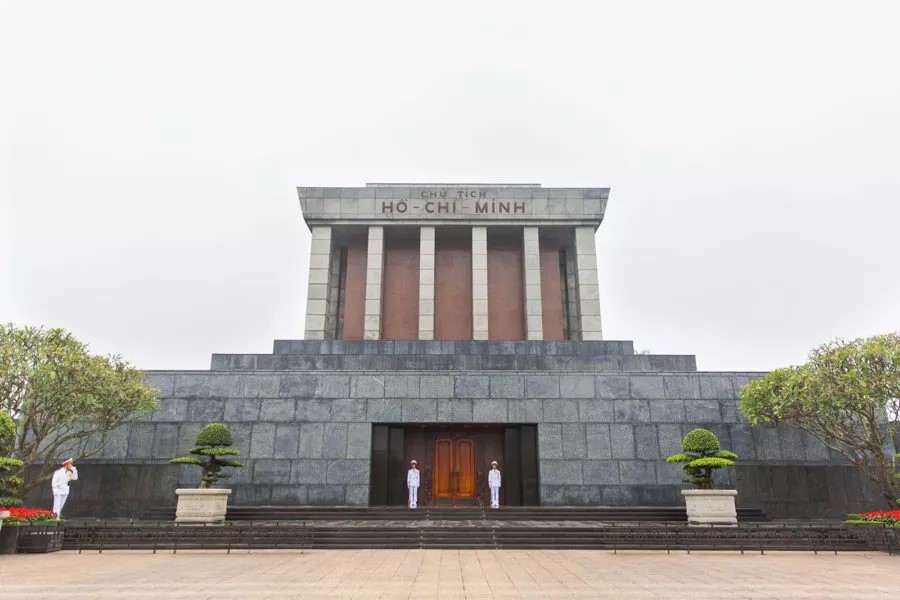
In front of the Ho Chi Minh Mausoleum
In the entrance hall, an iconic quote from the great leader is inscribed in gold letters: “Nothing is more precious than independence and freedom,” accompanied by his signature.
Inside, the body of President Ho Chi Minh rests in a glass coffin, placed within a peristyle of marble columns, giving the space a solemn and deeply respectful atmosphere. This type of granite was produced by the Soviet Union. Two frangipani trees are planted on either side of the entrance, while 79 cycads (Cycas revoluta)—symbolizing the President’s age at the time of his death—adorn the front and rear of the mausoleum. To the north and south, hedges of bamboo, a symbol of Vietnam, solemnly frame the monument.
Two honor guards stand watch at the main entrance, performing a guard change every 30 minutes.
The decoration, lighting, colors, and temperature create a solemn yet warm atmosphere for visitors, guiding them toward the much-anticipated place: the hall where the body of President Ho Chi Minh lies. The ideological theme of this hall symbolizes the unity between the Party, the Fatherland, and the President. He rests peacefully, dressed in his usual attire and accompanied by his familiar pillow, in a simplicity that brings him infinitely close to the people.
The officials and soldiers of the Ho Chi Minh Mausoleum Management Committee carry out with dedication their mission to preserve, safely and over the long term, the embalmed body of Uncle Ho.
Ba Dinh Square – A witness to Vietnam’s independence
At the beginning of the 20th century, the square did not yet bear the name Ba Dinh, nor did it have the character it is known for today. Originally, it was a vast open area located next to the Palace of the Governor of Tonkin, where the French had laid out a roundabout in honor of the missionary Paul-François Puginier.
After the success of the August Revolution in 1945, the site was renamed Ba Dinh, a name inspired by the uprising led in the late 19th century by Dinh Cong Trang, which began in Ba Dinh, in Thanh Hoa Province. It was for this reason that Ba Dinh Square was chosen, among many other potential locations, to host the Independence Ceremony in 1945.
Vietnam’s Declaration of Independence – September 2, 1945
Today, Ba Dinh Square covers an area 320 meters long and 100 meters wide. The square is divided into 168 squares measuring 10 × 10 meters, each planted with year-round grass. Between these grassy sections, 1.4-meter-wide pathways paved with pebbles create a harmonious layout. At the center of the square stands a 25-meter-high flagpole, a powerful symbol of national pride and Vietnam’s independence.
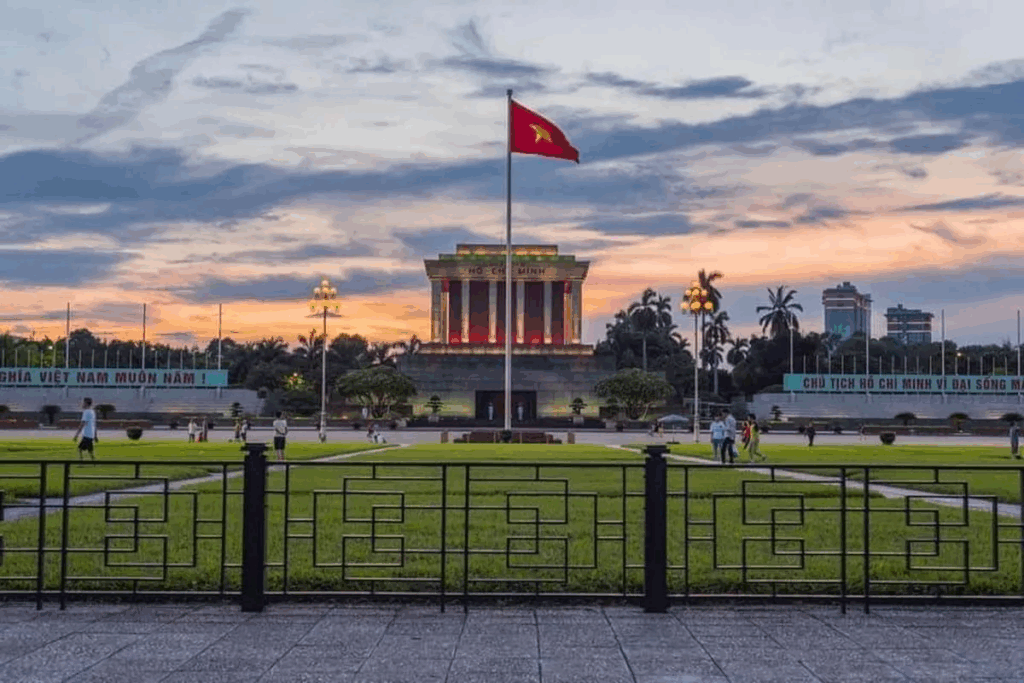
Ba Dinh Square and the Ho Chi Minh Mausoleum
For the past twenty years, the daily flag-raising and flag-lowering ceremonies have taken place at 6:00 a.m. and 9:00 p.m. in this square, the largest in Hanoi and in all of Vietnam. This solemn event is carried out by a detachment of 34 soldiers, representing the 34 founding members of the Armed Propaganda Brigade, the forerunner of the victorious Vietnam People’s Army. At the center of the square stands a 29-meter-high flag tower, from which the national flag is raised to the sound of the national anthem.
Visitor tips
The opening hours of the Ho Chi Minh Mausoleum vary depending on the day of the week as well as the season (summer or winter):
Summer (April 1 to October 31):
– Tuesday to Thursday: 7:30 a.m. – 10:30 a.m.
– Saturdays, Sundays, and public holidays: 7:30 a.m. – 11:00 a.m.
Winter (November 1 to March 31)
– Tuesday to Thursday: 8:00 a.m. – 11:00 a.m.
– Saturdays, Sundays, and public holidays: 8:00 a.m. – 11:30 a.m.
From the entrance near the Ho Chi Minh Museum, follow the line of visitors heading toward the mausoleum. Access is via a long corridor leading to Ông Ích Khiêm Street. As you move forward, the majestic Ba Dinh Square and the solemn Ho Chi Minh Mausoleum gradually come into view. Simply follow the flow of visitors to proceed inside.
Once inside the mausoleum, be sure to follow the designated directions. The route is one-way, and the exit is through a different door.
Please note that strict rules must be respected:
● Wear appropriate clothing (shoulders and knees covered; tank tops, shorts, and skirts above the knee are not allowed).
● Maintain a respectful posture (arms at your sides; no hands in pockets).
● Do not bring large bags or cameras.
● Remain silent throughout the visit.
For more information about other sites in Hanoi dedicated to Ho Chi Minh, you can read our article: Ho Chi Minh presidential complex: Legacy of a national leader