









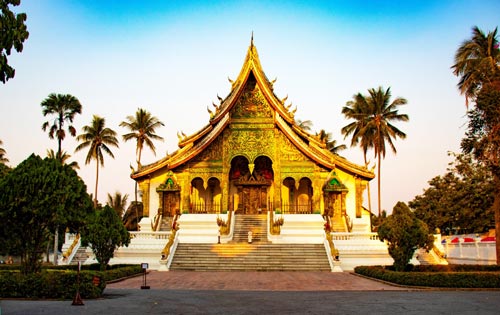


The Temple of Literature, located in the very heart of Hanoi, is far more than just a historical monument. This emblematic site of Vietnam embodies both the country’s spiritual and intellectual heritage. Founded in 1070 under the Lý dynasty, the temple is dedicated to Confucius and to Vietnamese scholars. It is especially renowned for having housed Vietnam’s very first university, the Imperial Academy (Quốc Tử Giám), which educated generations of mandarins and learned scholars.
This place, where the spirit of Confucius still seems to linger, invites travelers on a true journey through time. With its traditional Vietnamese architecture, peaceful gardens, and stone stelae engraved with the names of former Doctors, the Temple of Literature offers a unique immersion into Vietnamese culture and history.
Let’s dive into its history and symbolism!
What is the history of the Temple of Literature in Hanoi?
Founded in 1070 under the Ly dynasty, the Temple of Literature honors Confucius and was the cradle of Vietnamese education.
The Temple of Literature was founded in 1070 under the Lý dynasty by King Lý Thánh Tông to honor Confucius and his disciples. The Lý dynasty is one of the longest-lasting dynasties in Vietnamese history. Unlike earlier, often unstable dynasties, the Lý kings had the time and stability to devote themselves to the country’s political, educational, and cultural development. In 1076, King Lý Nhân Tông ordered the construction of the Quốc Tử Giám behind the temple—the first university in Vietnam—initially intended for royal children.
The present-day architecture is the result of several restorations throughout history (notably in the early 19th century under the Nguyễn dynasty and in the 1920s during the French colonial period). Nevertheless, it remains faithful to the original layout established under the Lý dynasty in 1070, with five courtyards aligned along a north–south axis. This design reflects traditional Confucian architecture, emphasizing symmetry as well as spiritual and intellectual progression.
What can you discover in the five courtyards of the Temple of Literature?
At the entrance of the Temple of Literature, four columns bear the inscription Ha Ma, meaning dismount from your horse.
Upon reaching the main entrance, you will notice four large columns, two of which bear the inscription “Hạ Mã” (“dismount from your horse”). In the past, all visitors—including kings and mandarins—were required to dismount here as a sign of respect for the sacred figures of the temple.
The Mieu Mon gate, with its characteristic “triple-gate” structure, embodies traditional Vietnamese architecture. The Cổng Tam Quan, composed of three passageways, symbolizes the Tam Tài (Heaven, Earth, and Humanity):
- Central passage: reserved for the king and the royal family.
- Left passage: for scholarly mandarins.
- Right passage: for military mandarins
The First Courtyard: Nhập Đạo (“Moral Initiation”)
The first courtyard, known as Nhập Đạo (“Moral Initiation”), extends from the Văn Miếu Gate to the Đại Trung (Great Middle) Gate, which is covered with a tiled roof. This gate is flanked by two side entrances: Thành Đức (“Fulfillment of Virtue”) on the right and Đạt Tài (“Achievement of Talent”) on the left.
In Vietnam, education has long been shaped by a fundamental principle: one goes to school first to learn proper conduct, and only afterward to consolidate knowledge in order to advance in one’s career. This philosophy marks the entry into the Confucian path. Preparing to follow this path means first learning rituals and moral values before acquiring scholarly knowledge.

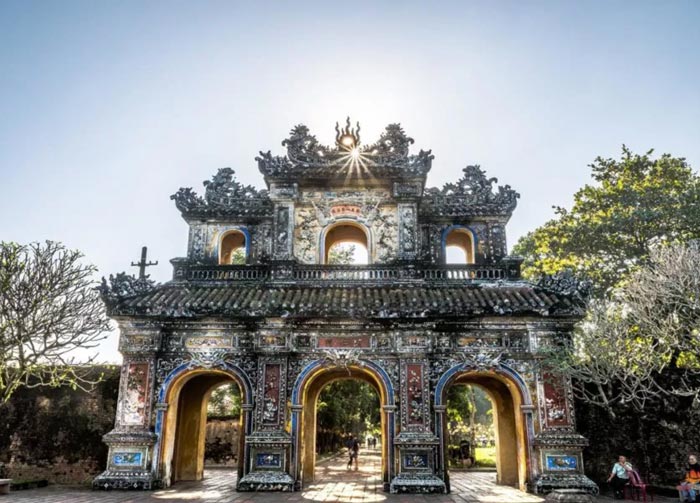
The Đại Trung Gate (Great Middle Gate), serving as the passage between the first two courtyards of the Temple of Literature
The Second Courtyard: The Great Achievement (Thành Đạt)
This courtyard symbolizes the culmination of educational efforts and the importance of knowledge in Vietnamese society. It is home to the Khuê Văn Các, a pavilion built in 1805. This two-storey structure, topped with eight roofs, is adorned with round windows reminiscent of the rays of the sun. Its name refers to the Khuê constellation, a symbol of scholars and literary excellence. Today, the Khuê Văn Các has become an iconic symbol of Hanoi, the capital city.
On either side of the pavilion stand two lateral gates, Bi Văn (“Magnificence of Literature”) and Súc Văn (“Crystallization of Literature”), whose names evoke the beauty and refinement of literary learning.

Khuê Văn Các, a true symbol of Hanoi
The Third Courtyard: The Well of Heavenly Clarity
This courtyard is dominated by the Thiên Quang Tỉnh, whose name means “Well of Heavenly Clarity.” In traditional Vietnamese thought, inherited from Confucianism, the square shape of the well symbolizes the earth, while the circular windows of the Khuê Văn Pavilion represent the sky. This combination illustrates the harmony between heaven and earth, a fundamental concept in Eastern philosophy. It also highlights the essential role of Confucian education in Vietnam, seen as a path toward wisdom and spiritual elevation in accordance with the laws of the universe.
Surrounding the well are the 82 Doctors’ Steles, each resting on the back of a stone turtle, a symbol of longevity and stability. These engraved steles record the names of the laureates of the imperial examinations held between 1075 and 1919. In total, 185 examinations were organized, but only 82 steles remain here today, as some were moved to Huế when the Nguyễn dynasty established its capital there.
The Doctors’ Steles and their global recognition
The Doctors’ Steles are among the most precious treasures of the Temple of Literature. In 2010, they were inscribed on UNESCO’s Memory of the World Register, and in 2011, they were officially recognized as world documentary heritage. Carved in Chinese characters, these steles bear witness to Vietnam’s long-standing educational tradition under the influence of Chinese culture.
In the past, visitors—especially students before examinations—used to touch the heads of the stone turtles supporting the steles to bring good luck. Today, this practice is strictly prohibited in order to preserve these invaluable heritage objects.
The imperial examinations
The regional examination (Thi Hương) was the first level of the mandarin examination system under Vietnam’s feudal dynasties. It aimed to select talented scholars from localities. Successful candidates earned a degree that granted access to official posts and allowed them to sit for the national examination (Thi Hội) the following year. The Thi Hương comprised four tests: explanation of Confucian texts, drafting of official documents, poetry composition, and an argumentative essay.
The national examination (Thi Hội), held every three years by the Ministry of Rites, enabled successful candidates to advance to the imperial examination (Thi Đình). The latter, the most prestigious of all, took place at the imperial palace under the direct supervision of the king, who personally set the examination topics. Laureates of the Thi Đình were appointed directly to positions within the imperial administration.
The fourth courtyard: The great ceremonial hall (Bái Đường)
On either side of the Đại Thành Gate stand the smaller gates Kim Thanh (“Sound of Gold”) and Ngọc Chấn (“Sound of Jade”), adding a poetic touch to the ensemble.
Passing through the Gate of Great Synthesis, visitors enter the main courtyard, where the buildings dedicated to ceremonies and worship are located. At the center rises the Temple of Confucius (Văn Miếu), featuring a richly decorated altar, flanked by the Ta Vu (Left Pavilion) and Huu Vu (Right Pavilion), which honor the 72 eminent disciples of Confucius as well as Chu Văn An.
At the heart of this courtyard, the Great Ceremonial Hall (Đại Bái Đường) and the Hall of Great Synthesis (Đại Thành Điện) form the most sacred space of the complex. This is where visitors—especially during examination periods—come to make offerings and pray for academic success, thus perpetuating Confucian ideals.
During Tết, the Vietnamese Lunar New Year, the tradition of “xin chữ” (requesting calligraphy) becomes an essential cultural practice. Many people visit the Temple of Literature (Văn Miếu) to ask calligraphers for meaningful characters such as “Phúc” (happiness), “Lộc” (prosperity), or “Trí” (wisdom).
This ritual goes beyond a simple wish for good luck in the new year; it also reflects the deep respect Vietnamese people have for the cultural and moral values passed down through generations. By honoring the beauty of calligraphy and the wisdom of the ancients, this tradition helps preserve cultural identity and inspires younger generations to cultivate humanistic virtues in their daily lives.

Calligrapher, Temple of Literature
The Fifth Courtyard: Tribute to Chu Văn An
This courtyard once housed the Quốc Tử Giám, where royal children were educated. Children from non-noble families had to pass rigorous competitive examinations to study here. Students were admitted between the ages of 8 and 15, and the curriculum focused on Confucian principles.
This area pays tribute to Chu Văn An, regarded as the “teacher of teachers.” Renowned for his integrity and moral courage, he trained many outstanding talents, including kings. Toward the end of the Trần dynasty, he withdrew from the royal court in protest against corruption among mandarins, demonstrating his deep commitment to ethical values.
What practical tips should you know before visiting the Temple of Literature?
The Temple of Literature is open from 8:00 a.m. to 5:00 p.m., with an entrance fee of 70,000 VND.
- Opening hours: 8:00 a.m. – 5:00 p.m.
- Entrance fee: 70,000 VND
- Best time to visit: On weekdays to avoid crowds; in spring to enjoy the blooming gardens.
- How to get there: By taxi, cyclo, or on foot from the Old Quarter.
The Temple of Literature is therefore much more than a tourist site. It is a timeless symbol of Vietnam’s educational and cultural values. Through its courtyards, steles, and history, it bears witness to the importance placed on education in Vietnamese society for centuries.
FAQ: Temple of Literature
What is the Temple of Literature in Hanoi?
The Temple of Literature (Van Mieu) is the most symbolic monument in Hanoi. Founded in 1070 under the Ly dynasty, it is Vietnam’s first university, dedicated to Confucius. It houses the turtle steles engraved with the names of doctoral graduates from the imperial exams.
How much does it cost to visit the Temple of Literature?
Entry to the Temple of Literature costs 70,000 VND (about 2.80 euros) for adults, with reduced rates for students and seniors. The site is open daily from 8am to 5pm. A guided tour in French or English can be arranged through Parfum d’Automne to understand the history and symbolism of this exceptional place.
How long does a visit to the Temple of Literature take?
Allow 1 to 1.5 hours for a complete and leisurely visit. The site comprises 5 successive courtyards with pavilions, gardens and the famous stele hall. Morning is the best time to avoid groups and enjoy the serene atmosphere.
What is the significance of the turtle steles at the Temple of Literature?
The 82 turtle steles at the Temple of Literature bear the names of doctoral laureates who passed the royal exams between 1075 and 1919. They represent the highest recognition of scholarship in imperial Vietnam and were recognized as UNESCO Memory of the World heritage in 2010-2011. Touching the turtle heads for good luck has been prohibited since the sculptures began deteriorating.