













Making your own bun cha in Hanoi or bánh xèo in Hoi An is one of the memories our travellers talk about most when they get home. A cooking class is about more than following a recipe: you pick the herbs at the market, learn how much fish sauce to add, and understand why the North and the Centre of Vietnam cook so differently.
Based in Hanoi since 2005, we regularly arrange these classes for our travellers, both in the capital and in Hoi An. Here is what we have learned on the ground to help you choose the right format, in the right place, at a fair price.
Why take a cooking class on a trip to Vietnam?
Vietnamese food is built on a delicate balance of salty, sweet, sour and bitter, and on an abundance of fresh herbs that are hard to find back home. Eating a dish in a restaurant lets you enjoy the result; cooking it lets you understand how it works.
It is also a very sociable activity. Classes are run by cooks or families who are happy to talk about daily life: what people eat for breakfast, how Tet is prepared, why a particular herb goes with a particular dish. For many travellers, it is the moment of the trip when conversation with Vietnamese people flows most naturally.
- half a day is enough, so it fits easily into a busy itinerary;
- it suits families as well as travellers who prefer a gentle pace;
- it works in rainy weather, since the cooking happens indoors;
- you usually leave with the recipes so you can cook the dishes again at home.
What happens during a cooking class in Hanoi?
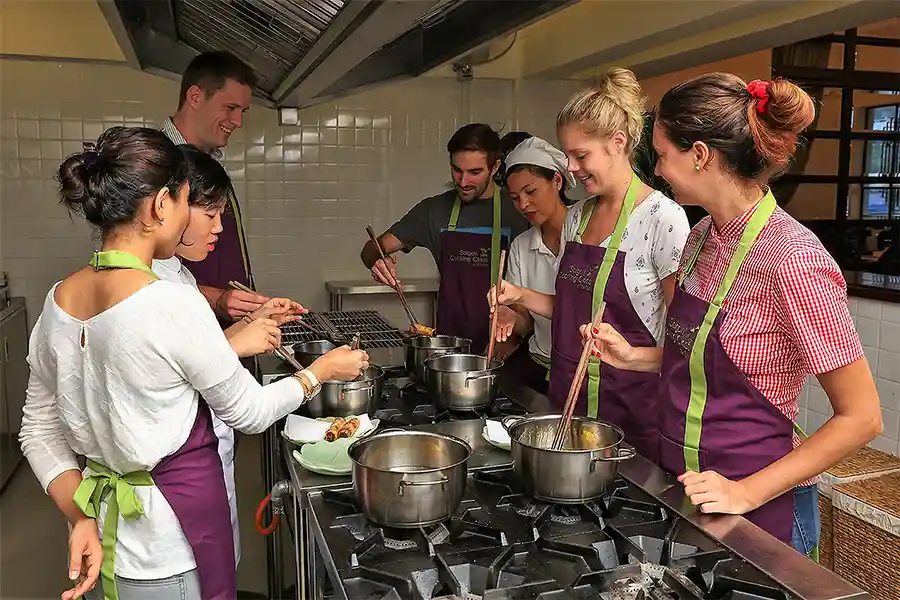
In Hanoi, a class usually lasts about four hours and often combines a visit to a local market with cooking three to five northern dishes.
Most classes start around 8:30 or 9 am, with a meeting point in the Old Quarter or a hotel pick-up. The chef or an assistant then takes you to a neighbourhood market, such as Hang Be near Hoan Kiem Lake or Yen Thai market, to buy ingredients and introduce the herbs, rice noodles and sauces.
Back in the kitchen, each participant usually has their own station. The dishes are those of northern cuisine, which is milder and less sweet than the food of the South:
- bun cha, grilled pork with rice vermicelli, herbs and a sweet-and-sour dipping sauce;
- nem ran, fried spring rolls filled with pork, wood ear mushrooms and glass noodles;
- pho bo or pho ga, beef or chicken noodle soup;
- green papaya or banana blossom salad;
- in some classes, egg coffee, a Hanoi invention.
The class ends with a shared meal of the dishes you have cooked. Some schools also run shorter afternoon sessions without the market, which are handy if you leave for Halong Bay or Ninh Binh the next morning.
One thing worth knowing: pho broth takes several hours to simmer. In a four-hour class it is almost always prepared in advance, and you mainly learn how to assemble and season the soup. That is not a flaw, but it helps to know beforehand.
What happens during a cooking class in Hoi An?
In Hoi An, many classes take place outside town and combine a market, a basket boat ride or an herb garden before you start cooking.
Hoi An, which has been part of Danang city since the 2025 administrative reform, probably has the widest choice of cooking classes in Vietnam. They fall into two main types.
Classes in town, around the central market
Schools in or near the old town start at the central market on the Thu Bon River, then cook in a restaurant or a converted house. Morning Glory, one of the town’s long-standing names, works this way. It is a convenient option if you stay in the centre and do not want a transfer.
Countryside classes: Tra Que, Cam Thanh and basket boats
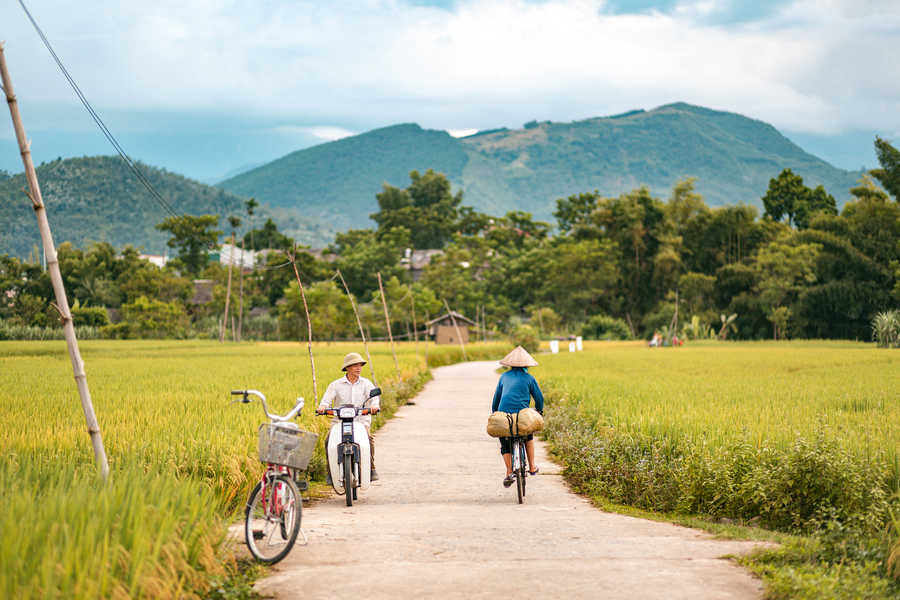
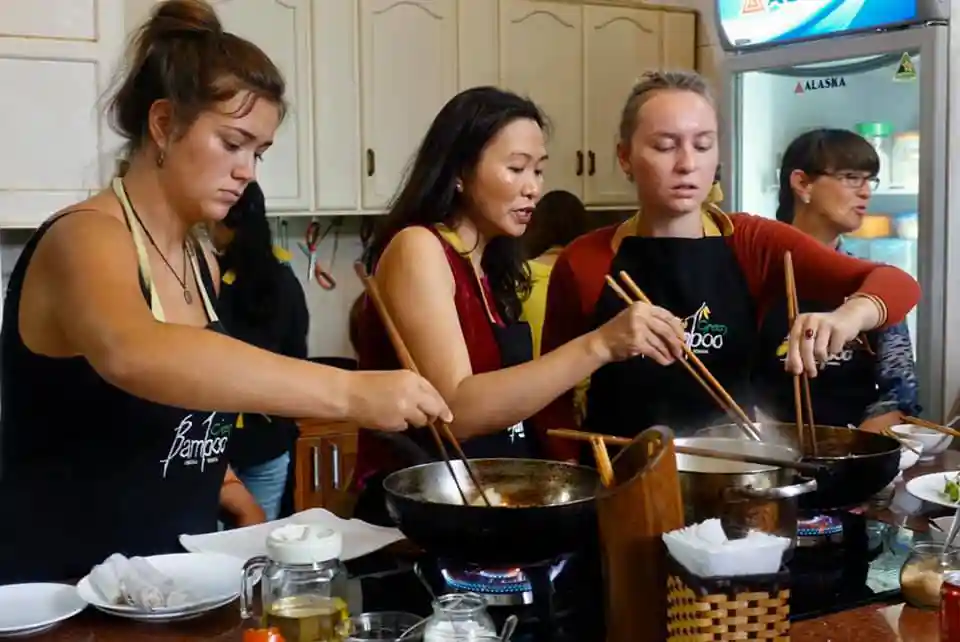
The most popular classes take place a few kilometres from the centre. Some head to Tra Que vegetable village, where you work the soil and pick herbs before cooking. Others go to the Cam Thanh coconut forest for a basket boat ride, sometimes with a go at net or crab fishing. Red Bridge, established for many years, combines a market visit, a boat trip on the river, an herb garden and the class itself.
You learn central Vietnamese dishes: bánh xèo, a crispy turmeric pancake, fresh spring rolls, papaya salad, fish steamed in banana leaf, and sometimes cao lau or mi quang. Expect three to five dishes in about four and a half hours, transfers included.
Mind the season: from October to December, central Vietnam gets heavy rain and Hoi An can flood. Basket boat rides may then be cancelled or replaced, and classes move indoors.
Hanoi or Hoi An: which cooking class suits your trip?
Choose Hanoi to learn northern cooking in an urban setting, and Hoi An for a more rural class among markets, vegetable gardens and rivers.
| Criteria | Hanoi | Hoi An |
|---|---|---|
| Cuisine | North: bun cha, nem ran, pho | Centre: bánh xèo, fresh rolls, cao lau |
| Setting | Neighbourhood market and city kitchen | Market, vegetable gardens, river, coconut forest |
| Usual length | 3 to 4 hours | 4 to 5 hours including transfers |
| Extras | Egg coffee, Old Quarter walk | Basket boat, herb garden, fishing |
| Best for | Short stays, city lovers | Families, nature lovers, slow travel |
If your itinerary includes both cities, we often suggest taking the class in Hoi An, where the setting adds a lot, and discovering Hanoi through its street food instead. The opposite makes sense if you spend longer in the North or are mainly interested in pho and bun cha.
How much does a cooking class cost in Hanoi and Hoi An?
Expect to pay around 20 to 50 USD per person for a group class with ingredients and a meal included, and considerably more for a private class.
Prices depend on group size, transfers and any added activities. These are the indicative ranges we see in 2026:
| Type of class | Hanoi | Hoi An |
|---|---|---|
| Group class without market | 20 to 30 USD | 15 to 25 USD |
| Group class with market | 25 to 45 USD | 20 to 40 USD |
| Class with basket boat or farm | Rarely offered | 30 to 50 USD |
| Private class | About 60 to 120 USD | About 50 to 100 USD |
As a guide, 1 USD is worth about 25,000 VND and 1 euro about 30,000 VND, so a class priced at 1,000,000 VND costs roughly 40 USD. The price usually covers ingredients, the meal, water or tea and the recipes; alcoholic drinks and tips are not always included.
Be wary of very cheap offers sold on the street: groups tend to be large, with one cooking station shared by several people. Paying a few dollars more often makes a real difference to the experience.
Cooking class or street food tour in Hanoi: which is better?
A street food tour lets you taste more dishes in a single evening, while a cooking class teaches skills you can use again at home.
Hanoi is one of the great street food capitals of Asia. A guided evening walk lets you try several specialities in a few hours, at stalls you might not dare to try on your own. To get ready, our guide to the typical dishes to try in Hanoi covers the specialities you will come across.
The two activities complement each other. If you only have two days in the capital, a street food tour gives a broader overview. If you enjoy cooking, a class leaves you with skills and recipes. Many of our travellers take a class in the morning and head out for dinner on their own around Ta Hien or Hang Buom streets, putting what they learned about herbs and sauces into practice.
How do you choose the right cooking class?
A few simple questions help avoid disappointment:
- Group size: beyond ten or twelve people, the chef’s attention gets spread thin. Small-group or private classes cost more but are far more engaging.
- Your own station: check that every participant actually cooks rather than just watching a demonstration.
- Dietary needs: most schools adapt menus for vegetarians if you mention it when booking. For peanut or shellfish allergies, be very clear, as these ingredients are widely used.
- Transfers: in Hoi An, countryside classes often include hotel pick-up; in Hanoi, you usually meet in the Old Quarter.
- Timing: mornings are best for the market, which is liveliest before 10 am. Afternoon classes work better after a flight or a night train.
- Language: classes are almost always in English. If you travel with us, your guide can come along and help.
In our tours, we place the cooking class at the stop where it fits best, taking into account the season, your pace and your interests. A class with a family near Hanoi or a morning in the Tra Que gardens is easy to arrange in advance.
FAQ: cooking classes in Hanoi and Hoi An
How long does a cooking class in Hanoi last?
Allow about three to four hours, including the market visit. Afternoon sessions without the market are often a little shorter.
What dishes do you learn in a Hoi An cooking class?
Mostly central Vietnamese specialities: bánh xèo, fresh spring rolls, papaya salad, fish in banana leaf, and sometimes cao lau or mi quang.
How much does a cooking class cost in Vietnam?
A group class usually costs 20 to 50 USD per person depending on the city and what is included. Private classes cost considerably more.
Are cooking classes suitable for vegetarians?
Yes, most schools offer adapted menus if you mention it when booking. Also flag any allergy clearly, especially to peanuts or shellfish.
Do you need to book a cooking class in advance?
In high season, from December to April, it is best to book a few days ahead, especially for small-group or countryside classes.
Is it better to take a cooking class in Hanoi or Hoi An?
Hoi An offers a more rural setting with markets, vegetable gardens and basket boats, while Hanoi is ideal for learning northern cooking on a short stay.