










Located on the shores of West Lake in Hanoi, Tran Quoc Pagoda is far more than a simple place of worship. It is an architectural and spiritual gem that has embodied the depth of Vietnamese Buddhist culture for over 1,500 years. Regarded as the oldest pagoda in the capital, it offers visitors a unique journey through history and serenity.
What is the history of Tran Quoc Pagoda?
Tran Quoc Pagoda, known as the Pagoda of National Defense, is one of the oldest Buddhist monuments in Vietnam, built in 541.
Tran Quoc Pagoda, known as the “Pagoda of National Defense”, is one of the oldest Buddhist monuments in Vietnam. Its construction began in 541 and was completed in 545, during the reign of King Lý Nam Đế, founder of the Early Lý dynasty. Originally, it was called Khai Quoc Pagoda, meaning “National Founder,” reflecting its spiritual and symbolic role in the affirmation of a nascent national identity.
Initially built on the banks of the Red River, the pagoda was relocated at the beginning of the 17th century, after more than 150 years of existence, due to riverbank collapse caused by erosion. It was then moved to the Kim Ngu islet (meaning “Golden Fish”), located in West Lake (Hồ Tây)—a site renowned for its natural beauty and tranquil atmosphere, ideal for meditation.
Over the centuries, the pagoda not only served as a place of worship but also played an important role in strengthening Buddhism in Vietnam. In 1681, during the reign of King Lê Hy Tông (1681–1705), the pagoda was renamed Tran Quoc, or “National Defense”. This new name expressed the hope that it would protect the nation from natural disasters and ensure prosperity and peace for the people.
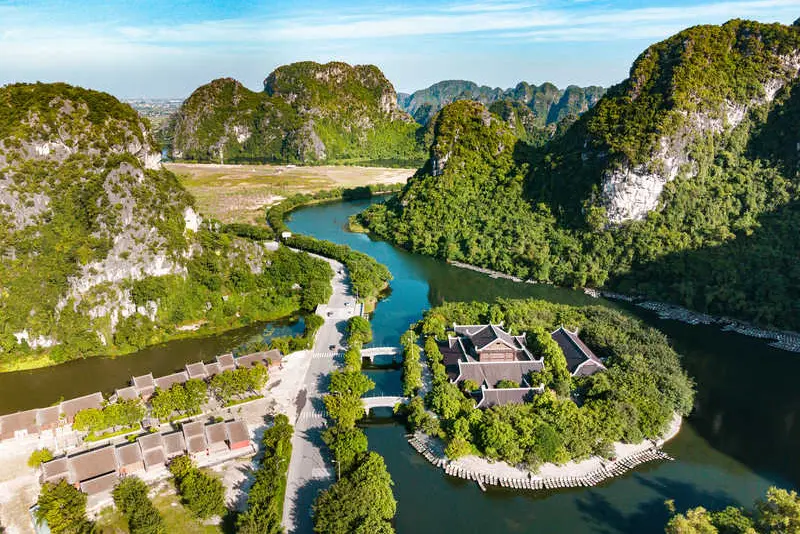
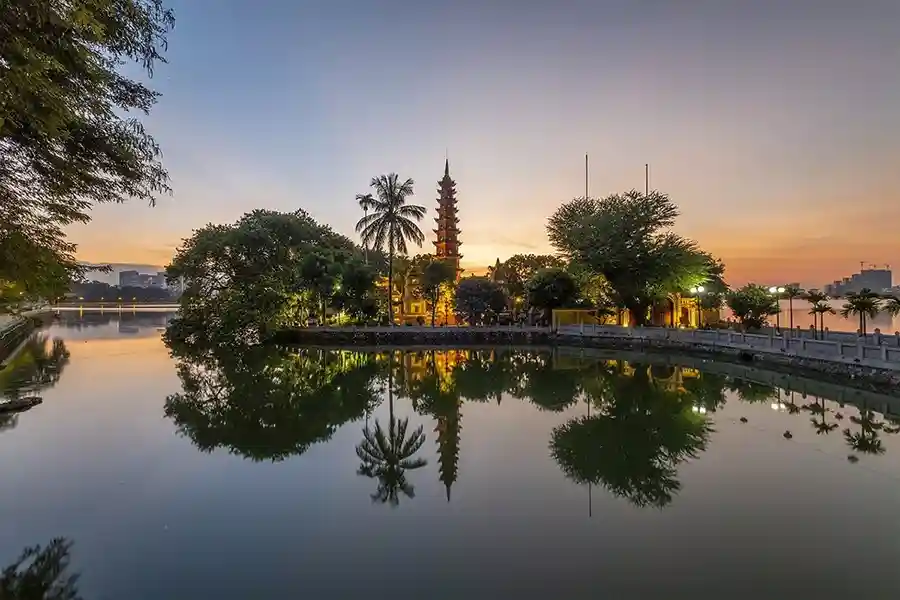
Today, Tran Quoc Pagoda is both an active religious site and one of Hanoi’s most iconic landmarks. Nestled on a small islet accessible by a stone causeway, it captivates visitors with its serene setting and rich architecture. The site houses several ancient relics, precious Buddhist statues, and a red-brick stupa built in honor of the Buddha, added in the 20th century. This harmonious blend of spirituality, history, and natural beauty makes Tran Quoc an unmissable destination for anyone exploring the Vietnamese capital.
Let now explore the main sections of the pagoda.
What to see at Tran Quoc Pagoda
Despite many renovations over the centuries, Tran Quoc Pagoda remains a striking example of traditional Vietnamese Buddhist architecture.
Despite the many renovations it has undergone over the centuries, Tran Quoc Pagoda remains a striking example of traditional Vietnamese Buddhist architecture, while also incorporating elements specific to local style. Seen from above, the layout of its buildings follows the shape of the Chinese character “Công” (工), a symbol of harmony and structural balance. This design reflects the hierarchical and sacred organization of space that is characteristic of Vietnamese religious architecture.
The pagoda is composed of three main structures:
Tien Duong (Front hall)
The Tiền đường, oriented toward the west, is followed by the Tam Bảo House, while the two lateral wings house the Thiêu Hương Hall and the Thượng Điện (Main Sanctuary). These spaces contain an impressive collection of statues, remarkable for their beauty and uniqueness. Among them, the most outstanding is the statue of Buddha Thích Ca (Shakyamuni) in the Nirvana position, carved from wood and covered with golden lacquer. It is recognized as one of the most beautiful Nirvana statues in Vietnam. The site also features numerous polished bronze Buddha statues, radiating majesty and serenity.
Nha Thieu Huong (Incense offering hall)
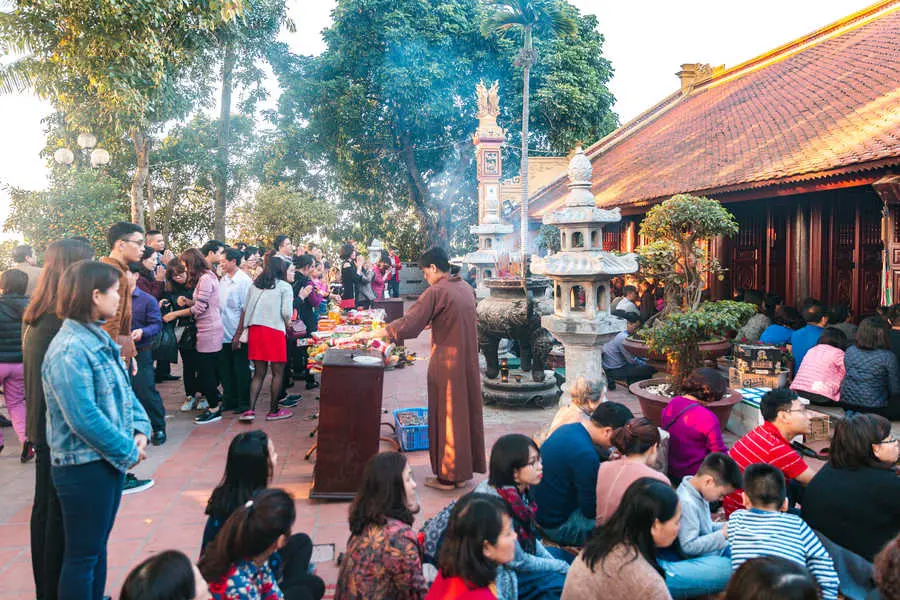
The Nhà Thiêu Hương, or Incense Offering Hall, occupies a central position within Tran Quoc Pagoda, linking the Front Hall (Tiền đường) to the Main Sanctuary (Thượng điện). This space is dedicated to incense-offering rituals—an essential symbolic act in Buddhist practice representing communication between worshippers and the divine. Elegantly designed, the hall stands out for its finely carved wooden columns and traditional decorations featuring Buddhist motifs. Altars adorned with incense burners, surrounded by candles and flowers, create an atmosphere of deep serenity where devotees express their prayers and gratitude. As the true spiritual heart of the pagoda, the Nhà Thiêu Hương embodies the transition between the material world and the sacred realm.
Thuong Dien (Hall of Altars)
The Thượng điện, or Hall of Altars, is the most sacred sanctuary of Tran Quoc Pagoda, reserved for the veneration of the Buddha and Buddhist deities. Located at the far end of the complex, it represents the spiritual heart of the site. Inside, visitors will find several beautifully decorated altars adorned with precious statues depicting the Buddha in various postures, symbolizing meditation, teaching, and enlightenment. Wall frescoes and ritual objects—such as singing bowls and bells—enhance the solemn and mystical atmosphere of this sacred space.
Designed according to the principles of traditional Buddhist architecture, the Thượng điện stands out for its double-sloped roof and finely crafted sculptures representing dragons and lotus flowers. Worshippers come here to meditate, pray, and make offerings, seeking inner serenity and expressing gratitude to the divine. A place of deep spirituality, the Thượng điện is a living testament to Buddhist faith and Vietnamese religious art.
Other highlights in the courtyard
Bao Thap (Lotus Tower)
The sacred Lục Độ Đài Sen tower, built between 1998 and 2003, is an essential feature of the pagoda’s tower garden. Rising 11 stories on a base of approximately 10.5 m², the tower houses a statue of Amitabha Buddha carved from precious stone at its center. It also contains 66 additional statues, while its summit is crowned with a nine-tiered lotus flower (Cửu phẩm liên hoa), finely carved from sparkling precious stone. Resembling a lotus in full bloom, this sculpture lends the tower a solemn splendor and highlights the harmonious elegance of the pagoda’s overall architecture.
The Sacred Bodhi tree: A symbol of international friendship
Beside the pagoda stands a sacred Bodhi tree, planted in 1959 by Indian President Rajendra Prasad and Vietnamese President Hồ Chí Minh. Grown from a cutting of the original tree under which the Buddha attained enlightenment more than 2,500 years ago, this Bodhi tree symbolizes the deep ties between Vietnam and India, while embodying the core Buddhist values of wisdom, compassion, and peace.
Why is Tran Quoc Pagoda a must-see in Hanoi?
A visit to Tran Quoc Pagoda offers complete immersion into Vietnamese history and spirituality, by the shores of West Lake.
A visit to Tran Quoc Pagoda offers a complete immersion into Vietnamese history and spirituality. The red-brick pathway leading to the entrance gently invites visitors into a calm and contemplative experience. Whether you are passionate about architecture, history, or simply seeking a moment of tranquility, this pagoda is an unmissable stop during your stay in Hanoi.
What is the best time to visit Tran Quoc Pagoda?
Tran Quoc Pagoda is one of Hanoi’s best spots to enjoy a spectacular sunset over West Lake.
Tran Quoc Pagoda is one of the must-see spots in Hanoi to enjoy a spectacular sunset. This time of day also offers an excellent opportunity to capture stunning photos of the islet and the pagoda reflected on the water. If you prefer a quieter atmosphere, visiting in the morning is also a good option, although the site can be quite busy during the day.
Entrance fee: Free
Opening hours: Daily from 7:30 a.m. to 6:00 p.m.
Address: Thanh Niên Street, Trúc Bạch Ward, Ba Đình District, Hanoi