














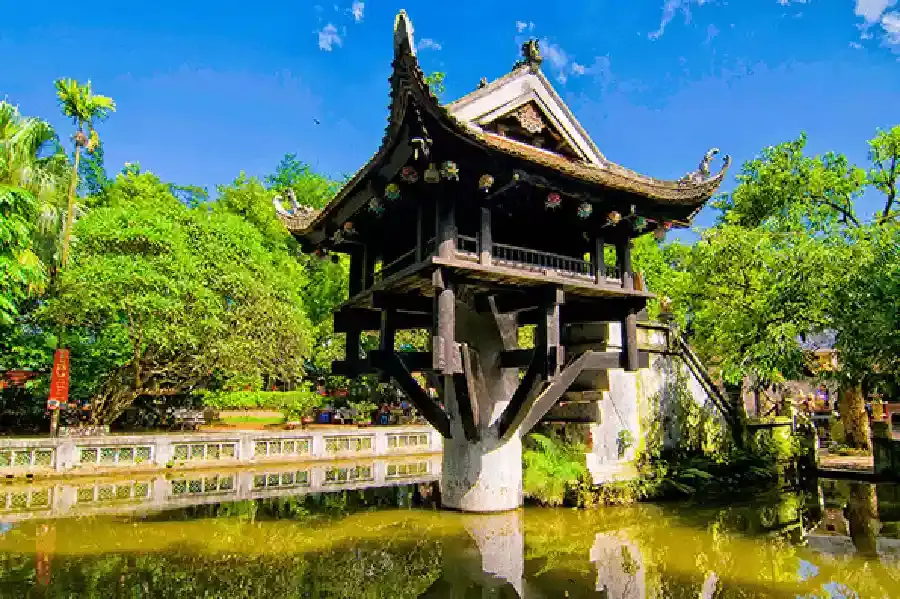
Among Vietnam’s cultural jewels, the One Pillar Pagoda is undoubtedly one of Hanoi’s most iconic, mystical, and frequently photographed monuments. Located in the peaceful Ba Đình district, not far from the Ho Chi Minh Mausoleum, this small pagoda fascinates visitors with its unique architecture and deep symbolic meaning. Each year, it attracts thousands of travelers from around the world who come to discover this sacred place imbued with calm and spirituality.
Gracefully rising from a stone basin like a lotus flower at sunrise, the pagoda embodies purity, wisdom, and resilience. Whether you are passionate about history, interested in architecture, or simply seeking a moment of peace during your journey in Vietnam, the One Pillar Pagoda of Hanoi is a precious and inspiring stop. In its own way, it tells a thousand years of Buddhist tradition and imperial history.
Below is its story and its key features.
A history between legend and reality
The origins of the One Pillar Pagoda date back to 1049, during the reign of King Lý Thái Tông. According to a legend passed down through generations, the king, deeply saddened by the lack of an heir, had a mysterious dream in which he saw the Goddess of Mercy, Quan Âm, seated on a giant lotus flower and handing him a child. Shortly afterward, the queen gave birth to a son. Convinced that this was a divine blessing, the king ordered the construction of a lotus-shaped pagoda in honor of Quan Âm. The structure was meant to reflect the dream itself: a flower rising from the water, pure and graceful.
Originally named Diên Hựu (meaning “long-lasting blessing”), the pagoda was regarded as a sacred place ensuring prosperity and peace for the kingdom.
In 1106, King Lý Nhân Tông expanded and embellished the sanctuary. A basin called hồ Linh Chiểu (“sacred basin”) was dug around the central pillar. The main pavilion, covered with gold leaves, was decorated with spiritual symbols, protective mythical creatures, and sacred inscriptions. Inside stood a golden statue of the Buddha at the center of the altar. A decorated corridor surrounded the basin, and arched bridges allowed worshippers to approach the sanctuary and make offerings. Two majestic towers flanked the main entrance of the complex.
At that time, the king also instituted a monthly religious ceremony: the ritual bathing of the Buddha, celebrated on the first day of each lunar month. This tradition aimed to purify the spirit and invoke prosperity for the kingdom, quickly becoming a respected spiritual custom.
Transformations through the dynasties
Like many historic monuments in Vietnam, the One Pillar Pagoda has passed through several eras, each leaving its mark.
In 1249, under the Trần dynasty, the pagoda was restored while preserving the architectural elements added in 1106. However, over the centuries, the original lotus structure deteriorated, particularly during the Mạc dynasty, and was no longer mentioned in official chronicles. Only a simple stone pillar topped with a small wooden pavilion remained.
Under the later Lê dynasty, the pagoda gradually lost its splendor. Scholar Phạm Đình Hổ reported that at the time, the roof was thatched, the corridors were in ruins, and only a modest statue of Quan Âm remained, isolated in the pavilion. Despite this decline, devotees continued to come and pray.
In 1805, the reconstruction of the Thăng Long Citadel led to the demolition of parts of the pagoda. Later, in the 1840s–1850s, the Nguyễn dynasty carried out another restoration, though it was poorly documented. In 1922, during the French colonial period, an additional restoration helped the pagoda regain some of its former glory.
The most dramatic event occurred in September 1954. Before leaving Hanoi, French troops blew up the structure, leaving only the central stone pillar standing. This was a shock to the local population. After the liberation of the city, the Vietnamese government promptly rebuilt the pagoda faithfully in its current form, respecting both its historical aesthetics and spiritual significance.
A unique architectural masterpiece
The uniqueness of the One Pillar Pagoda lies in its minimalist yet deeply symbolic design. Unlike large pagodas built on broad, solid foundations, this one rests solely on a single stone pillar, approximately 1.25 meters in diameter and 4 meters high. The pillar is anchored in the center of a square basin filled with water and, depending on the season, blooming lotus flowers.
At the top of the pillar stands a small wooden pavilion covered with curved tiles and adorned with delicate carvings of dragons—symbols of protection and wisdom. The whole structure evokes a lotus flower floating on the surface of the water, a major symbol in Buddhism representing spiritual purity emerging from the murky waters of suffering.
Nearby, visitors can also admire a bodhi tree, a gift from India to President Ho Chi Minh in 1958. This tree holds powerful Buddhist symbolism, as it was under a bodhi tree that Siddhārtha Gautama attained enlightenment and became the Buddha.
The lush greenery, the serenity of the basin, floral scents, and the refined simplicity of the structure make this site a true haven of peace in the heart of bustling Hanoi.
Practical tips for your visit
- Adress : P. Chùa Một Cột, Đội Cấn, Ba Đình, Hà Nội
- Opening hours: Daily from 7:00 a.m. to 6:00 p.m.
- Best time to visit: Early morning or late afternoon, when crowds are smaller and natural light enhances the site
- Dress code: Respectful and modest – avoid short clothing; cover shoulders and knees
- Access: Easily reachable by taxi, on foot, or by bicycle from the city center; just a few minutes from the Ho Chi Minh Mausoleum complex
Conclusion: a must-see in Vietnam
The One Pillar Pagoda is not just an ancient monument; it is a living testament to Vietnamese faith, history, and identity. Despite wars, restorations, and the passage of time, it continues to inspire visitors with its elegance and profound meaning.
During your journey in Vietnam, do not miss this beautiful and wise stop. It offers a peaceful pause, a moment of introspection, and a true architectural marvel.