


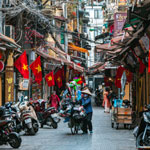
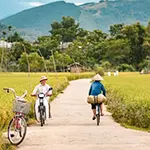






If you travel in Vietnam between mid-June and August, you cannot miss it: the country’s ponds are covered in pink and white flowers, and Hanoi’s flower sellers cycle through the streets at dawn with armfuls of lotus on their bike racks.
Why does this flower hold such a place in Vietnamese hearts? History, spirituality, food and tea: here is everything the lotus tells us about Vietnam.
Why is the lotus the symbol of Vietnam?
The lotus symbolises Vietnam because it rises pure from the mud, an image of the resilience of the Vietnamese people, chosen as national flower.
A famous Vietnamese folk song puts it better than anything: “close to the mud, yet never taking on its smell” (gần bùn mà chẳng hôi tanh mùi bùn). The lotus grows in the muddiest ponds, and it is precisely from this murky water that it draws a spotless flower. For Vietnamese people, the image speaks for itself: a people who lived through a thousand years of Chinese rule, a century of colonisation and decades of war, and who rose again with dignity each time.
In the large national poll held in 2011 to choose a national flower, the lotus won more than 71% of the votes, far ahead of every other candidate. The status has never been made official by law, but in practice the choice was made long ago: the lotus appears on Vietnam Airlines planes, on the national tourism logo, on ceramics, embroidery and family altars. On our tours, we notice it is often the first image of Vietnam our travellers spot, even before landing.
What is the history of the lotus in Vietnamese culture?
Present since the Ly dynasty in the 11th century, the lotus runs through Vietnamese Buddhism, architecture, poetry and everyday life.
The lotus is no passing fashion: it has accompanied the country’s history for almost a thousand years, and its influence can still be seen today in pagodas, first names and poems.
What does the lotus represent in Vietnamese Buddhism?
Buddhism made the lotus its emblem above all others. The Buddha is almost always shown seated on a lotus in full bloom, and legend says that with each of his first steps, a flower opened beneath his foot. For Vietnamese Buddhists, the whole plant sums up the three stages of existence: the rhizome buried in the mud stands for the past, the open flower for the present, and the seed nestled in the heart of the flower announces the future.
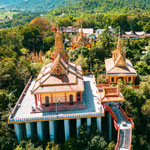
This symbolism explains why so many Vietnamese pagodas are surrounded by lotus ponds. Tran Quoc Pagoda, set on a small peninsula on Hanoi’s West Lake, and Tinh Tam Lake in the former imperial city of Hue are two examples we regularly show our travellers, ideally early in the morning, when the flowers are open and the places still quiet.
How has the lotus inspired architecture and the arts?
The most moving example remains Hanoi’s One Pillar Pagoda. Built in 1049 under King Ly Thai Tong, it stands on a single column rising from a pond: the pillar is the stem, the wooden shrine is the flower. According to the chronicles, the king had it built after dreaming that a deity handed him a son from a lotus throne.
A thousand years later, the inspiration has not run dry. The Bitexco Tower in Ho Chi Minh City takes its curved outline from a lotus bud, and the flower still adorns the lacquer, silk and ceramics of the craft villages. It even appears in first names: Sen and Liên, two words for lotus, are among the most common traditional names.
When and where can you see lotus flowers in bloom in Vietnam?
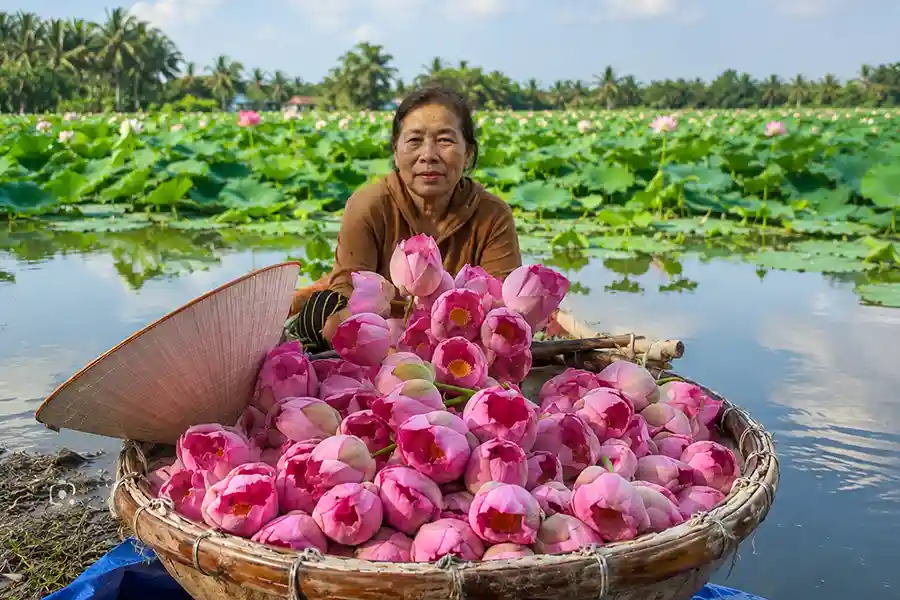
Lotus flowers bloom from May to August in Vietnam, peaking in June and July on Hanoi’s West Lake, in Ninh Binh and around Hue.
If you travel in June or July, you arrive right in the season. Here are the periods we observe year after year on the ground:
| Region | Full bloom | Places we recommend |
|---|---|---|
| North: Hanoi, Ninh Binh | June to early August | West Lake, the ponds of Ninh Binh at the foot of the karst peaks |
| Centre: Hue | June to July | Tinh Tam Lake, the moats of the imperial citadel |
| South: Mekong Delta | May to August | Dong Thap province, known as the land of the lotus |
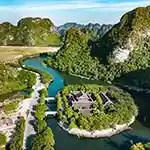
A few tips from experience to make the most of it: come between 5:30 and 8 am, because the lotus opens at dawn and starts to close as soon as the sun gets hot. On West Lake, the growers of the Quang Ba ponds will happily rent you a small boat for a few tens of thousands of dong, around 1 to 3 USD, and you will see Hanoi women posing for photos in ao dai among the flowers, a summer tradition our travellers always watch with a smile. In Ninh Binh, the ponds below Hang Mua make a spectacular foreground beneath the limestone cliffs. These stops fit very naturally into our tours of northern Vietnam, which we gladly adapt to the season of your visit.
How is the lotus used in Vietnamese cuisine?
Every part of the lotus is eaten: seeds, stems, roots and leaves go into salads, desserts, fragrant rice dishes and the famous lotus tea.
This is perhaps what surprises our travellers most: in Vietnam, the lotus is not only admired, it is eaten from root to flower. Each part of the plant has its own texture and use, and tasting lotus is one of the experiences we like to include in our food-focused tours.
Which Vietnamese dishes are made with lotus?
Here are the preparations you will come across most often:
- Lotus stem salad, gỏi ngó sen: the crunchy young stems are mixed with prawns, pork, fresh herbs and roasted peanuts. Fresh and tangy, it is the perfect starter on a summer evening.
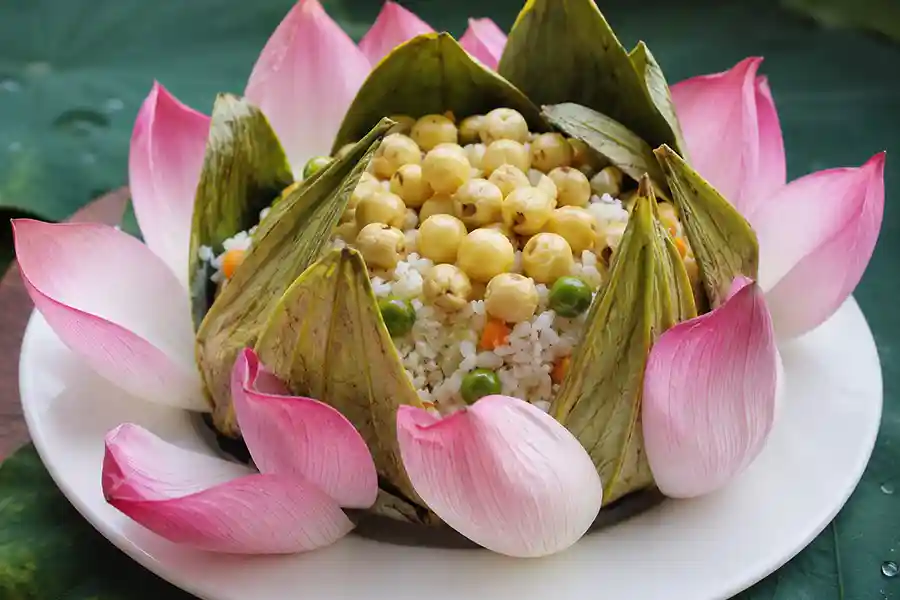
- Hue lotus rice, cơm sen: fried rice with lotus seeds, served wrapped in a lotus leaf that gently perfumes it. This refined dish was served at the imperial court, and Hue’s restaurants keep the tradition alive.
- Lotus seed dessert, chè hạt sen: a sweet soup in which the soft seeds are often paired with longan. Vietnamese people enjoy it warm or iced depending on the season.
- Candied lotus seeds, mứt sen: a must on the sweet trays of Tet, the Vietnamese New Year.
- Lotus leaf parcels: the leaf wraps sticky rice, chicken or fish for steaming, passing on its distinctive green fragrance.
In traditional medicine, the bitter green heart of the seed, tâm sen, is brewed as a herbal tea to help sleep: many Vietnamese families still keep a jar of it at home.
Why is lotus tea so precious?
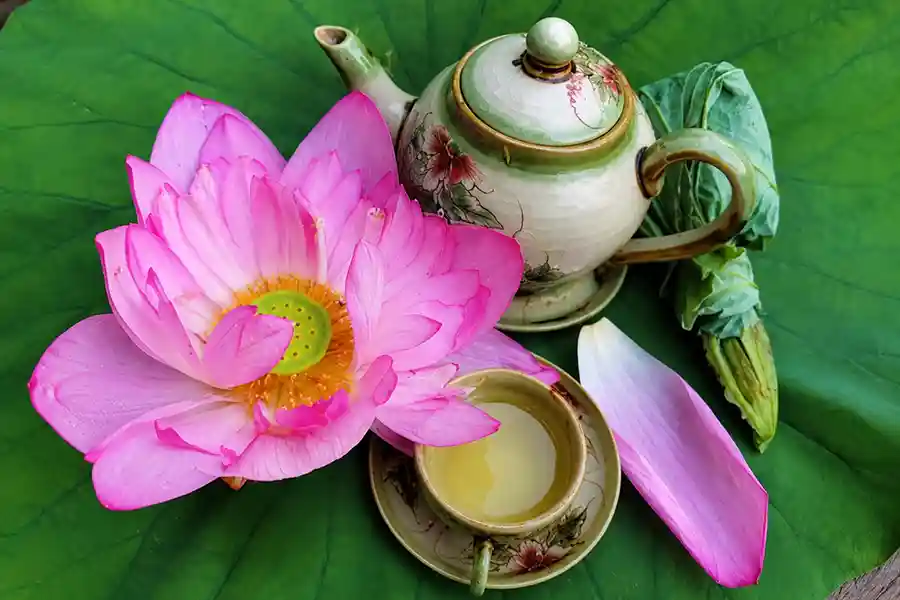
Lotus tea, trà sen, is surely the most refined expression of the flower, and Hanoi is its undisputed capital. On the shores of West Lake, a few families still follow a remarkably patient method: at dawn, they collect the “lotus rice”, the tiny white grains attached to the stamens, then use it to scent green tea in successive layers, repeating the process five to seven times over several weeks. It takes about a thousand flowers to scent a single kilo of tea, which explains why genuine West Lake trà sen sells for several million dong a kilo, a few hundred US dollars, and is given as a prestigious gift.
Fortunately there is a more accessible and equally charming version: tea scented inside the flower. In the evening, a handful of green tea is slipped into the heart of a lotus still closed on its stem; the flower is picked early the next morning, and the tea has absorbed its fragrance overnight. When we visit West Lake in June and July, we love to share this tasting with our travellers directly at the growers’ homes: it is a simple moment, and often one of the most vivid memories of the trip.
Does the lotus have health benefits?
Traditional Vietnamese medicine credits the lotus with soothing and digestive virtues, through its seeds, its leaves and the heart of its seed.
Traditional Vietnamese medicine attributes many qualities to the lotus, and here the kitchen meets the pharmacy. The seeds are considered soothing and nourishing, the heart of the seed brewed as tea helps you sleep, dried leaves are infused to aid digestion, and the crunchy, fibre-rich root ends up in family soups. Without turning the flower into a miracle cure, Vietnamese people use it to illustrate a principle dear to their cuisine: enjoying your food while taking care of yourself. This may be the lotus’s finest lesson: a flower that feeds the body as much as the mind, like a country that never separates beauty from usefulness. If you would like to see it for yourself, from June to August, we will be happy to build a trip with you that passes by the flowering ponds.
FAQ: the lotus in Vietnam
Is the lotus the national flower of Vietnam?
In practice, yes: it won more than 71% of the votes in the 2011 national poll, even though no official text has ever confirmed it.
When can you see lotus flowers in bloom in Vietnam?
From May to August, peaking in June and July. Come early in the morning, between 5:30 and 8 am, while the flowers are still open.
Where can you see lotus flowers in Hanoi?
Around West Lake, especially in the Quang Ba ponds, and near Tran Quoc Pagoda. In Ninh Binh, the ponds at the foot of Hang Mua are also very beautiful.
What is lotus tea?
A green tea scented with lotus stamens, a speciality of Hanoi’s West Lake. It takes about a thousand flowers to scent one kilo of tea.
Which Vietnamese dishes contain lotus?
Lotus stem salad, Hue lotus rice, chè with lotus seeds and the candied seeds served during Tet.
What does the lotus symbolise in Vietnam?
Purity born from the mud, an image of the resilience of the Vietnamese people, and in Buddhism, enlightenment and the three stages of existence.