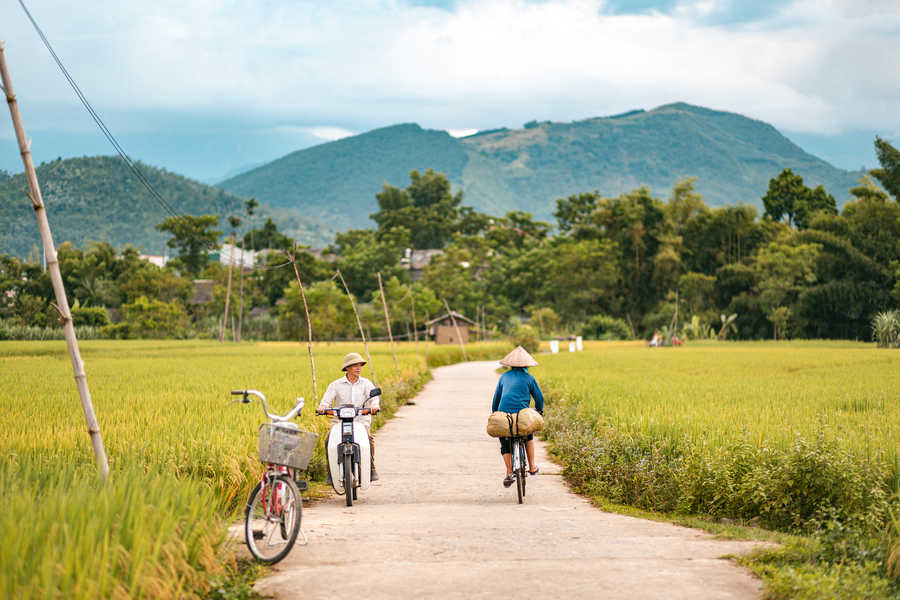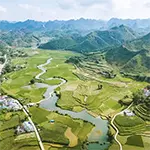















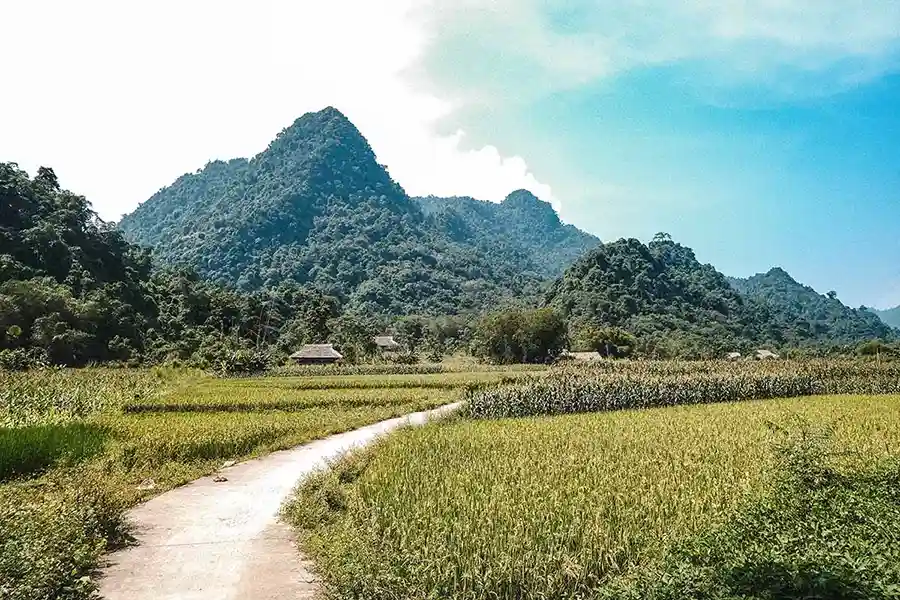
Lam Thuong is a commune in the Luc Yen district, located more than 250 kilometers from Hanoi and about 80 kilometers from Yen Bai city. It is also a valley that makes for a beautiful stopover on the road between Sapa and Ha Giang. Forests, hills, rivers, waterfalls, and rice fields can all be found in this charming place, which will surely delight anyone in search of authentic nature and a simple, rustic lifestyle.
Lam Thuong is mainly inhabited by the Tay ethnic group, the largest minority in Vietnam. Known for their hospitality, they certainly live up to their reputation here: you will be warmly welcomed into their traditional stilt houses, not only to spend the night but also simply to share a cup of tea or a small glass of homemade rice wine with the family. Everything is open here — the gardens, the houses — and trust reigns supreme, to the point that there is no need to lock your motorbike in the street! Just a few minutes spent in one of these homes will make you feel completely at ease.
The Tay people here live mainly from rice cultivation, livestock farming, and the trade of dried bamboo. In addition to the vast rice fields surrounding their homes, each family owns a fish pond. Mountain stream water flows into these ponds, ensuring they are always full and providing nourishment for fish and ducks.
To help you locate it, here is Lam Thuong’s position in northern Vietnam:
Location of Lam Thuong in Northern Vietnam
Why visit Lam Thuong?
Lam Thuong Valley bears some resemblance to Mai Chau, the well-known district southwest of Hanoi.
Lam Thuong is a valley somewhat similar to Mai Chau, a well-known district in Hoa Binh province, located southwest of Hanoi. There are indeed many similarities: a valley surrounded by mountains, with rice and corn fields. But the main difference lies in its inhabitants — Lam Thuong is home to the Tay ethnic group, whereas Mai Chau is mainly inhabited by the Thai. Even more importantly for travelers in search of authenticity, Lam Thuong remains largely untouched by tourism, with very few locals depending on it for a living.
A small house in the Lam Thuong Valley. Credit: Mathieu Arnaudet
Lam Thuong is also perfectly located between Sapa and Ha Giang, making it an ideal stop to discover a variety of landscapes — from Sapa’s terraced rice fields to Lam Thuong’s serene valley, then on to the limestone plateau of Dong Van. Coming from Sapa, you’ll enjoy reconnecting with the authenticity and peaceful rhythm of the Vietnamese countryside. It’s a different pace — one that may make you want to stay a few extra days!
Lastly, the hospitality and kindness of the local people are, in our experience, almost unmatched in Vietnam! Especially if you’re traveling with a guide, you’ll easily be welcomed into local homes to chat about their daily life, beliefs, and work. Even without a guide, you’ll often be invited in for a cup of tea!
In short, Lam Thuong is a beautiful off-the-beaten-path destination that will leave a lasting impression on your journey.
What to do in Lam Thuong?
Strolling through the local villages is one of the simplest and most rewarding ways to experience Lam Thuong.
Stroll through the villages
Your accommodation will most likely be located in the village of Tong Pang, one of the small hamlets in the valley. The first activity we recommend is simply to walk around the village and the surrounding rice and corn fields. With your guide, you can meet the locals, who will be delighted to chat with you. You’ll likely learn that many families in the village (and in neighboring ones) have members working in special economic zones, such as Bac Ninh near Hanoi. While agriculture and livestock farming allow the locals to live largely self-sufficiently, money has also become a necessity. The income brought back by family members helps the new generations live better than the previous ones, and you’ll notice several families improving and expanding their homes thanks to these earnings.
A family preparing rice bags. Photo credit: Mathieu Arnaudet
Discover the process of drying bamboo
As you stroll around, you’ll likely see bamboo drying in front of houses. The surrounding mountains are full of bamboo forests, and the villagers have made this their specialty, known throughout Vietnam. They sell it in markets or to businesses and restaurants, providing them with additional income. The locals will gladly explain the drying and preparation process, and you can ask your host to serve you a bamboo soup, often known in Vietnamese as Bún măng gà — a rice noodle soup with bamboo shoots and chicken.
Bamboo drying in front of a stilt house. Photo credit: Mathieu Arnaudet
Go for a bike ride to the Nam Chan and Na Ken waterfalls
Your hosts will provide you with bicycles — so make the most of it! In the valley, there are two main waterfalls: Nam Chan and Na Ken. We recommend visiting Nam Chan first. It’s located about 5 kilometers from Tong Pang village. You can leave your bikes in a small parking area just after a bamboo bridge and continue on foot to the falls. Enjoy the cool air and peaceful surroundings — it’s a lovely walk along the stream leading up to the waterfall. To reach the top, you’ll need to climb a steep, rocky path, so good shoes are essential to avoid twisting an ankle.
Nam Chan Waterfall. Photo credit: Mathieu Arnaudet
If you have time left, you can also head to Na Ken Waterfall, located in the opposite direction. The footpath leading there is less scenic than the one to Nam Chan, and you’ll need to use both hands and feet to scramble over rocks. At the end, you’ll be rewarded with a nice view over the valley and a modest but charming waterfall — perfect for those who enjoy a bit of adventure.
Na Ken Waterfall. Photo credit: Mathieu Arnaudet
Hike through the bamboo forest
You can also reach Nam Chan Waterfall by first taking a trek through the bamboo forest. Let’s be clear — this hike isn’t for everyone. It’s a real jungle adventure, with paths barely visible. Essentially, you’ll be following the footsteps of the Tay people who come here to harvest bamboo. While they’re used to carrying heavy loads on these trails, it’s a different story for visitors! If you decide to take on this trek, make sure you have good hiking shoes (to prevent slipping) and long pants (for protection from insects). You’ll sometimes need to use your hands for balance, but your local guide will be patient and ready to help when needed. After about two hours of walking, you’ll arrive at the waterfall, where your guide will prepare a delicious meal for you — grilled chicken with sticky rice and vegetables. You’ll then return by the same road you could also take by bike (see above).
Hiking through the bamboo forest. Photo credit: Mathieu Arnaudet
Go trekking to the top of Lung Trang Mountain
For a slightly less adventurous option, the hike to the summit of Lung Trang is also highly recommended — especially because at the top, you’ll be rewarded with a magnificent view over the entire valley. Along the way, you can also explore a few caves. This walk offers another perspective of the valley and brings you closer to the famous karst peaks. As always, you’ll be accompanied by a local guide during the trek.
View of Lam Thuong Valley from Lung Trang Mountain. Photo credit: Xoi Farmstay
Note: Local guides do not speak French or English. If you are traveling with a French- or English-speaking guide, they can translate the information provided by the local guide. If you are traveling alone, the local guide will mostly act as a pathfinder leading the way. However, don’t hesitate to use translation apps to communicate with them.
What activities do you suggest for a 3-day, 2-night stay in Lam Thuong?
A three-day, two-night stay in Lam Thuong allows time to fully explore the valley at an unhurried pace.
Here are the activities we suggest if you stay 3 days and 2 nights on site:
# Day 1: Early departure from Hanoi (7 a.m.) to arrive in Lam Thuong in time for lunch. Lunch at your accommodation, then a walk to the Nam Chan waterfall. Swimming. Return to your accommodation.
# Day 2: Full-day hike to the summit of Lung Trang Mountain. Picnic at the top. Return in the afternoon..
# Day 3: Bike ride through the surrounding villages and discovery of the local dried bamboo production. Departure after lunch (return to Hanoi or continue on to Sapa or Ha Giang).
Where to stay in Lam Thuong?
Lam Thuong still has very few homestays, which is part of what keeps the valley feeling genuinely authentic.
Lam Thuong still has very few homestays — and that’s actually a good thing! A few locals have, however, opened their homes or eco-lodges to visitors. Here are the options available on site.
Our Pick: Xoi Farmstay
Xoi is a young Tay woman working in tourism as a tour operator. Passionate about travel and fluent in English, she has converted her family’s traditional stilt house into a homestay that can accommodate about ten guests at a time.
For those seeking more privacy, Xoi has arranged a room with two double beds, and outside, two bungalows have recently been built.
Price :
- Homestay : 150 000/nuit ;
- Room : 170 000/nuit
- Bungalow : 600 000/nuit
Xoi’s place is truly a favorite: it’s clean, beautifully decorated, the family is kind and attentive, and the meals are delicious. It’s genuinely the kind of address you wish there were more of!
Separate beds in Xoi’s homestay. Photo credit : Mathieu Arnaudet
Interior of Xoi’s bungalows. Photo credit : Mathieu Arnaudet
Another option: Jack Ecolodge
Jack is also a native of the village. After studying in Ho Chi Minh City and living in Dalat, he decided to return home during the pandemic and build an ecolodge. Fluent in English and Chinese, Jack mainly welcomes guests from China and Singapore (a group of Singaporeans was staying there during our visit to the valley).
The lodge consists of two areas (just a few steps apart): a stilt house with six minimalist yet cozy bamboo rooms, and a two-room bungalow offering a stunning view of the river. The rooms in the stilt house feature typical Tay cultural details, while the bungalow rooms are more modern in style, with a beautiful bathtub.
Jack isn’t stopping there—he plans to start building ten new bungalows soon. Like Xoi, he wants to preserve the spirit and tranquility of the place. But will it be possible to do so while continuing to expand his lodge? That’s the paradox of tourism in rural areas.
Exterior of Jack Ecolodge. Photo credit: Jack Ecolodge.
How to get there?
The most comfortable way is by private car. From Hanoi, the drive takes about five hours. By leaving early in the morning (around 7 a.m.), you can arrive in time for lunch with your host.
For those preferring public transportation, you will need to take a bus from Hanoi toward Luc Yen, the main town of the district with the same name. Two bus companies are available: Du Tuyet (019001986) and Hung Hung (0912785262). Since the staff do not speak French or English, it is recommended to get help from your hotel staff. Once in Luc Yen, you can take a taxi to Lam Thuong (about 20 kilometers, approximately 250,000 VND).
To continue north, it is possible to take a bus from Luc Yen to Lao Cai. Ask your hosts to help you book it.
What Is the Best Season to Visit?
The best time to visit Lam Thuong is during one of the two rice harvest periods, in late May or late September.
We recommend choosing one of the two rice harvest periods: late May or late September. During these times, all the villagers are working in the fields, making it easy to approach them, talk, and take photos. Late September to early October also marks the end of the rainy season, so the streams and waterfalls are full and spectacular.
Villagers extracting rice grains. Photo credit: Mathieu Arnaudet
Now you have all the information to prepare your authentic and nature-filled stay!