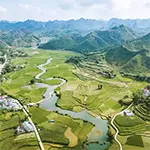

At 1,250 meters above sea level, nestled in a valley encircled by limestone peaks, Mèo Vạc stirs to life every Sunday well before dawn. H’Mong, Dao, Lô Lô and Giáy families leave their hilltop hamlets in the dark, sometimes after several hours of hiking along mountain trails, all converging toward the same place. Not tired, people say. Smiling, even. What you are about to witness at this market has no equivalent in Hà Giang province — nor, most likely, anywhere in northern Vietnam.
What Is the Meo Vac Market?
The Meo Vac market is the largest weekly market in Hà Giang province, held every Sunday on the Đồng Văn karst plateau, at the heart of the UNESCO Global Geopark.
This market has existed for generations, and no one knows exactly how long. What is certain is that it has established itself as the unmissable gathering point for the entire region: residents from the 18 communes of the Mèo Vạc district, as well as those from the neighbouring districts of Yên Minh and Đồng Văn, come together here every week. Since the demolition of the old Đồng Văn market in 2012, Mèo Vạc has officially become the largest and most vibrant market in Hà Giang.
This is not a tourist market. It is a market of life — a functional space, deeply rooted in the local economy, where buffalo, cattle, pigs, poultry and agricultural produce are exchanged according to unwritten rules passed down through the centuries.
Why Is This Market Different from Other Mountain Markets?
The Meo Vac market stands apart through the central role given to livestock, the diversity of ethnic groups present, and a social atmosphere that no other market in the region can replicate.
Many mountain markets offer handicrafts, embroidery, spices and a few animals on the periphery. At Mèo Vạc, livestock is at the very heart of the event. Buffalo and cattle are brought in from sometimes very distant villages and represent significant transactions for families whose livelihoods depend largely on animal husbandry. This market is also a major supplier of buffalo and beef for the entire region.
Another remarkable feature: there is no bargaining in the usual sense. Prices are firm, yet acquaintances spontaneously receive discounts, and cashless exchanges remain common between neighbours and close relations. What you observe is an economy of trust and reciprocity, bearing little resemblance to ordinary commerce.
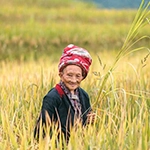
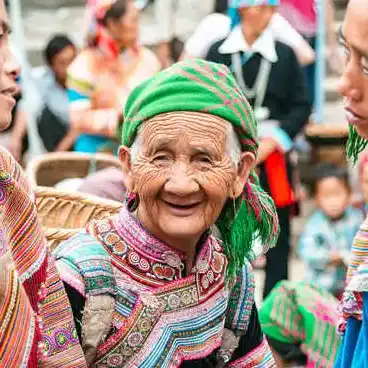
The ethnic groups present are numerous and visually distinctive: Black H’Mong, Dao, Lô Lô, Giáy… Each group wears its own colours, embroidery and headdresses. The diversity of traditional dress makes Mèo Vạc one of the most photogenic markets in northern Vietnam — something we confirm every time we accompany our travellers there.

What Will You See and Experience at the Meo Vac Market?
The Livestock Area: Buffalo, Cattle and Poultry
This is the section that gives the market its name and character. From as early as 5 or 6 in the morning, men arrive leading their animals on ropes, buffalo breathing clouds into the cool plateau air. Negotiations take place in hushed tones, through gestures, sometimes after long silences. Flanks are felt, teeth examined, gait assessed. To the uninitiated eye, the scene may seem cryptic. It is, in reality, the economic heartbeat of the entire region. Alongside the buffalo and cattle, trussed pigs, caged poultry and goats complete the picture.
The Food Stalls and Flavours: Thắng Cố, Five-Colour Sticky Rice, Corn Wine
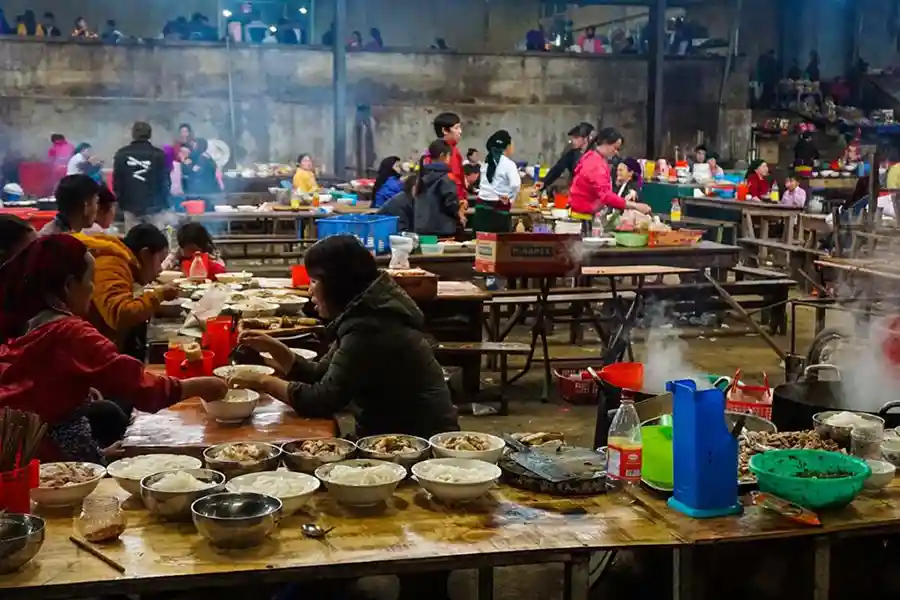
Inside the covered market halls and around braziers set directly on the ground, the culinary life of the market comes into its own. The unmissable dish is thắng cố: a stew simmered slowly in a large cauldron, made from horse or buffalo meat, bones, offal and local spices. Five-colour sticky rice is served hot, shaped by hand. Bowls of freshly cooked phở, corn bread, fried fritters and flatbreads round out the offering. Corn wine flows freely among the men, accompanying conversation and transactions alike.
Traditional Dress and Human Encounters
As the hours pass, the market grows denser and the colours more vivid. H’Mong women in embroidered skirts and dark aprons move alongside Lô Lô women in outfits adorned with multicoloured bands. Shops selling traditional clothing and jewellery line the upper floor of the market halls — silver jewellery, embroidered fabrics, costume accessories. This is also a place of intense social life: people come to catch up on news, discuss an upcoming wedding, reconnect with cousins seen only once a week. Elders sit and talk about their families. Young people steal glances at one another.
What Time Should You Arrive at the Meo Vac Market?
The Meo Vac market is held every Sunday from 4 a.m. to 4 p.m., reaching peak intensity between 7 a.m. and 9:30 a.m., before stalls gradually begin to thin out.
Arriving at 7 a.m. means finding the market at its most vibrant: livestock transactions in full swing, halls buzzing with activity, smells and sounds overlapping in every direction. Arriving after 10 a.m. means finding a market already winding down. We always advise our travellers to plan a Saturday night in Mèo Vạc, so they can be on site from the very first hours of the morning.
The best time of year? The market is lively year-round, but it reaches its peak intensity in winter — particularly in December and January — when the karst plateau is often wrapped in mist and residents gather with even greater fervour. The weeks leading up to the Lunar New Year are especially vibrant, with major purchases being made for the festivities. The post-Tết period, meanwhile, transforms into a festive gathering.
| Period | Atmosphere |
|---|---|
| October – December | Mist, soft light, very lively market |
| January – Tết | Festive shopping, great excitement |
| Post-Tết (February) | Festive atmosphere, traditional games |
| March – September | Regular market, less intense |
How to Include the Meo Vac Market in a Ha Giang Trip?
The Meo Vac market fits naturally into a Ha Giang itinerary, ideally combined with Đồng Văn, the Ma Pi Lèng Pass and the ethnic minority villages of the karst plateau.
The Đồng Văn–Mèo Vạc karst plateau is not something to improvise. Distances are short as the crow flies, but the mountain roads turn 22 kilometres into 45 minutes of winding, spectacular driving. The logical sequence from Hà Giang is as follows: arrive in Hà Giang, head north towards Đồng Văn (via Tam Sơn or the mountain pass route), spend the night in Đồng Văn, then visit Mèo Vạc on Sunday morning with the Ma Pi Lèng Pass on the way back.
The Ma Pi Lèng Pass road — 20 kilometres of switchbacks overlooking the Nho Quế River at up to 2,000 metres of altitude — is widely considered the most spectacular road in Vietnam. Combining it with the market on the same morning makes for one of the most extraordinary days possible in the country.
For travellers who wish to explore this entire region in the best possible conditions, with a local guide and carefully selected accommodation, our 8-day Authentic Discovery of Northeast Vietnam circuit is designed to travel through these territories at a human pace, with the Mèo Vạc market as its crowning highlight. For further help planning your visit to Hà Giang, our complete guide to what to see in Hà Giang will give you all the keys to building your itinerary.
The Mèo Vạc market resembles nothing a European traveller has ever seen before. It is not a picturesque market for tourists. It is a living, necessary market, rooted in an economy and a culture that time has not erased. Go early, stay long, eat on site — that is how you come away with something essential.