










On April 30, 1975, the T-59 tank bearing number 390 of the 203rd Armored Regiment smashed through the main gate and entered the Independence Palace, marking the end of the country’s reunification war, which had lasted more than 20 years.
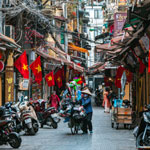
April 30, 2025. The streets of Saigon—now Ho Chi Minh City—pulse with celebration. Red flags flutter from balconies, drums echo through narrow alleys, and colorful lanterns illuminate colonial façades. On the sidewalks, children run between food stalls while troops in traditional costumes parade to the sound of music.
In this festive atmosphere, the city seems suspended between memory and modernity. Every street evokes a page of history; every monument bears witness to a glorious past. Welcome to Saigon, 50 years after its liberation, for a journey through time and space, between shared memories and a reinvented city.
And if you would like to discover the city through both its history and its present-day life, explore our one-day Ho Chi Minh City tour with a English-speaking guide—ideal for understanding the legacy of this period and the city’s vibrant energy today.
What was the context leading to the fall of Saigon on April 30, 1975?
The fall of Saigon on April 30, 1975 marked the end of the Vietnam War and the disappearance of South Vietnam.
The fall of Saigon on April 30, 1975 marked the end of the Vietnam War and the official disappearance of the Republic of Vietnam (South Vietnam). It was the result of an irreversible military dynamic combined with a rapidly accelerating internal political collapse.
From a military standpoint, North Vietnamese communist forces had launched a lightning offensive from March 1975 onward: the Ho Chi Minh Campaign. Taking advantage of American war fatigue, the U.S. military disengagement following the Paris Peace Accords of 1973, and the growing disorganization of the South Vietnamese army (ARVN), Northern troops secured victory after victory as they advanced swiftly from central Vietnam toward the south. In barely two months, they captured the main southern cities without facing any truly structured resistance.
Politically, the South Vietnamese regime was deeply weakened. After the resignation of President Nguyễn Văn Thiệu—unable to maintain popular support and national unity—his successors Trần Văn Hương and then Dương Văn Minh were powerless to stop the collapse. Institutions crumbled, panic spread among the population, and elites attempted to flee the country.
Although still present through its embassy, the United States had already significantly reduced its direct military support. Operation “Frequent Wind”, launched in the final hours, enabled the emergency evacuation by helicopter of thousands of American nationals and South Vietnamese civilians.
On the morning of April 30, North Vietnamese tanks entered Saigon, breaking through the gates of the presidential palace. Newly inaugurated President Dương Văn Minh declared unconditional surrender. The city was renamed Ho Chi Minh City, marking the reunification of the country under the banner of the Vietnamese Communist Party.
How did April 30, 1975 unfold in a single day in Saigon?
In the early morning of April 30, 1975, North Vietnamese troops encircled Saigon, backed by southern liberation forces.
Early morning (from 4:00–5:00 a.m.):
North Vietnamese troops of the People’s Army of Vietnam (PAVN), supported by the National Liberation Front of South Vietnam (Viet Cong), completely encircle Saigon. The last units of the South Vietnamese army (ARVN) are disorganized and demoralized, offering almost no resistance. The streets are deserted and tense; some areas witness looting or hurried mass departures.
6:30 a.m. – 10:00 a.m.:
North Vietnamese armored units break through the city’s outer defenses and advance toward the center. President Dương Văn Minh, in office since April 28, knows he lacks both popular support and military means to defend the capital. He calls for surrender to avoid bloodshed.
8:00 a.m. – 10:30 a.m.:
The U.S. Embassy becomes the scene of a chaotic evacuation as Operation Frequent Wind continues under extreme urgency. Helicopters land on the rooftop and in the courtyard to extract American nationals and Vietnamese close to the regime. Thousands attempt to flee, but only a few thousand are evacuated before the operation is halted.
11:00 a.m. – 12:00 p.m.:
North Vietnamese tanks reach the city center and head straight for the Independence Palace. The iconic image of a T-54 tank smashing through the palace gates becomes the enduring symbol of the war’s end. Inside, President Dương Văn Minh receives North Vietnamese officers and announces unconditional surrender.
Midday – afternoon:
The Viet Cong flag is raised over the palace. Radio broadcasts announce the victory of revolutionary forces. The war is officially over. General Trần Văn Trà, who led the final offensive, enters the city with his troops amid an atmosphere of both relief and uncertainty.

Evening:
Saigon is now under communist control. Confusion still reigns in the streets. Scenes of popular jubilation alternate with fear and apprehension. Many families go into hiding, afraid of reprisals. Radio announcements proclaim the imminent unification of the country under the name Socialist Republic of Vietnam, with Saigon officially renamed Ho Chi Minh City.
What were the consequences of the fall of Saigon?
The fall of Saigon on April 30, 1975 officially ended the Vietnam War after more than two decades of conflict.
The fall of Saigon on April 30, 1975 officially ended the Vietnam War after more than two decades of conflict. Immediately, the country came under the control of the Communist Party, and the Republic of South Vietnam ceased to exist. The city of Saigon was renamed Ho Chi Minh City in honor of the revolutionary leader. Thousands of former soldiers, civil servants, and intellectuals from the South were sent to “re-education camps”, while others attempted to flee by sea, giving rise to the tragedy of the boat people.
In the longer term, the reunification of the country as the Socialist Republic of Vietnam led to a brutal transition toward a centralized, planned economy. The following years were marked by deep economic crisis, shortages, and diplomatic isolation, particularly with the United States. It was not until the economic reforms known as Đổi Mới, launched in 1986, that Vietnam began a true transformation—gradually opening to the world, foreign investment, and rapid growth, while remaining a single-party state.
What are the symbolic sites of memory from the fall of Saigon?
The Reunification Palace, formerly the Independence Palace, remains one of the most symbolic sites of this history.
The Reunification Palace
Formerly known as the Independence Palace, the Reunification Palace is a place steeped in history and closely linked to the final hours of the Vietnam War. It was here, on April 30, 1975, that North Vietnamese tank number 843 crashed through the main gates, symbolizing the fall of the South Vietnamese regime and the reunification of the country under communist authority. This event officially marked the end of a long and devastating conflict.
The palace has since been transformed into a museum but has been meticulously preserved in its original 1970s condition. Visitors can explore the vast reception halls used for official ceremonies, the office of President Nguyễn Văn Thiệu, and the map room—the strategic nerve center of South Vietnam’s military operations. The basement, designed as a bunker, still houses communication equipment, tactical maps, and crisis rooms, offering a poignant immersion into the military stakes of the era.
With its modernist 1960s architecture and atmosphere frozen in time, the Reunification Palace is not only a testament to Vietnam’s political past but also an essential site of national memory in Ho Chi Minh City.
War Remnants Museum
Located just steps from the center of Ho Chi Minh City, the War Remnants Museum is one of Vietnam’s most powerful memorial sites. Through a rich collection of photographs, documents, personal objects, and military equipment, the museum retraces key episodes of the Vietnam War from both Vietnamese and international perspectives.
Permanent exhibitions immerse visitors in the brutality of the conflict, highlighting the devastating consequences of bombings, chemical weapons (notably Agent Orange), and human rights violations. Civilian testimonies, images captured by war correspondents, and remnants of American weapons and armored vehicles convey the scale of suffering endured by the population.
But the museum goes beyond condemnation. It also pays tribute to the resilience and courage of the Vietnamese people through stories of reconstruction, solidarity, and reconciliation. More than a historical site, the War Remnants Museum is a call for peace, remembrance, and reflection that leaves a lasting impression on its visitors.

Dong Khoi Street and the colonial district
Formerly known as Catinat Street during French Indochina, Dong Khoi Street is one of Ho Chi Minh City’s most emblematic avenues. Running through the historic center, it alone tells more than a century of history. Strolling along this street is like stepping back in time: elegant colonial-era buildings such as the Saigon Opera House, the Central Post Office, and the Continental Hotel—made famous by writers and war correspondents—line the avenue.
Yet Dong Khoi is far from frozen in the past; it is also a symbol of the city’s renewal. Behind its historic façades now lie elegant boutiques, contemporary art galleries, retro-chic cafés, and luxury brands. The district is popular with both curious travelers and locals seeking relaxation or inspiration.
Blending architectural heritage, a bohemian atmosphere, and vibrant modernity, Dong Khoi Street perfectly illustrates the harmonious coexistence of colonial history and contemporary urban energy that defines Ho Chi Minh City. It is a must-visit for anyone wishing to feel the historical and cultural pulse of the southern capital.
How did Ho Chi Minh City celebrate the 50th anniversary of Liberation?
For the 50th anniversary of Reunification, Ho Chi Minh City offered an exceptional program from April 19 to 30, 2025.
On the occasion of the 50th anniversary of Reunification, Ho Chi Minh City is offering an exceptional program from April 19 to 30, 2025. Here are the highlights not to be missed:
National ceremony and military parade (April 30 at 6:30 a.m.)
Held on Lê Duẩn Avenue in front of the Reunification Palace, the official ceremony will include:
- A grand military parade with 36 military units, 12 civilian delegations, and the participation of foreign delegations (Laos, Cambodia).
- Solemn speeches, wreath-laying ceremonies, and a minute of silence in tribute to the victims of the war.
Artistic and technological performances
- “Colors of Uncle Ho’s City” Festival on April 19, 26, 29, and 30, featuring 3D projections on City Hall, patriotic songs, symphonic music, and street performances.
- On the evening of April 30, a drone show with 2,000 drones will light up the sky, followed by a spectacular fireworks display visible from several points across the city.
Exhibitions and screenings
- Photo exhibition “Echoes of the Great Spring Victory of 1975”, showcasing over 300 historical images along Nguyễn Huệ Street.
- Open-air documentary film screenings retracing the stages of Liberation and life in Saigon before 1975.
What remains of this memory in Ho Chi Minh City today?
Fifty years after Liberation, Ho Chi Minh City remains a city of contrasts, emotion, and constantly evolving energy.
Fifty years after Liberation, Saigon—Ho Chi Minh City—remains a city of contrasts, emotion, and energy. It has continued to evolve while honoring its history. Its streets still echo with memories of 1975, but its glass towers, modern districts, and dynamic youth reflect a confident Vietnam looking toward the future.
What resources can help you learn more about the fall of Saigon?
Several books, written by French and American war correspondents, offer deeper insight into this defining 20th-century event.
Here are a few books that immerse you in this defining event of the 20th century. The first was written by a French war correspondent; the other two were written by Americans and, unfortunately, have not been translated into French.
L’adieu à Saïgon – Jean Lartéguy (Presses de la Cité, 1975)
Written in the heat of the moment by one of the great war correspondents of the time, this account bears witness to the fall of Saigon as experienced on the ground. With a vivid style and a keen sense of historical drama, Lartéguy describes the atmosphere of panic, diplomatic dilemmas, and the collapse of a world the West could not—or would not—save.
Decent Interval – Frank Snepp (Random House, 1977)
As the CIA’s chief analyst in Saigon, Snepp delivers an unflinching testimony of U.S. unpreparedness and the abandonment of Vietnamese allies.
Peace with Honor: An American Reports on Vietnam, 1973–1975 – Stuart A. Herrington (Presidio Press, 1983)
An American military intelligence officer, Herrington recounts from the inside the collapse of South Vietnam, last-minute negotiations, and the fate of abandoned civilians. A lucid, human, and lesser-known testimony, written with restraint.