






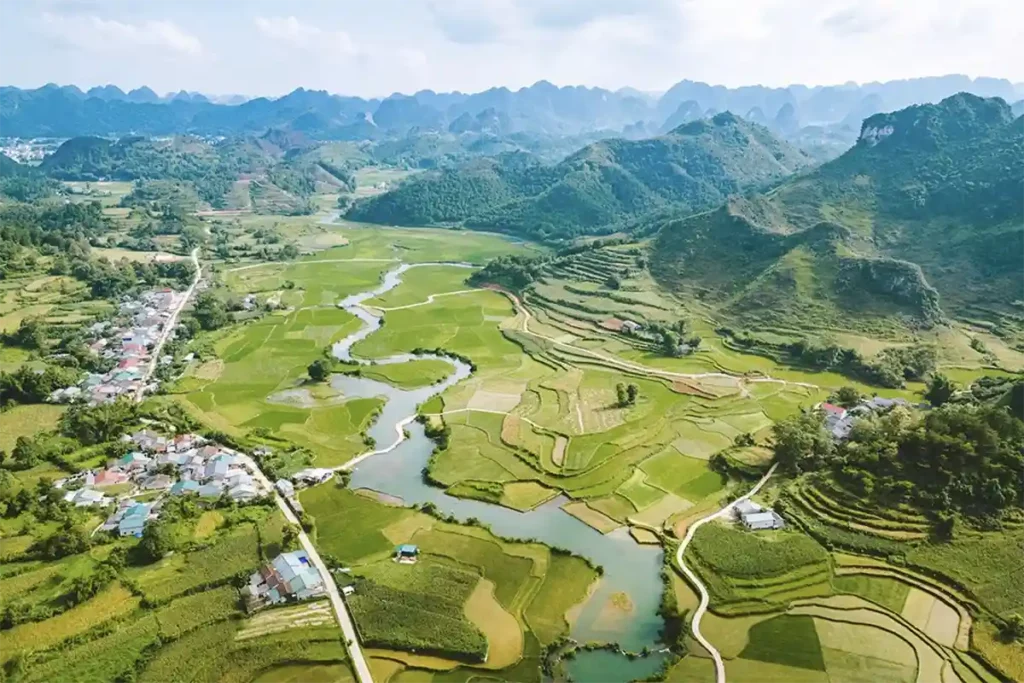
In this article, we invite you to explore Cao Bang, a fascinating region located in the extreme northeast of Vietnam. You will find practical information and our top 10 destinations to visit in the province.
For those who wish to explore this region with peace of mind, discover our 8-day tour “Authentic Discovery of Northeast Vietnam“, combining Cao Bang and Ha Giang — two provinces with spectacular landscapes, to experience as a private tour with an English-speaking guide.
What makes Cao Bang a fascinating destination?
Cao Bang province is known for its spectacular natural landscapes, brimming with beauty across the region.
Cao Bang, magnificent natural landscapes
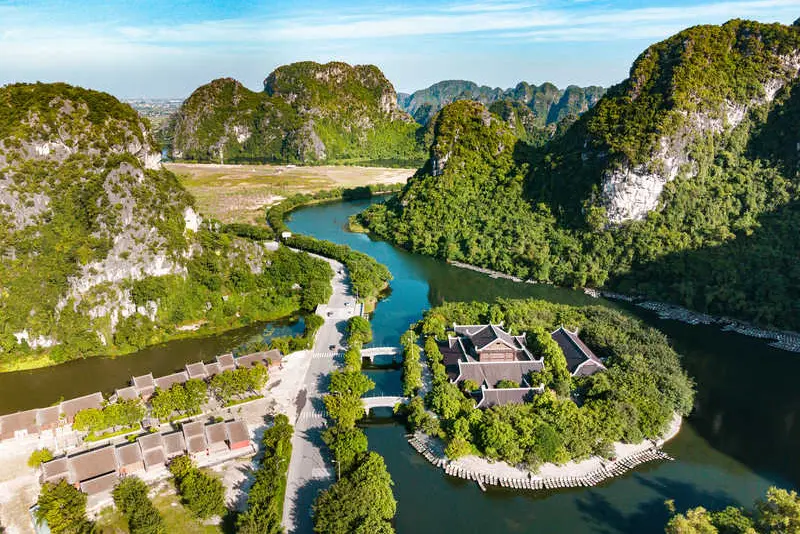
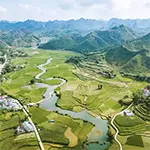
The province of Cao Bang is a fascinating destination brimming with natural beauty. Known for its spectacular mountainous topography, Cao Bang offers travelers breathtaking landscapes. The majestic limestone mountains, lush green valleys, winding rivers, and picturesque waterfalls create a stunning backdrop for nature enthusiasts.
The region is part of the Non Nuoc Cao Bang UNESCO Global Geopark, recognized in 2018 for its karst formations, caves and fossils. Hikers can explore trails winding through the forest, between terraced rice fields and villages, and geology enthusiasts will be amazed by Nguom Ngao Cave, where stalactites and stalagmites have formed over millennia.
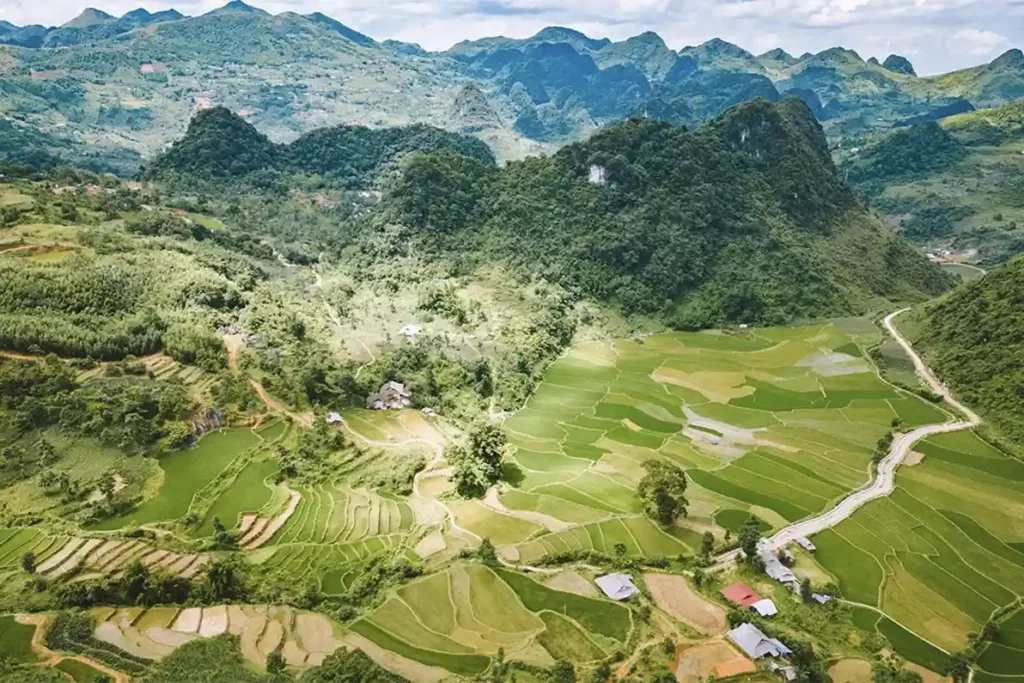
Aerial view of Cao Bang. Credit : Mathieu Arnaudet
Cao Bang, the cradle of Vietnamese resistance
Beyond its natural beauty, Cao Bang is steeped in history. It was here, at Pac Bo, that Hồ Chí Minh returned to Vietnam in 1941, after thirty years in exile, to prepare the struggle for independence. The caves and paths that sheltered him can be visited today. The Kim Dong memorial site, honoring a young national hero, is also an important pilgrimage site for the Vietnamese.
Cao Bang, a multi-ethnic region
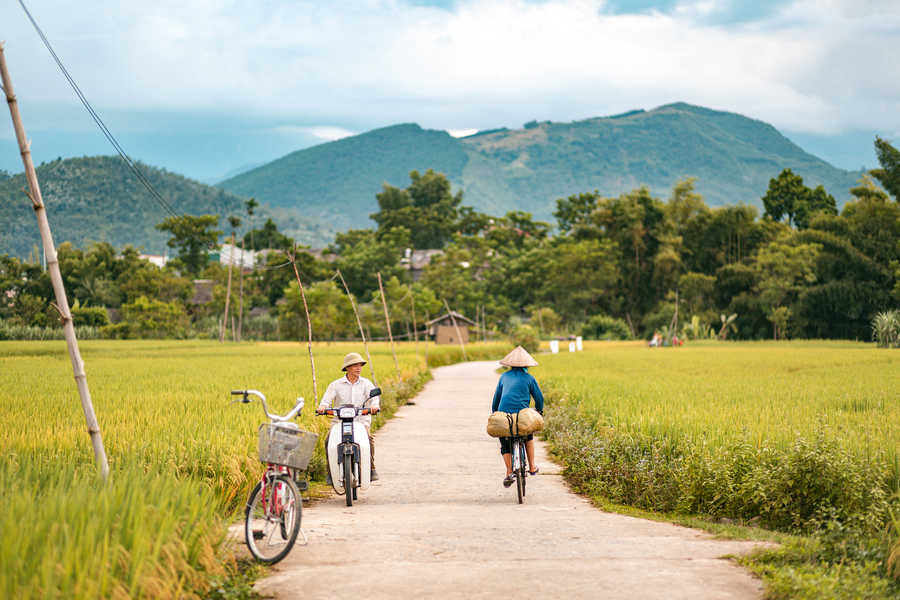
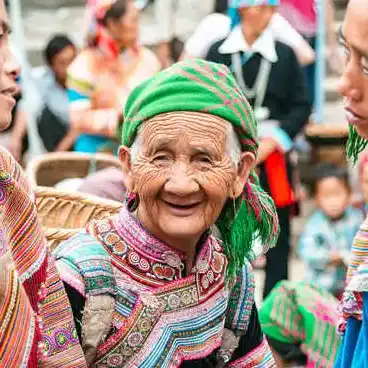
The inhabitants of Cao Bang belong mainly to the Tay, Nung, and Hmong ethnic groups, making it an ideal destination for travelers interested in the cultural diversity of Vietnam. Visitors can stay in traditional villages, explore local customs, taste delicious regional cuisine, and participate in lively festivals that showcase craftsmanship, music, and traditional dances. One should not forget the Black Lolo ethnic group, living near Bao Lac, in the far west of the province.
What are the top activities to do in Cao Bang?
The Ban Gioc Waterfalls, located in Cao Bang province, are among the most stunning natural wonders in Vietnam.
| Site | Entrance fee | From Cao Bang city | Visit time |
|---|---|---|---|
| Ban Gioc Falls | 45,000 VND, raft 50,000 VND | ≈ 2.5 h drive (85 km) | 1.5 to 2 h |
| Nguom Ngao Cave | about 40,000 VND | 4 km from Ban Gioc | 1.5 h |
| Phat Tich Truc Lam Pagoda | free | 500 m from Ban Gioc | 30 min |
| Phong Nam Valley | free | on the way to Ban Gioc | 2 to 3 h walk |
| Nui Thung and Thang Hen Lake | about 30,000 VND for the lake | ≈ 45 min (25 km) | half a day |
| Pac Bo historical site | 20,000 VND | ≈ 1 h 15 (50 km) | 1.5 to 2 h |
| Phuc Sen blacksmith village | free | ≈ 1 h (40 km) | 1 h |
| Phia Oac – Phia Den National Park | — | ≈ 1.5 h (45 km) | half a day |
| Khuoi Khon Lolo village (Bao Lac) | — | ≈ 3.5 h (130 km) | one night in a homestay |
Indicative prices and times, checked in 2026; distances are from Cao Bang city.
Ban Gioc Waterfalls
The Ban Gioc Waterfalls, located in the Cao Bang province of Vietnam, are one of the most stunning natural wonders in the country. Nestled on the border between Vietnam and China, these majestic waterfalls are among the largest and most spectacular in Southeast Asia. The turbulent waters of the Quay Son River cascade from a height of over 30 meters, creating a powerful waterfall that crashes into a picturesque landscape.
The Ban Gioc Falls are surrounded by lush vegetation, karst mountains, and vibrant terraced rice fields, creating a scene of breathtaking beauty. The contrast between the vibrant turquoise waters of the waterfall and the intense greenery of the surrounding nature forms a striking tableau that captivates visitors.
One distinctive feature of Ban Gioc Falls is that they are divided into three different levels. Each level offers a different view and a unique experience. Visitors can stroll along well-maintained trails to admire the waterfall from various angles, refresh in the clear waters of the river, or rent a bamboo boat to get closer to the falls and feel the power of the crashing water. The deafening sound of rushing water, refreshing splashes, and the peaceful atmosphere make the visit to Ban Gioc Falls a memorable experience.
Practical Information:
Entrance fee: 45,000 VND per person (about 1.80 USD).
Boat ride for a closer view of the waterfall (and the Chinese!): 50,000 VND/person
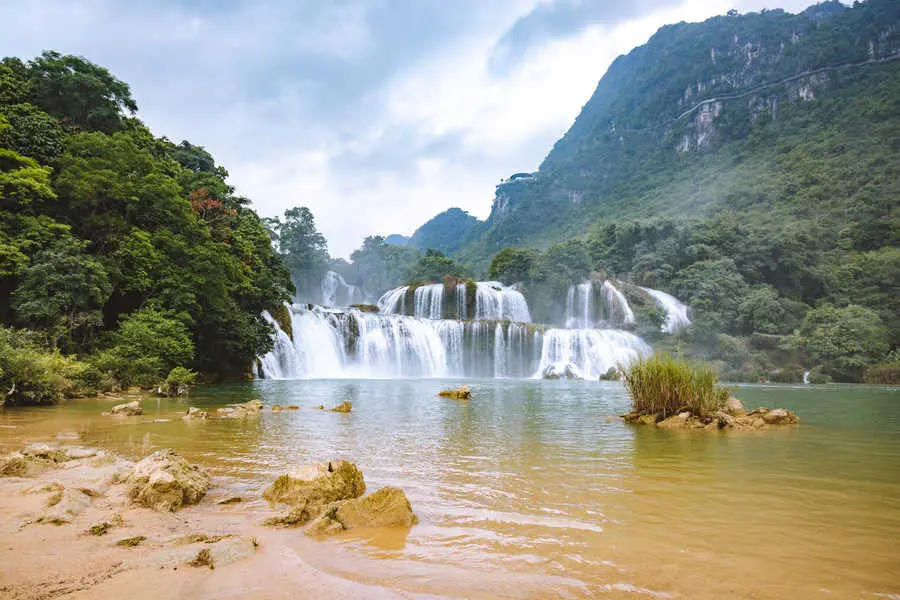
Ban Gioc waterfalls. Credit : Mathieu Arnaudet
Nguom Ngao caves (tiger caves)
Located just 4 kilometers from Ban Gioc Falls, the Nguom Ngao Cave is one of the most impressive underground wonders in the Cao Bang province. Discovered in 1921 by French and Vietnamese administrators, it was nicknamed the ‘Tiger Cave’ in the language of the Tay ethnic group because, according to legend, tigers used to inhabit it.
The cave is very large, and you’ll need to walk 2 kilometers to complete the circuit. You’ll be impressed by the height and grandeur of the surroundings. However, the cave’s lighting is relatively poor – especially compared to caves like Phong Nha Ke Bang – mainly in yellow hues. The province is still in its early stages of promoting tourism, especially to Western tourists, and it’s likely that the hospitality and presentation will improve in the future.
Practical Information:
Entrance fee: about 40,000 VND per person.

Nguom Ngao cave. Credit : Mathieu Arnaudet
Phat Tich Truc Lam pagoda
Inaugurated on December 15, 2014, the pagoda was built on a total area of 3 hectares, nestled against the Phia Nham mountain, just 500 meters from Ban Gioc Falls. From the pagoda, visitors can contemplate the entirety of Ban Gioc Falls surrounded by rice fields and mountain ranges.
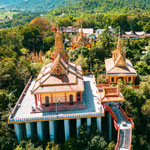
The pagoda was built in the traditional Vietnamese style, with ironwood and terracotta tiles. It includes a statue of the bodhisattva Avalokiteshvara, a temple dedicated to the Mother Goddess and a temple honoring Nung Tri Cao, a hero who defended Vietnam’s northern border. The highlight is the Thien Bao bell tower, which houses a 1.5-ton bronze bell.
Phong Nam valley
You’ll see it on the road; Cao Bang still boasts absolutely beautiful and largely undiscovered places. One such gem is the Phong Nam Valley, which you can explore with your guide. It’s a magical setting rarely visited by tourists.
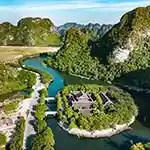
The Quay Son River meanders through the valley, originating in China and then traversing the landscapes of Vietnam. This river, along with the rice fields and towering jungle-clad mountains on either side, gives the region a fairy-tale ambiance. Especially during the harvest season, also known as the golden season, when the rice fields turn a golden yellow, the views along the way are breathtaking.
There are two things to do in the valley:
- Take a stroll along the paths to the end of the valley to enjoy the waterfall (about 3-4 kilometers if you start at the beginning of the valley).
- Hike up to the viewpoint, which takes about 1 hour. The trail is not easily accessible, and it’s preferable to do it with a guide who can precisely locate the trailhead.
The valley is beautiful all year round, but if you want to see it during the ‘golden season’ – the harvest season when the rice fields are all a golden yellow – choose late September and early October. The months just before (July and August) also offer stunning landscapes when the rice is still green.

Phong Nam valley. Credit : Mathieu Arnaudet
Nui Thung mountain
Coming from the city of Cao Bang and driving north towards Ban Gioc, you pass through the Ma Phuoc Pass, then take the DT205 road. After 10 km on this road, you’ll find a small road on your left that leads you through a mountain to the stunning hidden valley of Tuyet Tinh Coc.
The Nui Thung Mountain, also known as the Genie’s Eye Mountain (Mắt Thần), is still a lesser-known location, just 30 km from the city of Cao Bang and 70 km from Ban Gioc Falls. It’s not just the mountain that is worth the excursion, but the entire region, with Thang Hen Lake (see below), villages, mountains, and rice fields, all situated in a hidden valley called Tuyet Tinh Coc.
Its nickname makes sense at first glance: a huge hole runs through the mountain just below its summit!
Around the mountain, you’ll find vast plains and lakes. There are 36 emerald lakes connected to Nui Thung Mountain, and the nearest one is called Thang Hen Lake. There’s also a small waterfall called Nam Tra Waterfall. It’s a favorite spot for locals to camp and fish, depending on the water level in the lake in front of Nui Thung.
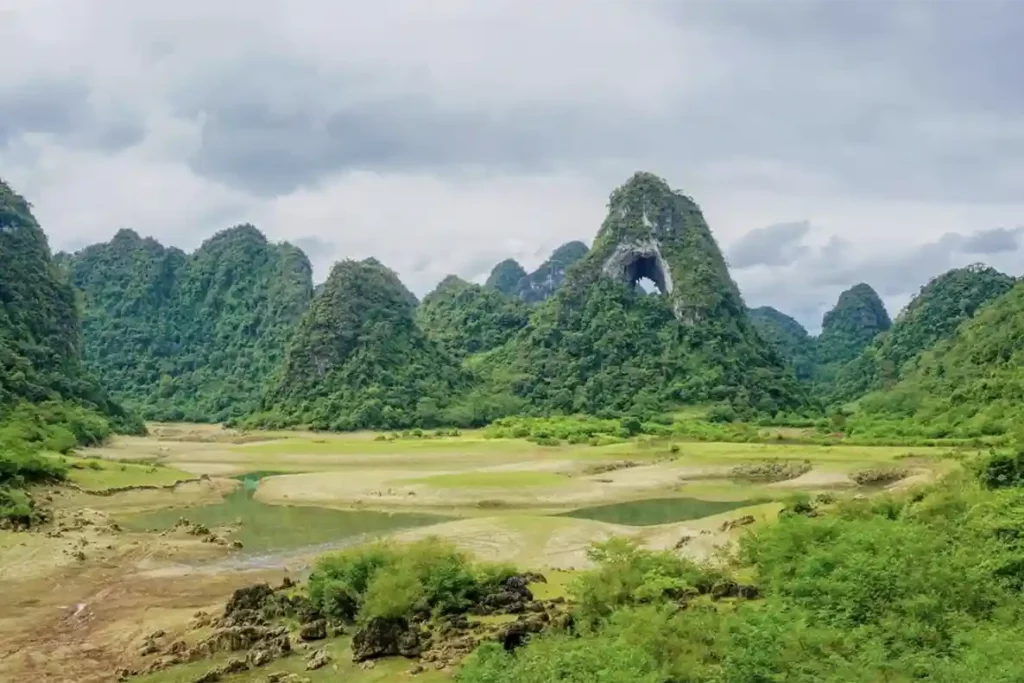
Nui Thung mountain in Cao Bang
Thang Hen lake
Just a 10-minute drive from Nui Thung, you’ll find Thang Hen Lake surrounded by beautiful jungle and mountains. It is part of this system of 36 lakes, each separated by several hundred meters and all located in the same valley. At 2 km long and 500 meters wide, Thang Hen is the largest lake of them all. The mountains and jungle surrounding the lake complete the impressive landscape. Unlike most other lakes in Vietnam that turn brown during the rainy season, Thang Hen Lake remains blue all year round as it is fed by clear and pure water from a cave located above the lake.
Access to the lake costs about 30,000 VND per person. A road runs around part of the lake, on foot or by car, and you can also explore it by boat. A restaurant lets you have lunch on site.
Phia Oac National Park
Phia Oac – Phia Den National Park stretches across the west of the province, around the small mining town of Tinh Tuc. It covers more than 10,500 hectares and rises to nearly 2,000 meters, making it one of the few places in the Northeast where it can snow in some winters.
Preserving a pristine forest ecosystem in the high mountains, the national park is home to nearly 2,000 species of rare animals and plants, many of which are listed in the World Red Book.
As the first recognized national park in the Cao Bang province, it will play a crucial role in preserving and promoting sustainable development of the mountainous forest ecosystem while fostering local socio-economic development, security, and defense.
Phia Oac – Phia Den National Park is located within the Non Nuoc Cao Bang Geopark system, which has been acknowledged as a new member of UNESCO’s Global Geoparks Network
Phuc Sen blacksmithing village
The forge village of Phuc Sen is located in Phuc Sen commune, near Quang Uyen. This place has long been famous throughout the country for its traditional forging tools. It is closely linked to the life of the Nung people and has become a strong cultural feature of this region.
The commune consists of 10 villages with over 400 households and more than 2,000 residents, mainly people of the Nung ethnic group wearing typical indigo clothing. The main road of the commune has been paved, but the stilt house model and the lifestyle of the residents remain virtually unchanged.
The forging activity in Phuc Sen has existed for over 1,000 years, passed down from generation to generation to the present day. Currently, there are about 150 family blacksmiths, spread across 6 hamlets: Phia Chang upstream, Phia Chang downstream, Dau Co, Pac Rang, Tinh Dong, and Lung Vai, forming the famous forge village of Phuc Sen.
What is special here is that the artisans only forge handmade items, mainly based on their long experience. Everything is done manually, from the selection of materials to the steel processing. The blacksmiths not only produce knives but also scissors, hoes, sickles, etc., all of good quality and highly appreciated.
Black Lolo village in Bao Lac
Originally from southern China, the Lolo belong to the Tibeto-Burman family, like the Yi people. After leaving China in the 18th century, many clans settled in Vietnam. Today they are one of the country’s smallest ethnic groups, with fewer than 5,000 people, some of whom live on the highlands overlooking Bao Lac, in the west of Cao Bang province.
You can stay in the village of Khuoi Khon, where the Lolo population lives, and where a recently built guesthouse is run by a Tay woman and her Kinh husband. Accompanied by your local guide, you can first climb to the viewpoint to get a panorama of the region. For those who want to hike further, you can visit the villages and learn more about the ancestral crafts of the Lolo and Hmong people, such as weaving, spinning, and textile dyeing techniques.

Black Lolo woman at work. Credit: Mathieu Arnaudet
Pac Bo historical site
Pac Bo is a historical pilgrimage site for many Vietnamese. After Hồ Chí Minh crossed the border between China and Vietnam in 1941, Pac Bo became a place that will forever be engraved in Vietnamese history. In this relatively small area, you will find the cave of Hồ Chí Minh, better known in Vietnamese as ‘Hang Cốc Bó.’
It was in this cave that the revolutionary leader spent his first weeks back in Vietnam, protecting himself from his enemies and organizing the rebellion. The so-called ‘Lenin Stream’ flows next to this cave, a stream with clear blue water.
As a pilgrimage site, it is also a place that people from the province cherish for picnics and spending quality time with family.
The ticket price to enter the cave is 20,000 VND per person.
If you want to know how to combine these destinations, check out our article on the Cao Bang loop, ideally done with an English-speaking guide.
What practical information should you know about Cao Bang?
How long to stay in Cao Bang depends on what you want to visit, typically four to five days for the essentials.
How long should you stay in Cao Bang?
It will, of course, depend on what you want to visit. If you plan to visit all the sites described above, you will need 4 to 5 days to take your time, especially if you are traveling by motorcycle, for example. The landscapes are stunning, and you will make many stops along the way. If you go on a tour, it will probably be combined with Ha Giang. In that case, there will likely be 3 days in the Cao Bang province.
How do you get to Cao Bang?
There are several options:
By bus from Hanoi: There are several bus companies departing from My Dinh station to Cao Bang. The journey takes between 6 and 8 hours.
By bus from Ha Giang: For those who want to continue their journey after visiting Ha Giang, you can take a bus from Ha Giang city to Cao Bang. You have the option of taking local buses (from the bus station) or tourist buses (from your hotel). It’s a mountainous road, and it will take between 8 and 10 hours to reach your destination!
By private car: This is, of course, the most comfortable option, allowing you to stop wherever and whenever you want. You have two options: either hire the services of a driver and predefine the stops. Or, and this is what we suggest, book a private tour where you will be accompanied by an English-speaking guide. Your guide will enable you to interact with the locals, which is necessary for an authentic and immersive travel experience.
When is the best time to visit Cao Bang?
We recommend Cao Bang from September to late December: the rice fields turn golden in late September and early October, Ban Gioc Falls remain powerful until November and skies are often clear. Summer, from June to August, brings the most spectacular falls and lush green rice fields, but with storms. Spring, from February to April, is cool and full of flowers.
January is cold, especially at altitude: in some winters snow even falls on the peaks of Phia Oac, but it remains rare.
Where should you stay in Cao Bang?
It will depend on the destinations.
Next to Ban Gioc Falls, we can recommend Lan Homestay. It’s a traditional stilt house homestay ideally located between the mountains and a river.
In Cao Bang, we recommend two accommodations:
- Jeanne Hotel: A hotel located in the center of Cao Bang city. Good service and beautiful rooms.
- Max Boutique Hotel: A superb hotel with comfortable beds and nicely decorated rooms.
Finally, in the village of Khuoi Khon, where the Black Lolo ethnic group lives, we can only recommend Khuoi Khon Homestay, which is a beautiful guesthouse with private rooms. It’s new, well-decorated, and has a superb view. Please note that the toilet and shower facilities are shared.
What should you eat in Cao Bang?
Here are some dishes that are typical of the province:
Banh cuon Cao Bang: Banh cuon, or steamed rice rolls, is served in Cao Bang with a bowl of bone-based broth containing Vietnamese pork sausage called cha lua, as well as egg, instead of the small bowl of fish sauce commonly found in other regions of the country. Therefore, the dish is also called “steamed rice rolls in soup” to distinguish it from its counterparts in other regions. Culinary adventurers can also add tuong ot mang chua mac mat, a mixture of bamboo shoots, clausena leaves, and spicy sauce.
Xoi tram, or sticky rice with trám: trám is a kind of black olive that only ripens in autumn. Locals soak the fruits in hot water to soften them, remove the skin and stone, then mix the pulp with sticky rice, which takes on a pinkish-purple color and a rich taste.
Banh ap chao or Fried Duck Cake: This is a popular street food. The crust is a mixture of rice flour, glutinous rice flour, and soybean. Locals use newly harvested rice, soak it in water for half a day to soften it, then grind it into flour. Soybeans and egg yolks are added to the flour to make a paste. The filling is prepared from deboned and marinated duck meat, similar to roasted duck. Then, the cake is fried in a large wok with hot oil and flipped until it is golden on both sides.
People enjoy this cake during cold periods. Locals say that the banh ap chao season is between November and February when the aroma of the cake fills the streets.
Vit quay bay vi, or Seven-Flavor Roast Duck: The seven flavors refer to seven spices and condiments used to marinate the duck: ginger, garlic, dried onion, pepper, honey, tofu, and dried clausena leaves (mac mat in Vietnamese) that grow in the forests of Cao Bang. Then, the duck is roasted to achieve a crispy golden skin on the outside and tender meat on the inside.
Where should you go after Cao Bang?
As we have seen, the Cao Bang region is often visited in combination with Ha Giang. In fact, our 8-day itinerary in Northeast Vietnam will take you to these two fantastic regions and also to Ba Be Lake, a peaceful haven. You will find more ideas among our tours in Northern Vietnam.
FAQ: visiting Cao Bang province
How many days should you spend in Cao Bang?
Allow 3 days for the essentials: Ban Gioc, Nguom Ngao Cave, Phong Nam Valley and Thang Hen Lake. With 4 to 5 days, you can add Pac Bo, Phia Oac National Park and a night with the Lolo people of Bao Lac.
Should you choose Cao Bang or Ha Giang?
Ha Giang impresses with its dizzying passes and stone plateaus, but it is busier. Cao Bang charms with its waterfalls, rice valleys and calm. The two provinces are neighbors, and we often combine them in a single tour.
How do you get from Hanoi to Cao Bang?
By private car, allow 5 to 6 hours via the Thai Nguyen expressway. By bus, it takes 6 to 8 hours from My Dinh bus station, with day and night departures. From Ha Giang, the mountain road takes 8 to 10 hours.
When is the best time to visit Cao Bang?
From September to late December: golden rice fields in late September and early October, still powerful falls and often clear skies. Summer brings the strongest falls but also storms, and January is cold at altitude.
Can you get close to Ban Gioc Falls by boat?
Yes, bamboo rafts take you to the foot of the falls for about 50,000 VND per person. The border with China runs through the middle of the river, so you will see Chinese rafts on the other side.
Should you carry your passport in Cao Bang?
Yes, always keep it with you: the province borders China, and accommodation as well as some road checkpoints will ask for it.