

















Facing shifting administrative rules, knowing exactly which visa to apply for your stay in Vietnam in 2026 is often the first stressful step of your trip preparation.
Our team, based on the ground in Hanoi, breaks down every official procedure for you, from the 45-day exemption to how the e-visa works in detail for longer stays. This practical guide gives you the clarity you need on fees, processing times and the pitfalls to avoid, so you can arrive with total peace of mind and no risk of being turned away at the border.
The essentials for 2026: do you need a visa?
French, Belgian and Swiss nationals do not need a visa for a stay in Vietnam of 45 days or less.
The 45-day visa exemption: the easiest way in for French and European travelers
For most of you, especially French, Belgian or Swiss nationals, the visa question doesn’t even come up. In 2026, the exemption remains the rule for short stays, considerably simplifying your paperwork before departure.
The rule is simple but strict: your stay must not exceed 45 days maximum, counting both your arrival and departure days. The good news is that this counter resets with every new entry into the country, giving you real flexibility.
It’s the perfect format for enjoying a 3-week itinerary in Vietnam without unnecessary paperwork.
The golden rule: your passport’s validity
Here’s the point that still catches out too many travelers: your passport must be valid for at least 6 months after your planned date of entry into Vietnam. This is non-negotiable, whether you’re traveling under the exemption or not.
One day short and you’ll be flatly denied boarding. Check this crucial date well before booking your flights. It’s really the basics of properly preparing your trip to Vietnam and avoiding disaster at the airport.
Also make sure your passport still has at least two blank pages for stamps.
When the exemption isn’t enough: switching to the e-visa
If your urge to explore goes beyond 45 days, the exemption no longer applies. At that point you have no choice: you’ll need to apply for an official electronic visa (e-visa). Don’t try to work around this rule — checks are systematic.
This option is for those planning a two-month journey, fans of slow travel, or anyone who wants to settle in without having to leave the country just to renew their exemption.
The entire process is now done online before departure; it has become the standard for long stays.
How do you get an e-visa to extend your stay in Vietnam?
The Vietnamese e-visa allows a 90-day stay, applied for online, for trips longer than the exemption period.
If the 45-day exemption isn’t enough to satisfy your curiosity, the e-visa is the ideal solution to extend your experience. It’s now the most reliable method, and we’ll walk you through exactly how it works.
What is the e-visa and who can apply for it?
The e-visa is an official visa obtained through a fully digital process on the Vietnamese immigration portal. This electronic document allows you to stay in the country for up to 90 days, giving you real freedom.
The good news is that eligibility is very broad. It now includes every country in the European Union, as well as the United States, Canada and Australia.
Since the post-pandemic reopening, this format has replaced most of the old, classic consular procedures.
The online application process, step by step
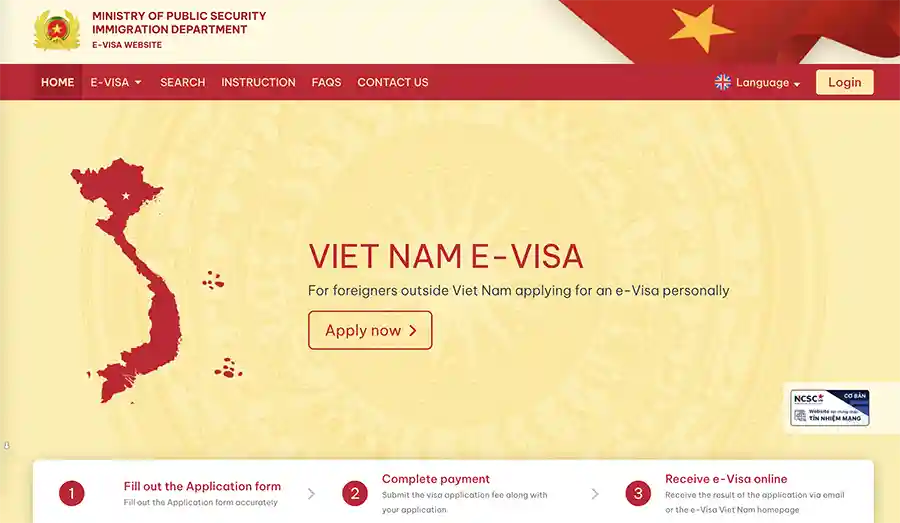
Be careful: the only valid address is the official website of the Vietnamese Immigration Department. Avoid third-party platforms that only add unnecessary fees to your bill.
The steps are simple: fill in the online form, upload your documents, pay the administrative fee, and simply wait to receive your visa by email.
Before you start, make sure you have the following on hand so nothing holds up your Vietnam visa application:
- A digital ID photo (.jpg format, white background, no glasses).
- A clear photo or scan of your passport’s identity page.
- An international bank card to make the secure payment.
Costs, processing times and validity: the numbers to know
For the fees in effect in 2026, expect 25 USD for a single-entry e-visa and 50 USD for a multiple-entry e-visa, both valid for 90 days. Note that this online payment is non-refundable.
The official processing time is generally between 3 and 5 business days. To be safe, we strongly recommend starting the process at least 2 weeks before departure.
With a validity of 90 days, the “single-entry” option becomes void if you leave Vietnam, while the “multiple-entry” option lets you exit and re-enter freely during that period.
Exemption or e-visa: how do you choose for your trip to Vietnam?
The choice between exemption and e-visa mostly depends on your planned length of stay: beyond 45 days, the e-visa becomes necessary.
For a clearer picture, nothing beats a direct comparison. We’ve summarized the key differences between the exemption and the e-visa so you can pick the option that fits your trip perfectly.
How to read this table: the deciding factors
Your Vietnam visa choice depends essentially on two factors we always look at: your total length of stay and whether you’ll need to leave and re-enter Vietnam during your trip.
If you’re staying less than 45 days without leaving the country, the exemption is for you. Otherwise, the table below shows why the e-visa is necessary.
Comparison table of entry requirements for Vietnam in 2026
Here’s a simple tool to visualize your options and avoid a needless denied boarding.
| Criteria | Visa exemption | E-visa |
|---|---|---|
| Maximum length of stay | 45 days | 90 days |
| Cost | Free | 25 USD (single entry) / 50 USD (multiple entry) |
| Procedure | None (passport checked on arrival) | Mandatory online application before departure |
| Multiple entries possible | No (single entry only) | Yes (with the 50 USD option) |
| Best for… | Short stays, classic tours | Long stays, flexible trips, “visa runs” |
| Documents on arrival | Valid passport + proof of onward travel | Passport + printed e-visa + proof of onward travel |
Do you still need to apply for a classic visa through the embassy?
Applying for a classic visa through the embassy has today been largely replaced by the faster, simpler e-visa.
You might assume that going through the embassy is still the standard way to secure your entry. Think again. This traditional method has today been largely replaced by digital processing, and we’ll explain why insisting on this route is often a strategic mistake that wastes your time.
In which cases is this route still relevant?
Let’s be direct: this route has become marginal for a Vietnam visa. It now only applies to non-tourist visas, such as work or study permits, along with the handful of nationalities still excluded from the electronic system.
If you’re eligible for the e-visa, as French nationals are, there’s no good reason to go this route. Why make things complicated when you can keep them simple?
The procedure through a Vietnamese representation
The process starts by contacting the Vietnamese embassy or consulate in your country of residence. They will give you the exact list of required documents, which sometimes varies from one office to another.
You’ll need to fill in a complex form, provide photos, and send in your original passport. This ties up your most precious document for an undetermined period, and an official invitation letter is also frequently requested to complete the file.
Depending on the consulate’s rules, the file is submitted either in person at the counter or by secure mail.
Why we rarely recommend this option
The verdict is clear: it’s a longer, more expensive and more complex option. The total cost often exceeds 60 euros with additional fees, whereas the official e-visa only costs you 25 dollars.
On top of that, having to part with your passport for several days or weeks is an unnecessary risk. It’s a source of logistical stress we prefer to spare our travelers.
For pure tourism, the e-visa remains the go-to route, without hesitation.
How do you handle unexpected visa issues before a trip to Vietnam?
A simple typo on an e-visa, such as a misspelled name, can be enough to prevent boarding.
Preparing your trip also means anticipating the small hiccups. As a local agency, we know the details that change everything. Updated as of December 2, 2025, here are our on-the-ground tips for handling situations that fall outside the ordinary.
Mistake on your e-visa: what to do before departure
A simple typo on your Vietnam visa — a misspelled name or a transposed number — is enough to get you denied boarding. Careful proofreading is your best insurance.
Keep in mind that once the e-visa has been issued by immigration, it is impossible to amend. It’s a rigid system; don’t waste your energy looking for a miracle fix that doesn’t exist.
Faced with this administrative wall, there’s only one practical way out to save your departure.
- The only reliable solution is to submit a brand-new, complete e-visa application.
- Unfortunately, you’ll have to pay the 25 or 50 USD fee again.
- Never take the risk of traveling with an e-visa that contains an error, even a minor one.
The famous “visa runs”: making the most of your stay
A “visa run” means physically leaving Vietnam for a neighboring country, such as Laos or Cambodia, to “reset” your right to stay. Contrary to rumor, this is a common and entirely legal practice.
In practice, you can use up your 45-day exemption, leave the country, then come straight back in with a 90-day e-visa obtained beforehand.
This trick lets you smartly combine the advantages of both systems to extend very long stays.
Proof of onward travel: a requirement not to overlook
Be aware that airlines and immigration officers may ask for proof that you will leave Vietnamese territory within the allowed time. This is a spot check, but a tricky one.
This usually means a return flight ticket or a ticket to a third country. For a land entry, a confirmed bus or train ticket to Cambodia or Laos is often requested to validate entry.
We recommend always carrying this document with you, even if the check isn’t systematic, to avoid unnecessary stress at the border.
What are the authorized entry and exit points with the e-visa?
All of Vietnam’s international airports now accept the e-visa, making it the smoothest way to enter the country.
For most of you, the trip begins on the tarmac. We can confirm that absolutely all of Vietnam’s international airports now accept the electronic Vietnam visa. It’s by far the smoothest entry method, and the one we recommend to avoid any unnecessary stress on arrival.
You’ll most likely land at one of the major hubs, Hanoi (HAN) or Ho Chi Minh City (SGN). If your itinerary is aimed directly at the center or the beaches, note that Da Nang (DAD), as well as Phu Quoc (PQC) and Cam Ranh (CXR) airports, are fully equipped to process your entry.
Entering by land: the border checkpoints to know
If you’re planning a combined trip across Southeast Asia, note that the e-visa is also valid at many land border checkpoints. That’s great news for anyone who wants to cross borders overland without having to go through an embassy again.
Among the crossings most used by our travelers, we often mention Moc Bai (the classic route from Cambodia to Ho Chi Minh City). For those arriving from Laos toward the center or the north, the Nam Phao/Cau Treo or Na Meo checkpoints are reliable options.
To plan your overland route, check out our dedicated page on Vietnam by land: the border checkpoints for a more complete list of border crossings.
Arriving by sea: the eligible seaports
While this is less common for the individual tours we typically organize, the e-visa is also accepted at several seaports. This is useful to know if your trip includes an international cruise leg before joining us on dry land.
Port authorities validate this electronic visa at the main ports, including Ho Chi Minh City, Da Nang, Hai Phong and Nha Trang. Just make sure your disembarkation point matches the one stated on your document.
What is the Digital Arrival Card and do you need to fill it out?
Since April 2026, the Digital Arrival Card has been mandatory for foreigners arriving in Hanoi, Ho Chi Minh City, Da Nang or Phu Quoc.
This new document is not a visa: it’s an online arrival declaration, to be completed within 72 hours before your flight, on the official portal prearrival.immigration.gov.vn. It comes on top of your visa exemption or e-visa — it does not replace either one.
One point where we often see our travelers make a mistake: in the field for your entry status, French nationals (along with the other beneficiaries of the historic 45-day exemption: Germany, Spain, Italy, the United Kingdom, Japan, South Korea, etc.) should select “unilateral exemption,” not “bilateral exemption” — the latter category applies to countries that have a visa reciprocity agreement with Vietnam, such as ASEAN members. For Belgian and Swiss nationals, whose 45-day exemption comes from a more recent regulation, we recommend checking directly on the portal which box matches your situation, as the exact wording is not yet clearly documented at this time.
Once the form is completed, you receive a QR code to show to immigration officers on arrival. We recommend keeping both a digital and a printed copy, in case of connectivity issues at the airport.
Since April 15, 2026, this declaration has been mandatory at Tan Son Nhat airport (Ho Chi Minh City). It has since been extended to Phu Quoc, Noi Bai (Hanoi), Cam Ranh and Da Nang, as well as some land border checkpoints. The system is expected to keep expanding, so we recommend checking for the latest information before you depart.
What happens if you overstay your visa in Vietnam?
Overstaying your visa in Vietnam, even by a single day, can lead to a fine, being blocked from departing, or a blacklist entry.
You might be tempted to stretch the fun a little longer, but where immigration rules are concerned, that’s a very bad idea. Overstaying, even by a single day, can lead to unpleasant consequences that we strongly advise you to avoid.
The consequences of an illegal stay
Overstaying your Vietnam visa is a serious violation of local law. Don’t see it as a minor administrative formality. It’s a direct breach of the immigration rules in force.
Penalties are generally applied at the crucial moment of leaving the country. Immigration officers at the airport or border checkpoint will block your departure until the matter is resolved.
The bill can quickly add up depending on how late you are. Here’s what you’re actually risking:
- A cumulative daily fine that climbs quickly over time.
- Being placed on a blacklist, jeopardizing your future trips here.
- A detention procedure followed by deportation in serious cases.
How to fix your situation: the extension process
Let’s be honest, getting a visa extension on the spot has become a real ordeal. Don’t count on this uncertain option. You would have to go in person to the immigration offices in Hanoi, Da Nang or HCMC.
Be aware that these extensions rarely benefit holders of classic tourist visas. They’re generally reserved for business visas or specific family reunification cases, which makes it a difficult path.
The most reliable method is to do a “visa run” to a neighboring country. Leave before your visa expires, then come back with a fresh exemption.
Our expert tip: always plan ahead to avoid trouble
Our on-the-ground experience leads us to give you this simple but vital piece of advice. Be sure to note the expiry date of your exemption or visa in your phone. Set an alarm a week before the deadline so you’re never caught off guard.
Peace of mind is the key to a successful trip to Vietnam. Avoid this unnecessary stress.
What visa rules apply to specific nationalities in Vietnam?
French-speaking travelers from outside the European Union, such as those from Morocco or Tunisia, must apply for an e-visa.
French-speaking travelers outside the European Union (Morocco, Algeria, Tunisia…)
We often reassure travelers who are worried about this exact point. The good news is that most countries, including Maghreb countries such as Morocco, Algeria and Tunisia, are now eligible for the 90-day e-visa.
Do be careful, though, not to make a mistake on your Vietnam visa file. These travelers do not, however, benefit from the 45-day visa exemption. The e-visa is therefore mandatory.
Rest assured, the e-visa application process is exactly the same as for other nationalities.
Traveling with children: documents required for family trips
Forget the old family passports, which are no longer accepted. Today, every traveler, including babies and children, must have their own valid passport.
If an e-visa is required, a separate application must be made for each child. The file requires their own photo. You’ll also need to scan their own passport. Don’t try to bundle them together in your application.
If only one parent is traveling, a signed exit authorization from the other parent is strongly recommended.
Registering with the local police: a simple requirement
Vietnamese law requires every foreign visitor to register with the local police in the neighborhood where they spend the night. This is a mandatory administrative formality to help ensure the safety of all travelers.
Rest assured right away: in 99% of cases, it’s the hotel, guesthouse or Airbnb host who takes care of it by holding on to your passport for a few minutes.
We hope this guide has clarified the paperwork for your upcoming trip. Whether it’s the exemption or the e-visa, planning ahead is the key to a stress-free departure. Free of these constraints, you can now focus on what matters most: dreaming up the itinerary we’ll be delighted to help you design.
FAQ
Do I need a visa for a trip to Vietnam in 2026?
It depends on your length of stay and your nationality. If you’re a French, Belgian or Swiss national, we have great news: you benefit from a visa exemption for any stay under 45 days. For a longer trip, or if you want to stay up to 90 days, getting an e-visa will be mandatory before you depart.
How do I get a visa for Vietnam?
The process has been greatly simplified and is now entirely online. To get your e-visa, go to the official Vietnamese immigration portal, fill in the form, upload an ID photo and your passport page, then pay the fee. Once approved, we recommend printing your e-visa to present on arrival.
What is the official price of a Vietnamese visa?
The official e-visa fees currently in effect are 25 USD for a single entry and 50 USD for a multiple-entry visa. These fees are paid directly online when you apply. Be careful: if a website asks for a higher amount, it’s likely a private intermediary rather than the official government site.
How long does it take to get an e-visa?
The standard processing time announced by immigration is 3 to 5 business days. That said, from experience, we strongly recommend not waiting until the last minute. Apply at least two weeks before your flight to allow for any delay or data entry error that might need correcting.
Which website should I use to apply for my visa?
This is an essential question to avoid extra costs. The only address to use is the official website of the Vietnamese Immigration Department. Many commercial websites mimic the official look to charge extra service fees; we recommend carefully checking the URL before making any payment.
Do I need a return ticket to enter Vietnam?
Yes, it’s an entry requirement. Immigration authorities, and more often airlines at boarding, may ask for proof that you will leave the country (a return flight ticket or a ticket onward to a third country) dated before your exemption or visa expires.
What is the Digital Arrival Card and is it mandatory?
The Digital Arrival Card is an online arrival declaration, separate from your visa, that has been mandatory since April 2026 for foreigners arriving in Hanoi, Ho Chi Minh City, Da Nang or Phu Quoc. It must be completed within 72 hours before your flight on the official portal prearrival.immigration.gov.vn, and it comes on top of your visa exemption or e-visa rather than replacing it.