








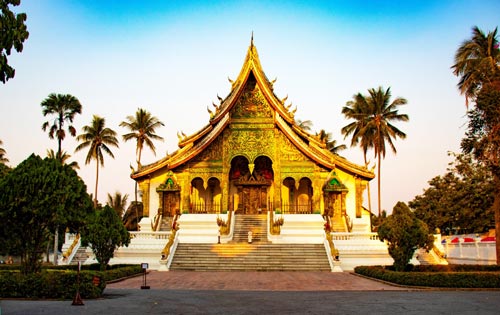

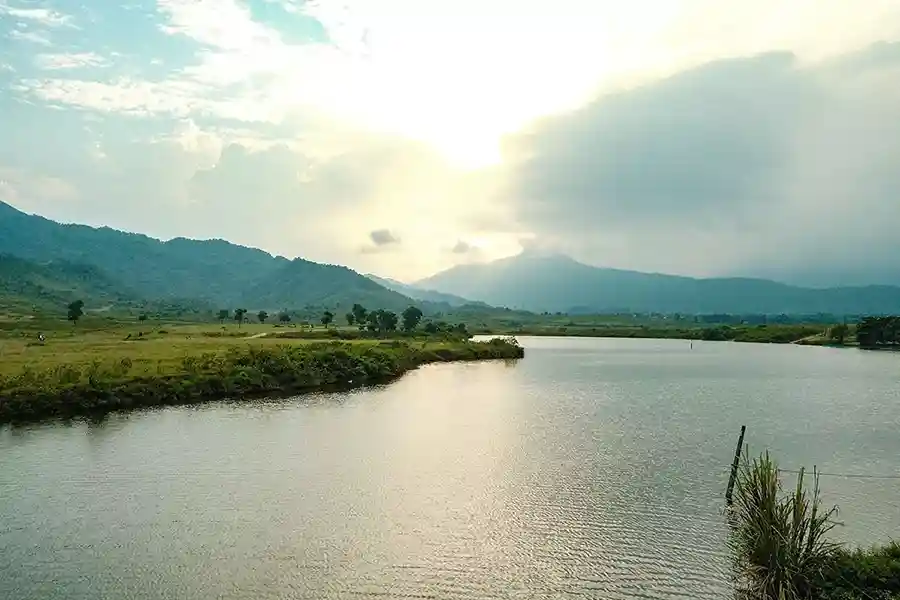
Ba Vi National Park is a beautiful destination to visit if you live in Hanoi or want to explore the surroundings of the Vietnamese capital.
Thanks to its rainforest, its three magnificent mountain peaks, and its pleasant climate year-round, the Ba Vi mountains attract many local Vietnamese families and students for picnics/weekends—especially in the hot summer.
You can visit Ba Vi either as a day trip or as a 2-day program including an overnight stay on site.
Located about 60 km west of Hanoi, around 1 hour 30 minutes by road, the park is perfect for a getaway. In this article, we tell you what to see there.
What is there to see in Ba Vi National Park?
Ba Vi National Park offers French-era ruins, temples on its peaks, waterfalls, a cactus garden and a pine forest, all within easy reach of Hanoi.
| Site | Why go | Our tip |
|---|---|---|
| French ruins (church, prison, villas) | Remains of the early 20th-century hill station | Go in the morning, before the mist |
| Vua Peak (1,296 m) | Highest point, temple dedicated to Uncle Ho | Wear good shoes: many steps |
| Tan Vien Peak (1,227 m) | Temple of the mountain spirit Son Tinh | Clear views in fine weather |
| Waterfalls (Thien Son, Suoi Nga, Ao Vua) | Swimming and cool air | Best in summer, ideally on weekdays |
| Cactus garden | Greenhouse with hundreds of species | About 1 km from the entrance |
| Pine forest | Picnic with a lake view | Lunch available on site |
| Ngoc Hoa cave | Small shrine dedicated to the princess | 3.5 km from the cactus garden |
Why explore the French-era ruins in Ba Vi?
Ba Vi National Park lets visitors discover Vietnam’s colonial history through ruins scattered across the mountainside.
Besides its natural beauty, Ba Vi lets you discover Vietnam’s colonial history. As you walk through the park, you’ll see many ruins of buildings (prisons, villas, church) built by the French in the early 20th century. Back then, the French turned the Ba Vi mountains into a “climatic station,” similar to Sapa or Da Lat. During summer, high-ranking French officers would rest in the mountains to escape the lowland heat. Today, these ruins are overtaken by lush vegetation, giving a mystical ambiance. Among the most beautiful ruins: the church, and also the prison where some political prisoners were held during their fight against the French.
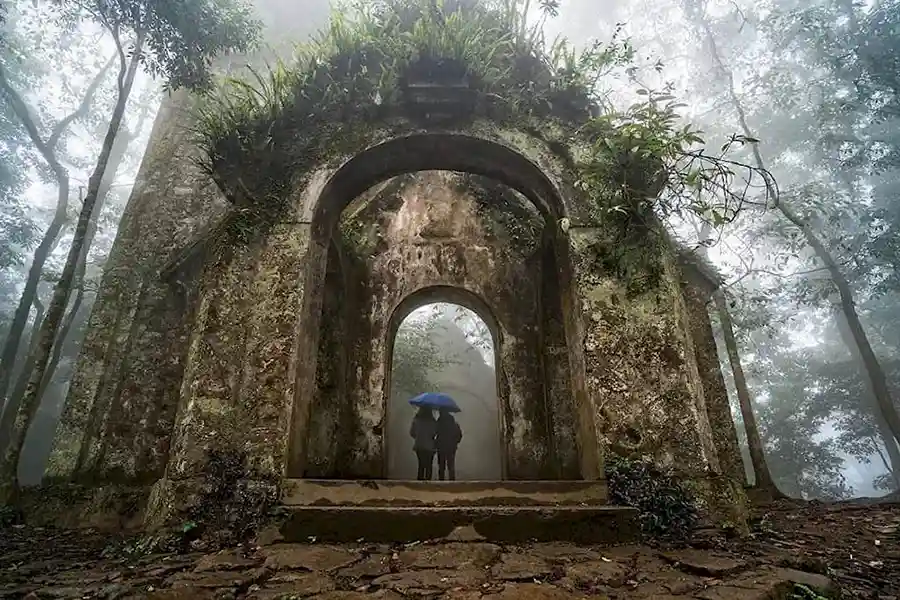
Ruins of the church in Ba Vi, Vietnam
Why conquer the Ba Vi peaks?
Hiking to the peaks of the Ba Vi mountain range is a true delight for nature lovers and hiking enthusiasts.
Hiking to the peaks of the Ba Vi mountain range is a delight for nature lovers and hikers. You’ll walk through tropical forests, breathe fresh air, and catch magnificent views of the Red River Delta and Da River winding along the mountain range. To be honest: most of the time, Ba Vi is covered in clouds, but when the sky is clear, the scenery is spectacular. Note: to reach the summit, you need to climb many steps, which requires considerable effort.
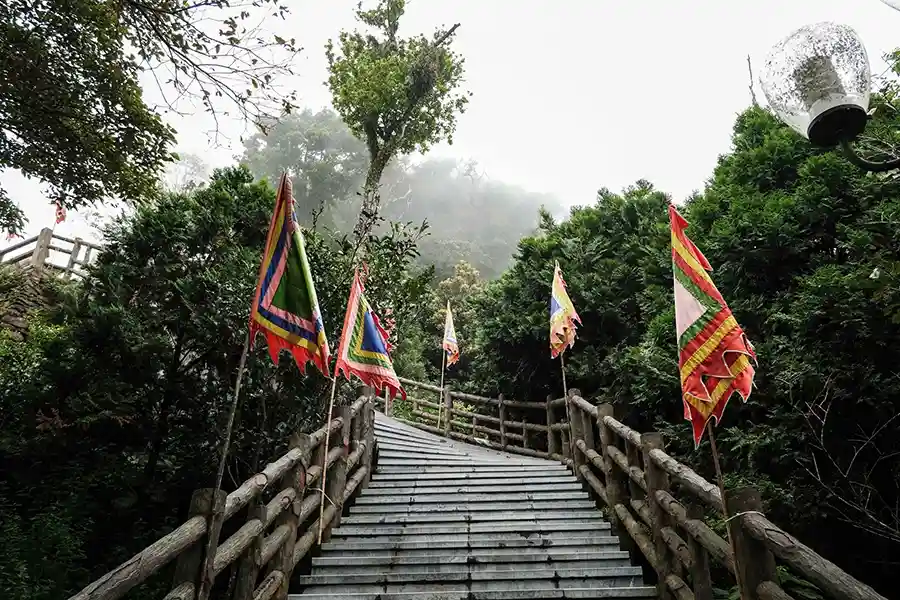
Steps leading to the mountain peaks, Ba Vi. Photo credit: Mathieu Arnaudet
Why visit the Uncle Ho temple in Ba Vi?
Ho Chi Minh, deeply revered in Vietnam as the father of the modern nation, has several worship sites, including one in Ba Vi.
As you may know, Ho Chi Minh is highly revered in Vietnam as the father of the modern nation. There are many places of worship dedicated to him across the country, and in Ba Vi a temple was built in 1999 on the summit of Vua Peak (1,296 m), the highest point in the park. Although his body is preserved in the Mausoleum in Hanoi, the government wanted to fulfill in its own way the publicized will of “Uncle Ho” by building a simple temple dedicated to him. This temple attracts many local Vietnamese each year as a sacred site to visit within Ba Vi National Park.
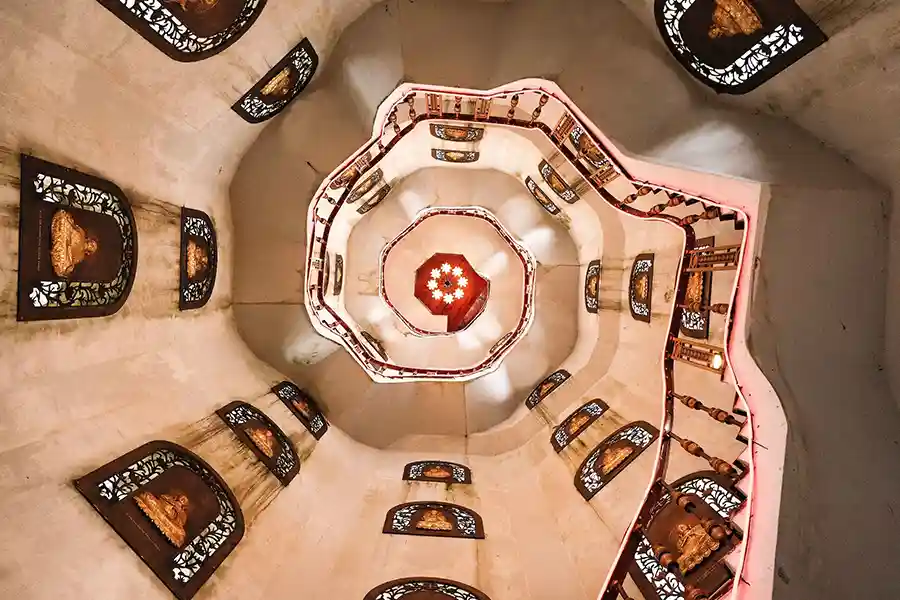
Interior of the stupa at the Bac Ho temple, Ba Vi. Photo credit: Mathieu Arnaudet
Why visit Tan Vien Temple in Ba Vi?
A visit to the Ba Vi mountains also offers a chance to discover the ancient Vietnamese culture of the Hung dynasty.
A visit to the Ba Vi mountains is also an opportunity to discover ancient Vietnamese culture of the Hung Kings—the first dynasty of Vietnam according to tradition, whose capital lay near present-day Viet Tri, in Phu Tho province. The Tan Vien mountain is considered the place of the mythical contest between two suitors for marriage with the daughter of King Hung.
The winner, Son Tinh (or Tan Vien), who had the power to raise mountains, is considered one of the four immortal saints in Vietnamese mythology.
If you climb to the Tan Vien peak, you’ll have the chance to visit the mountain saint’s temple built on a cliff face to worship Saint Tan Vien. At 1,227 metres, it is the park’s second-highest peak, after Vua Peak.
Which waterfalls can you enjoy in Ba Vi?
After hiking to the peaks, several waterfalls offer a refreshing break, including Thien Son, Suoi Nga, and Ao Vua.
After hiking up to the peaks, it’s pleasant to “cool off” at a waterfall. There are several: Thien Son, Suoi Nga, Ao Vua, Thac Da… Many of them lie below the Ba Vi mountains, even before entering the national park proper.
Why visit the cactus garden in Ba Vi?
The Cactus Garden, housed in a large glass structure, is often the first stop visitors see when entering the park.
The first place you’ll likely see when entering the park is the Cactus Garden (situated in a large greenhouse on a hill, about 1 km from the park entrance). Allow about 10,000 VND per person and stroll to the glass house containing hundreds of different cactus species. A surprising experience!
Why picnic in the pine forest of Ba Vi?
At just 400 meters elevation, surrounded by a pine forest, Ba Vi Resort offers an ideal picnic spot overlooking the lake.
At only 400 m elevation and surrounded by a pine forest sits the Ba Vi Resort. It’s an ideal spot for a picnic with a beautiful view over the lake and surrounding plains. You can order lunch or book an overnight here. You can also walk through this forest and visit the old French military zone.
Why walk to the Ngoc Hoa cave in Ba Vi?
Hidden beneath the mountain, Ngoc Hoa Cave houses a small shrine honoring the princess of the same name, according to legend.
Under the mountain lies a hidden cave where the local population has installed a small shrine to honor Princess Ngoc Hoa. According to legend, Ngoc Hoa was a daughter of King Hung and married Son Tinh (the mountain saint whose temple is on Mount Tan Vien). About 3.5 km from the cactus garden, after a few turns, you’ll see the sign for Ngoc Hoa cave on your right; descend for a while, and you’ll reach the cave and the Ngoc Hoa temple.
What is the best time to visit Ba Vi National Park?
Ba Vi can be visited all year round, but late October and November, the wild sunflower season, offer the most beautiful scenery.
You can visit Ba Vi National Park at any time of year whenever you want to escape city noise and enjoy natural scenery and a peaceful atmosphere. From April to October the vegetation is lush and the days are warm, but storms are frequent, so bring rain gear. Our favourite time is late October and November, when wild sunflowers bloom along the park’s roads. From November to March, the climate is colder (especially at altitude) and the Ba Vi mountains are often cloaked in thick fog. A mystical atmosphere emerges from the surroundings.
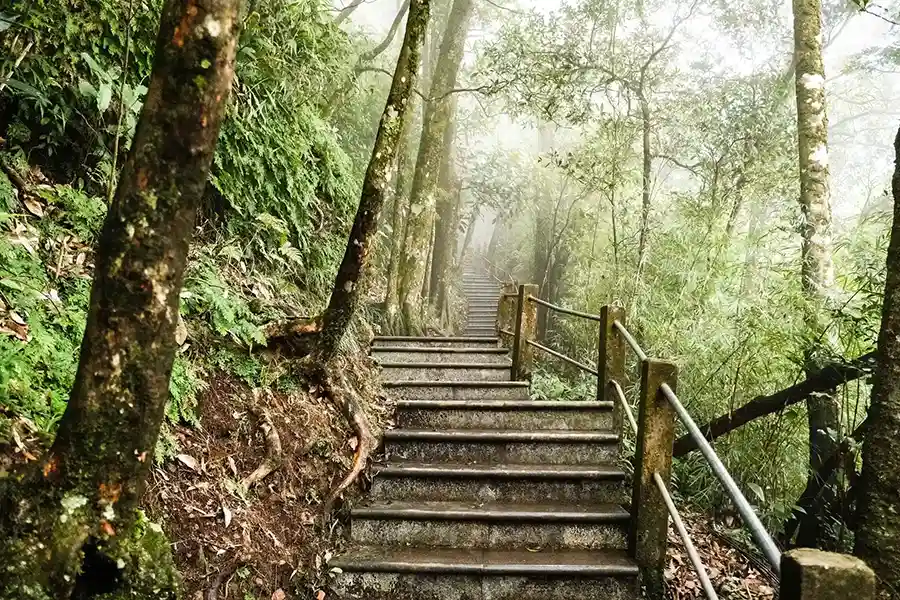
Rays of light in the Ba Vi forest. Photo credit: Mathieu Arnaudet
Ba Vi is not the only getaway around the capital: discover our best excursions from Hanoi.
FAQ: visiting Ba Vi National Park
How far is Ba Vi National Park from Hanoi?
About 60 km west of central Hanoi, roughly 1 hour 30 minutes by road.
How long do you need to visit Ba Vi?
One day is enough for the highlights. Two days, with a night on site, let you hike at a relaxed pace and enjoy the cool evening.
What is the highest point in Ba Vi National Park?
Vua Peak, at 1,296 metres, home to the temple dedicated to Uncle Ho. Tan Vien Peak, at 1,227 metres, has the temple of the mountain spirit.
When should you visit Ba Vi National Park?
All year round. Late October and November, the wild sunflower season, are our favourite months. From November to March it is cooler and often misty.
What is there to see in Ba Vi?
French-era ruins, the temples of Uncle Ho and Tan Vien, waterfalls, the cactus garden and the pine forest.
Is the climb to the peaks difficult?
You have to climb many steps: it takes real effort but is accessible to a reasonably fit walker. Bring good shoes and water.