











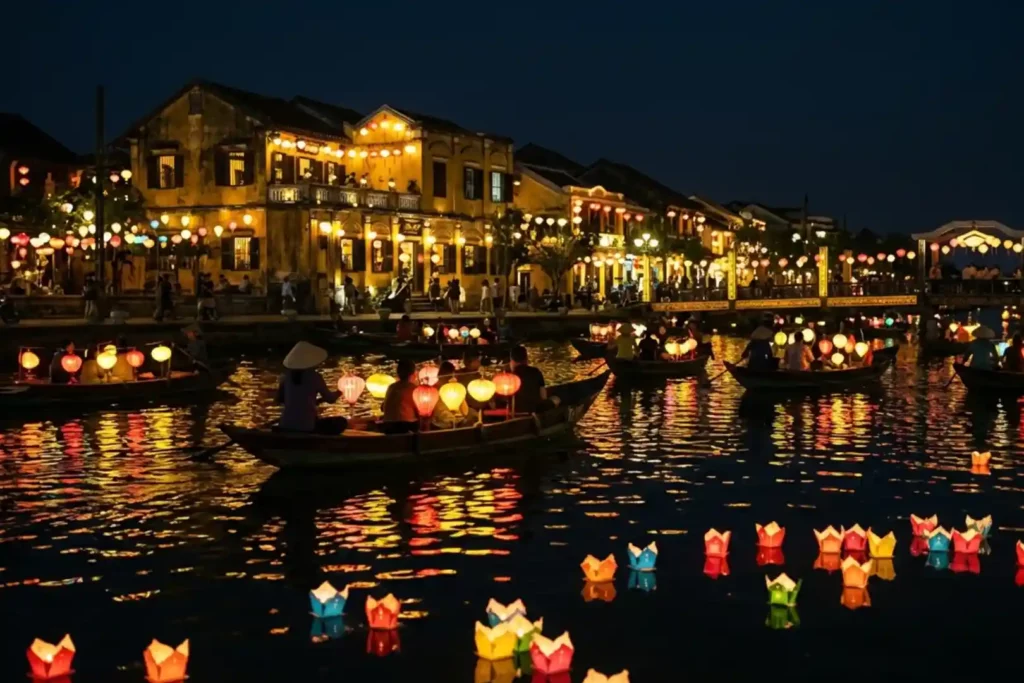
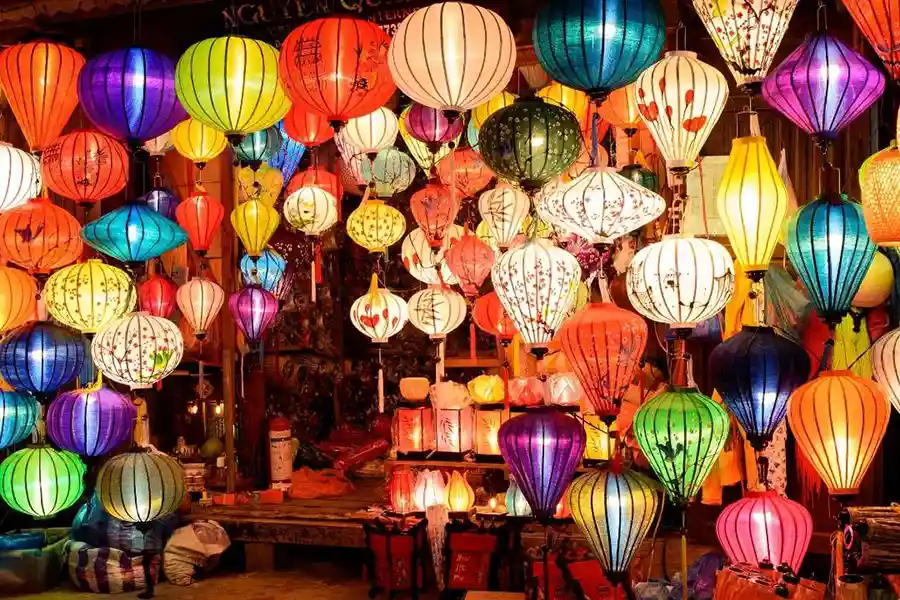
Once a month, Hoi An’s old town switches off its streetlights and many of its shop signs, leaving only the glow of silk lanterns. On that evening, the night before the full moon, the streets are closed to motorbikes, traditional songs drift along the Hoai River and hundreds of small paper lanterns float on the water.
Here are the dates for 2026 and 2027, how the evening actually unfolds, what it costs and our tips for enjoying it without fighting the crowds.
What is the Hoi An Lantern Festival?
The Hoi An Lantern Festival is a monthly evening when the old town turns off its electric lighting and lives by the soft glow of lanterns alone.
Locally it is called Đêm Rằm Phố Cổ, the “full moon night of the old town”. It began in 1998, a year before Hoi An was listed as a UNESCO World Heritage Site, to revive the atmosphere of the old trading port. It takes place on the 14th day of every lunar month, the eve of the full moon, when many families visit the pagoda and place offerings on their ancestral altar.
It is not a festival with a big stage and a timed programme, but rather a mood. Street lighting goes off, shopkeepers light their lanterns, some residents set up a small altar outside their door and burn incense. On the riverside square, performers lead games of bài chòi, a sung card game unique to Central Vietnam and listed by UNESCO as Intangible Cultural Heritage in 2017.
Two larger celebrations follow the same idea: the Lantern Festival of the first lunar month (Tết Nguyên Tiêu), about two weeks after Tet, and the Mid-Autumn Festival (Tết Trung Thu) in the eighth lunar month, a favourite with children. Since Vietnam’s 2025 administrative reform, Hoi An belongs to Da Nang city rather than Quảng Nam province, but the festival itself has not changed.
When is the Hoi An Lantern Festival in 2026 and 2027?
The festival falls on the 14th day of every lunar month, the eve of the full moon, so its date in the Western calendar changes every month.
We worked out the dates below from the Vietnamese lunar calendar. An evening may occasionally be cancelled, during floods or national mourning, so ask for confirmation locally.
| Month | Festival night | Good to know |
|---|---|---|
| November 2026 | Sunday 22 November | Rainy season, risk of flooding |
| December 2026 | Tuesday 22 December | After the International Lantern Festival (3 to 6 December) |
| January 2027 | Thursday 21 January | Cool evenings, rainy season over |
| February 2027 | Friday 19 February | Eve of Tết Nguyên Tiêu, two weeks after Tet: very busy |
| March 2027 | Sunday 21 March | Excellent season |
| April 2027 | Tuesday 20 April | Excellent season |
| May 2027 | Wednesday 19 May | Hot days, pleasant evenings |
| June 2027 | Friday 18 June | Start of Vietnamese school holidays |
| July 2027 | Saturday 17 July | Busy weekend |
| August 2027 | Sunday 15 August | Hot and humid |
| September 2027 | Tuesday 14 September | Eve of the Mid-Autumn Festival |
| October 2027 | Wednesday 13 October | Rainy season |
| November 2027 | Thursday 11 November | Rainy season, risk of flooding |
| December 2027 | Saturday 11 December | Rain easing off |
If your trip does not match any of these dates, don’t worry: the old town is decorated with lanterns every night of the year. The difference lies mainly in the switched-off electric lighting, the riverside performances and a calmer, more contemplative atmosphere.
What happens on a full moon night in the old town?
Motorbikes leave the centre around 5pm, electric lights go off around 6pm and the evening is at its most beautiful between 7pm and 9pm.
Late afternoon
From around 5pm, motorbikes and scooters are gradually banned from the historic centre, which becomes fully pedestrian. This is the best time to arrive: the golden light warms the yellow facades of the merchant houses, the lanes are still quiet and you have time to pick a restaurant or a viewpoint for later.
At nightfall
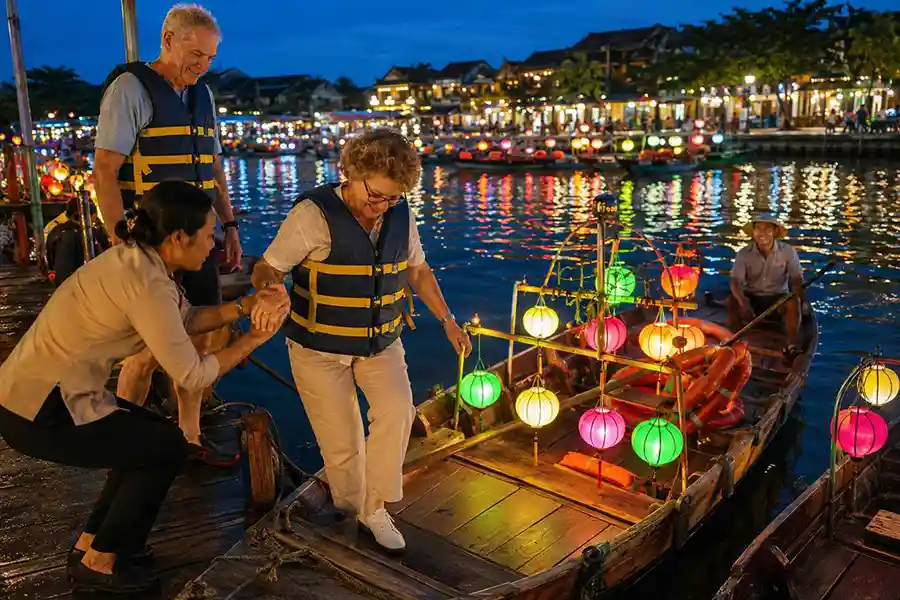
Around 6pm, streetlights and some shop signs are switched off. The full effect is best seen from 7pm. Wooden boats then shuttle up and down the river, carrying travellers who set their paper lantern on the water and make a wish. Bài chòi games and singing start on the riverside square.
After 9pm
The crowds thin out after 9pm and the lights come back on around 10pm. It is a good time to wander through the inner lanes between Nguyễn Thái Học and Trần Phú streets, or to cross over to An Hội islet and its night market. The Vietnamese families who fill the streets early in the evening have gone home.
How much does an evening in Hoi An cost?
Allow about 5 dollars for the old town ticket, 6 to 9 dollars per boat and well under a dollar for a paper lantern set afloat on the river.
Since January 2026, the Hoi An Centre for Cultural Heritage Management and Preservation has offered two tickets, at the same price for Vietnamese and foreign visitors. They cover the old town and a choice of monuments, are valid for your whole stay up to three days and are free for under-16s. The centre asks visitors to buy a ticket before entering the old town, so keep it with you as it may be checked at entry points.
| Expense | Typical price | Good to know |
|---|---|---|
| Old town ticket, 3 monuments | 80,000 VND, about 3 USD | Includes the Japanese Covered Bridge or Quan Công Temple |
| Old town ticket, 5 monuments | 120,000 VND, about 5 USD | Also includes a museum |
| Boat ride on the Hoai River | 150,000 to 220,000 VND per boat, 6 to 9 USD | 15 to 20 minutes, up to 5 people |
| Floating lantern | 10,000 to 30,000 VND, under 1.50 USD | Sold on the riverbank by street vendors |
Boat prices vary with the number of passengers and tend to rise on full moon nights. Use the official piers on Bạch Đằng street, where prices are displayed, and agree on the price and duration before you step aboard.
Where should you stand to see the lanterns without the crowds?
The finest views are from the An Hội footbridge and the Cẩm Nam riverbank, which is far quieter than the busy quays along Bạch Đằng street.
- The An Hội footbridge: a view down onto the river and its lit-up boats, but very crowded between 7.30pm and 9pm.
- The An Hội bank, away from the bridge: it is easier to find a low wall to sit on, facing the old town.
- The Cẩm Nam bank, across the bridge of the same name: few visitors come here and the lantern reflections on the water are superb.
- The lanes between Nguyễn Thái Học and Phan Chu Trinh: fewer people, candlelit houses and family altars outside the doors.
- The Japanese Covered Bridge (Chùa Cầu), restored in 2024: best seen early in the evening, before the rush.
Should you plan your trip around the full moon?
It is not essential, but if your dates are flexible, shifting your stay in Hoi An by a day or two to catch the full moon is well worth it.
Whenever the calendar allows, we time the night in Hoi An to match the 14th lunar day, even if it means swapping two stops. It is easy to adjust, for instance, in our 3-day Central Vietnam tour through Hue, Da Nang and Hoi An. Plan at least two nights there: the old town is best explored in the morning, before the heat and the groups, and best enjoyed in the evening.
Note also the launch of an International Lantern Festival, scheduled from 3 to 6 December 2026 to mark the 27th anniversary of the UNESCO listing. The organisers have announced around fifteen large light installations, lantern-making workshops with artisans and a lantern parade through the old town on the evening of 4 December.
What weather should you expect in each season?
Central Vietnam has its own climate, quite different from the North and the South. From September to December it is the rainy and typhoon season: the Hoai River regularly bursts its banks and, during floods, boat rides are suspended and some evenings lose their performances. In late 2025, Hoi An flooded several times within a few weeks. If you are aiming for the November full moon, book accommodation with flexible cancellation and keep a spare evening.
From February to April, evenings are mild and dry, perfect for strolling. From May to August, days are hot and humid but nights remain pleasant by the water.
What are our tips for a successful evening?
- Arrive before 5.30pm if you are staying outside the old town, in An Bàng or Cửa Đại: after that, cars are stopped well away from the centre.
- Book dinner for 6pm or after 9pm; in between, riverside restaurants are packed.
- Carry small dong notes: boats, lanterns and snacks are paid in cash.
- Arrange your ride back in advance, with the hotel shuttle, a taxi or a ride-hailing app: late in the evening the wait can be long.
- Be discreet near family altars and pagodas: for many residents, this is first and foremost an evening of prayer.
- You don’t have to buy a floating lantern: candles and paper end up in the river, and the view from the banks is just as lovely.
FAQ: Hoi An Lantern Festival
When is the Hoi An Lantern Festival held?
Every month, on the 14th day of the lunar calendar, the eve of the full moon. Upcoming dates: 22 November and 22 December 2026, then 21 January, 19 February and 21 March 2027.
What time does the lantern festival start?
Motorbikes are banned from the centre around 5pm, electric lights go off around 6pm and the atmosphere is at its best between 7pm and 9pm. The lights come back on around 10pm.
Do you need a ticket for the lantern festival?
There is no specific ticket for the evening, but the heritage centre asks visitors to buy the old town ticket, at 80,000 or 120,000 VND and valid for up to three days, before entering.
How much is a boat ride on the Hoai River?
Expect 150,000 to 220,000 VND per boat, about 6 to 9 USD, for 15 to 20 minutes. Use the official piers on Bạch Đằng street and agree on the price before boarding.
Are the lanterns lit only on full moon nights?
No, the old town is decorated with lanterns every evening. On the full moon night, electric lighting is switched off, the streets are pedestrian and traditional performances take place by the river.
Does the festival go ahead in the rainy season?
Usually yes, but during floods, mainly between October and December, boat rides are suspended and performances may be cancelled. Check with your hotel on the day.