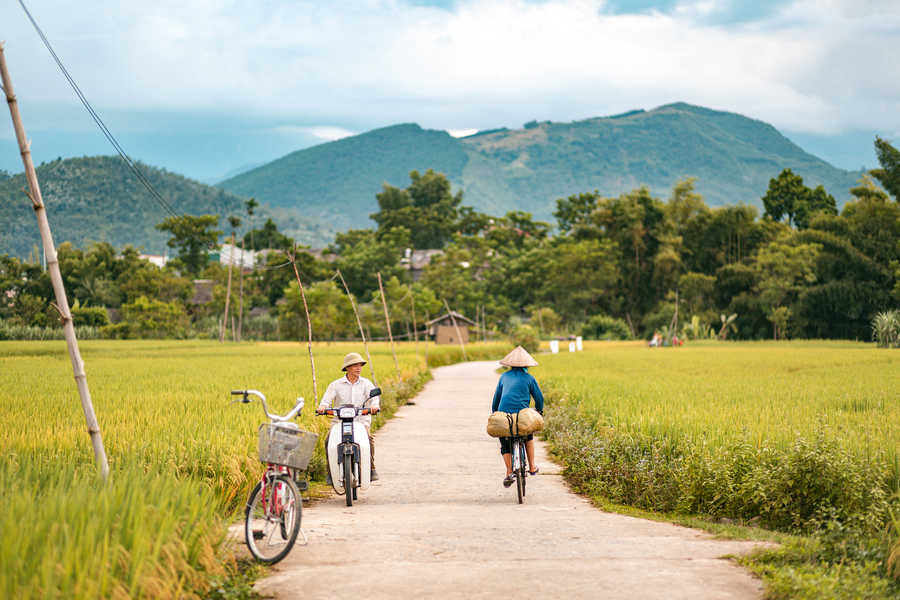












Hanoi is the political, administrative, cultural, and historical capital of Vietnam. In 2010, the city celebrated its millennium, and on this occasion, the authorities built the longest mosaic in the world on the dike wall that protects downtown Hanoi from the floods of the Red River.
It is a fascinating city where ancient and recent history coexist with today’s vibrant energy — a constant flow of motorbikes and countless small shops lining the streets.
Hanoi is still the Asia you’ve always imagined!
So: what should you visit in Hanoi?
To immerse yourself in this city, we suggest in this article to explore the most important cultural and historical sites of the Vietnamese capital.
What are the must-see historical sites in Hanoi?
Hanoi’s must-see historical sites are Tran Quoc Pagoda, the Temple of Literature, the Cathedral, Long Bien Bridge, the Opera House and the Mausoleum.
| Site | Period | Why go |
|---|---|---|
| Tran Quoc Pagoda | 6th century (current site since 1615) | The city’s oldest pagoda, on West Lake |
| One Pillar Pagoda | 1049 (rebuilt in 1955) | A symbol of Hanoi, in the middle of a lotus pond |
| Temple of Literature | 1070 | The country’s first university and the doctors’ steles |
| St. Joseph’s Cathedral | 1886 | Neo-Gothic, in the heart of the old centre |
| Long Bien Bridge | 1902 | First bridge over the Red River, a witness to the bombings |
| Presidential Palace | 1906 | Former Governor-General’s palace and Uncle Ho’s stilt house |
| Hanoi Opera House | 1911 | Inspired by the Palais Garnier |
| Ba Dinh Square and Mausoleum | 1945 and 1975 | Where independence was proclaimed |
What is the history of Hanoi?
Hanoi became the capital in 1010 under the name Thang Long, and went through the Ly, Tran and Le dynasties, French colonisation and the wars of the 20th century.
In 1010, Ly Thai To, founder of the great Ly dynasty, moved the capital from Hoa Lu, in today’s Ninh Binh province, to Dai La, on the banks of the Red River. The country had regained its independence in 938, when Ngo Quyen defeated the Chinese armies on the Bach Dang River, ending more than a thousand years of Chinese domination. The Ly dynasty opened a long period of stability for the kingdom.
Ly Thai To named the new capital Thang Long, meaning “City of the Rising Dragon.” According to legend, when he decided to establish his capital there, he saw a golden dragon spreading its wings over the city. Seeing this as a good omen, he chose to name the city in honor of the dragon.
Illustration: Ly Thai To and the dragon above the city that would become Hanoi
In the 13th century, the Tran dynasty repelled the Mongol invasions three times. After twenty years of Ming occupation (1407–1427), Le Loi won victory in 1428 and founded the Le dynasty, which ruled until the late 18th century. During this period, Hanoi developed a system of guild-based neighbourhoods, and the city also took the name Dong Kinh (“Eastern Capital”), which later gave Europeans the word Tonkin. The city opened up to merchants from Siam, Java and southern China, and Vietnamese handicrafts, such as silk, satin, brocade, lacquerware and porcelain, flourished throughout Asia.
In 1802, the Nguyen dynasty moved the capital to Hue, and Thang Long lost much of its prestige. In 1831, Emperor Minh Mang named it Ha Noi (“the city within the rivers”). The French, who took control of Tonkin in the 1880s, sought until their departure in 1954 to turn it into a Western-style city with elegant architecture and wide boulevards. Hanoi became the capital of French Indochina in 1902.
Capital of the Democratic Republic of Vietnam proclaimed in 1945, then of North Vietnam from 1954, Hanoi became in 1976, after the reunification of the country, the capital of the Socialist Republic of Vietnam.
Throughout the centuries, Hanoi has remained at the heart of Vietnam’s tumultuous history. For this reason, visiting some of its most important and emblematic monuments is a must. Although the city was bombed during the war, notably in December 1972, its historic centre was largely spared: most of its sites are in good condition and are still in use today.
What are the different names Hanoi has had throughout history?
Before becoming Hanoi in 1831, the city was called Dai La, then Thang Long from 1010, with other names over time such as Dong Do or Dong Kinh.
Hanoi has remained an important city through the centuries, but its name has changed several times. Here’s a quick timeline to help you follow its evolution:
Before 866: several Chinese citadels succeeded one another on the site, such as Tong Binh;
866–1009: Dai La (“the Great Enclosure”);
1010–1831: Thang Long, with other names at certain times, such as Dong Do or Dong Kinh;
Since 1831: Ha Noi, a name given by Emperor Minh Mang.
We will now describe several sites that reflect the cultural and historical diversity of Hanoi and Vietnam. This will help you choose the ones that interest you most and plan your personalized itinerary with us.
What are the notable pagodas of Hanoi?
When Ly Thai To came to power in 1010, he elevated Buddhism to the highest level within the state.
When Ly Thai To came to power in 1010, he brought Buddhism to the highest level of the state. Buddhism thus became the official religion of the Empire, reaching its golden age. It was also during this time that the population became deeply imbued with Buddhist beliefs.
We will now introduce you to two of the most important pagodas in Hanoi
Tran Quoc Pagoda (6th Century)
Tran Quoc Pagoda, located on a peninsula of Hanoi’s West Lake, is the oldest in the city: it was founded in the 6th century under Ly Nam De (544–548), founder of the Early Ly dynasty, a brief interlude of independence during the long Chinese domination. It later became an important spiritual centre under the Later Ly dynasty.
Like the city itself, the pagoda has changed names several times: founded as Khai Quoc (“Foundation of the Kingdom”), it received its current name, Tran Quoc (“Defence of the Kingdom”), in the 17th century from Emperor Le Hy Tong.
It was also relocated: originally built near the Red River, it was rebuilt in 1615 on Kim Ngu (Golden Fish) Islet, on the shore of the West Lake.
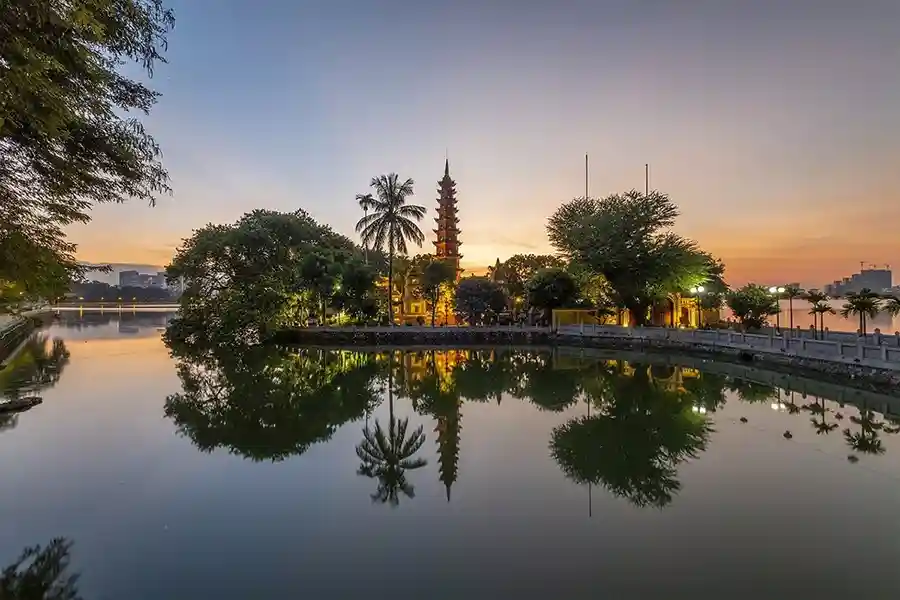
Outside Tran Quoc Pagoda, Hanoi, Vietnam
A major reconstruction took place in 1815, and many renovations have been carried out since then. Despite its importance, the site remains relatively small. The first courtyard houses the stupas of monks who marked the pagoda’s history. Visitors can then explore a small garden at the tip of the peninsula. Inside the main sanctuary, there are four Buddha trinities arranged in tiers, and outside stands a stele dating from 1639 recounting the pagoda’s history. Finally, you can rest beneath the Bodhi tree, a sacred fig tree from India—the cradle of Buddhism—under which the Buddha attained Bodhi (Enlightenment or supreme knowledge).
One Pillar Pagoda (11th Century)
The One Pillar Pagoda (Chua Mot Cot) was built in 1049 by order of Emperor Ly Thai Tong.
Legend says that the Emperor, unable to have a child, dreamed that the Goddess of Mercy, Quan Am, seated on a lotus flower, handed him an heir. Shortly afterward, the Emperor married a young peasant woman who bore him a son! In gratitude for this miraculous event, the Emperor ordered the construction of this unique pagoda.
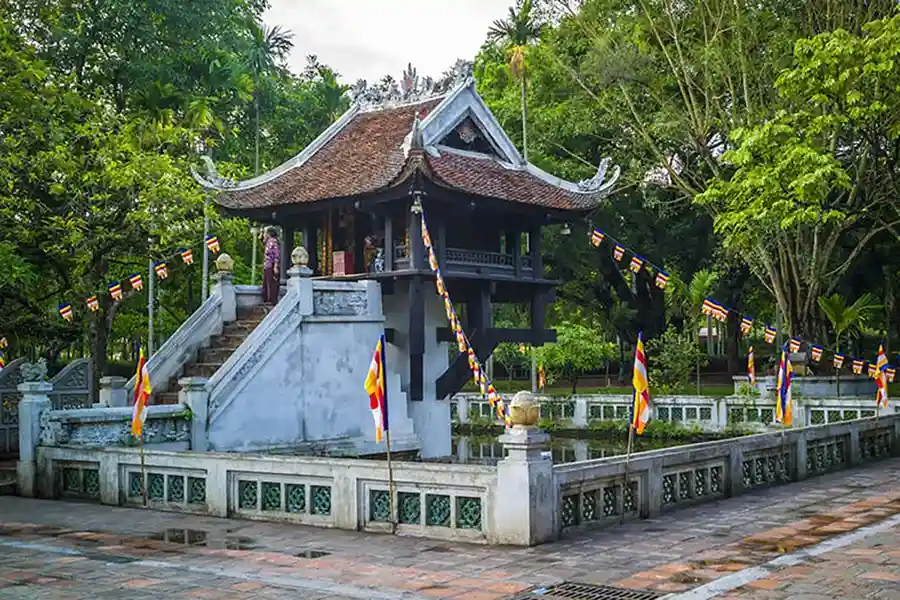
One Pillar Pagoda of Hanoi, Vietnam
The pagoda is made of wood and stands on a pillar now made of concrete. Destroyed by the French army in 1954, it was rebuilt identically in 1955.
The pagoda is located next to Ba Dinh Square, near the Ho Chi Minh Mausoleum and Museum.
What is the legacy of Confucianism in Hanoi?
While Buddhism most likely originated in India, Confucianism arrived in Vietnam as a moral and political philosophy.
While Buddhism most likely originated in India, Confucianism is a moral philosophy that came from China. Confucius is believed to have lived in the 5th century BC. According to his teachings, human behavior must follow five main virtues: benevolence, righteousness, propriety, wisdom, and sincerity.
In addition to these virtues, Confucian morality establishes a social order based on obedience, which is considered synonymous with harmony. This moral system has deeply influenced Vietnamese society, even though it has been criticized multiple times throughout history, including today. The younger generations often see it as a rigid tradition, no longer fully aligned with modern values.
The emblem of Confucianism in Hanoi is the Temple of Literature.
Temple of Literature (11th century)
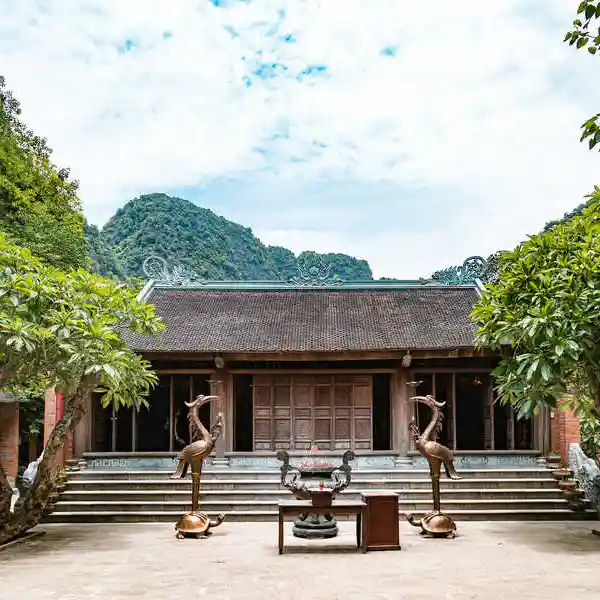
The “Temple of Literature” (Van Mieu) was founded in 1070 by Emperor Ly Thanh Tong and dedicated to Confucius. In 1076, the Quoc Tu Giam, the “College for the Sons of the Nation”, was set up there: it was the country’s first university, initially for the children of the royal family. Its creation marked the rise of the mandarin system: the young men who studied there became senior officials serving the State.
The adoption of Confucian moral principles by the elite served, in a way, to legitimize a power that at the time remained fragile.
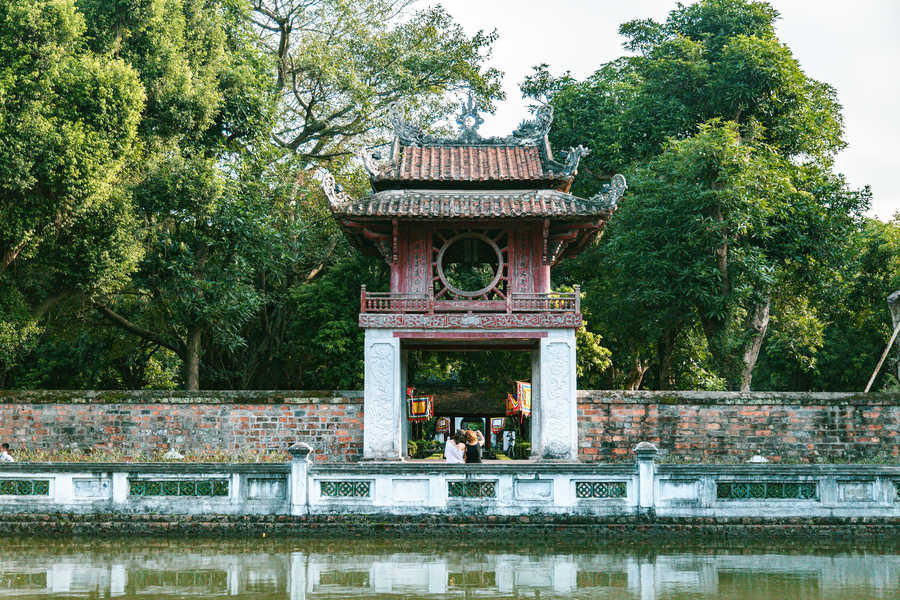
Temple of Literature, Hanoi, Vietnam
The university gradually opened its doors to wealthy families and learned men, regardless of their social origins. Only men, of course, were admitted…
Don’t worry, today everyone can visit it! In the early 19th century, when the capital moved to Hue, teaching stopped there and the site remained a place of worship dedicated to Confucius. Don’t miss the 82 doctors’ steles, standing on stone turtles and listed in UNESCO’s Memory of the World Register.
Several restorations of the buildings were carried out with the support of the French School of the Far East in 1920 and 1947. Further renovations have been made since the end of the Indochina War and the Vietnam War.
What was the impact of the French presence in Hanoi?
The French presence in Hanoi left the cathedral, Long Bien Bridge, the Presidential Palace and the Opera House, all built between 1886 and 1911.
The French presence in what is now Vietnam began in 1858 with the attack on Da Nang, followed by the conquest of Cochinchina, which became a French colony between 1862 and 1867. The treaties of 1883 and 1884, then the Franco-Chinese War of 1884–1885, extended the protectorate to Annam and Tonkin. The French then divided Vietnam into three parts: Tonkin in the north, Annam in the centre and Cochinchina in the south.
After the creation of the Indochinese Union in 1887, Hanoi became its capital in 1902. The French wanted to make Hanoi their showcase in the East, and built numerous monuments that still give the city much of its character today.
Let’s take a look at some of the most important buildings from the French colonial heritage.
St. Joseph’s Cathedral (1886)
The Hanoi Cathedral was completed in 1886, after two years of work, on the site of the Bao Thien Pagoda, which the French had destroyed in 1883—a striking symbol of their power and desire to start anew.
It was built according to plans by Monsignor Paul-François Puginier, vicar of Western Tonkin, and dedicated to Saint Joseph, the protector of the vicariate. Over the years, the cathedral became a place of remembrance for Christian martyrs, including Father André Tran An Dung Lac (1795–1839), a Vietnamese priest executed under Emperor Minh Mang. A chapel inside houses his relics.
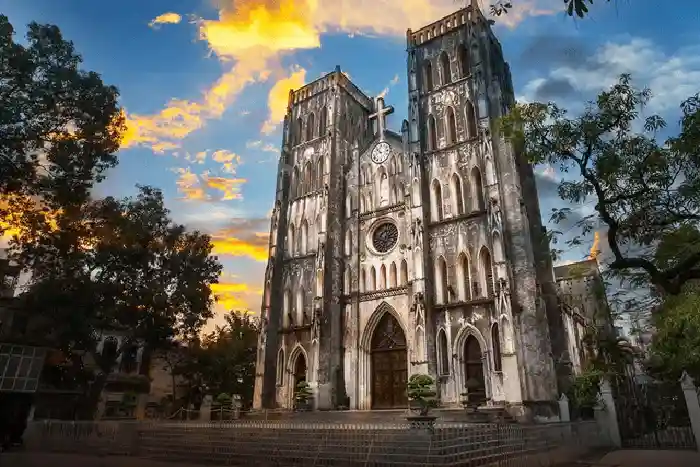
The Cathedral illuminated at Christmas time, Hanoi, Vietnam
After the French departure in 1954, widespread looting led to the loss of many historical and valuable objects. Nevertheless, the cathedral remains an important part of the spiritual life of Vietnamese Catholics. Nearly 7 million Vietnamese identify as Christians, and you may be surprised to see the cathedral full during Sunday Mass. Since January 2019, a French-language Mass has been held every Sunday at 10:00 a.m.
Long Bien Bridge (1902)
The Long Bien Bridge, originally called the Paul Doumer Bridge after the Governor-General of Indochina at the time, was inaugurated on February 28, 1902, after four years of construction. Contrary to popular belief, the bridge was not designed by Gustave Eiffel, but by the Daydé and Pillé company, which was later absorbed by the Eiffel Group in the second half of the 20th century.
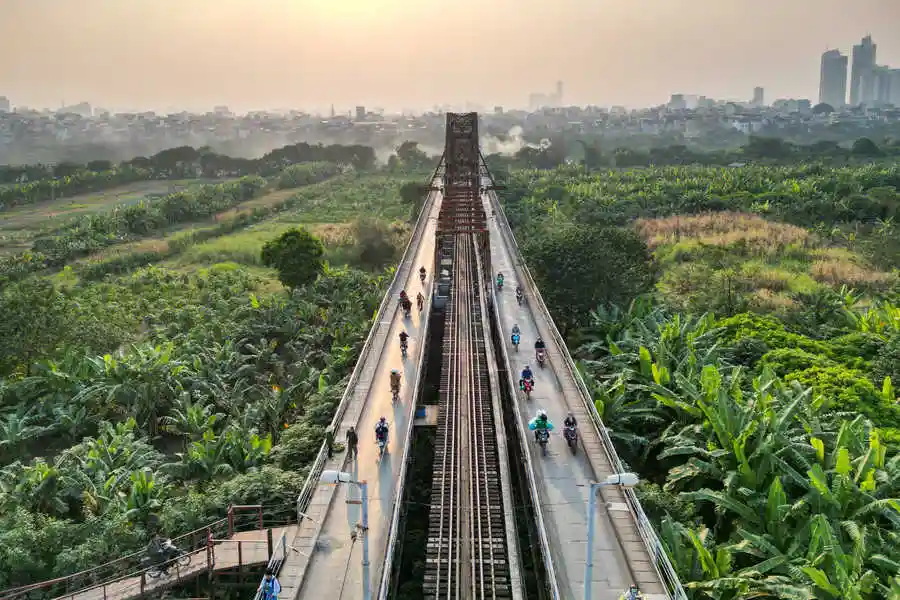
Long Bien Bridge, Hanoi, Vietnam
At the time, this bridge, almost 1.7 km long, was the first to cross the Red River in Hanoi. It was then one of the longest bridges in the world and a symbol of French engineering. Bombed several times during the Vietnam War, it was repaired and is still used by trains, motorbikes and pedestrians.
Presidential Palace (1906)
Located today next to Ho Chi Minh’s Mausoleum, the Palace of the Governor-General was designed by architect C. Lichtenfelder and built between 1900 and 1906. During the French colonial period, it served as the residence of the Governor-General of Indochina. It remained so until 1945.
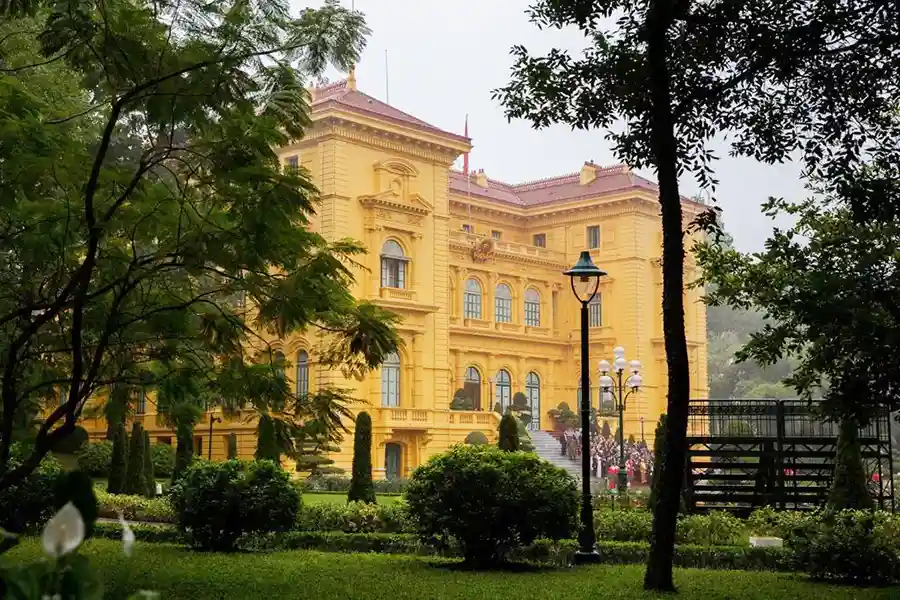
View of the Presidential Palace from its gardens, Hanoi, Vietnam
This building continues to hold great political significance today, as it now serves as the Presidential Palace, hosting official receptions for foreign heads of state.
It is worth noting that Ho Chi Minh chose not to live there, preferring instead a simple wooden house nearby, which still stands within the palace gardens. The Father of Vietnam’s Independence disliked the luxury and grandeur associated with political power, choosing instead to live modestly and remain close to the people.
Hanoi Opera House (1911)
The Hanoi Opera House is a symbol of the “French Quarter”, built in the early 20th century. Paul Bert Street (now Trang Tien Street) became the center of construction for numerous villas and municipal buildings during this period.
The street leads to the Hanoi Opera House, which was built between 1901 and 1911. Inspired by the Palais Garnier in Paris, the building is a fine example of neoclassical architecture.
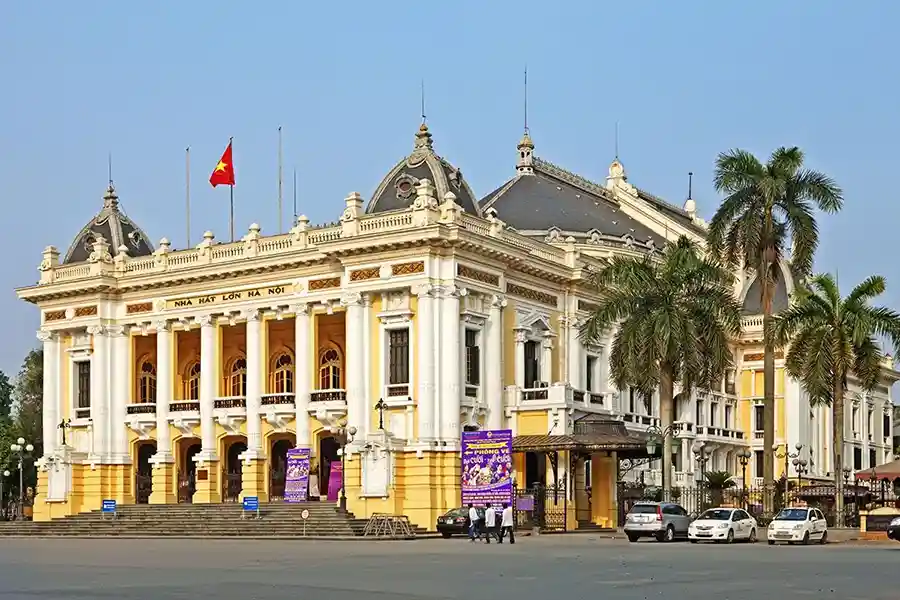
Hanoi Opera House
This opera house remains one of the finest venues in Vietnam today and hosts numerous cultural events. It is also historically significant as the site where the first session of the National Assembly was held on 2 March 1946.
What defines Hanoi’s modern national history?
A new chapter in Vietnam’s history began in 1945, with Ho Chi Minh’s Declaration of Independence in Hanoi.
A new chapter in Vietnam’s history began in 1945, with Ho Chi Minh’s Declaration of Independence on September 2nd. Two key sites in Hanoi embody the importance of this event: Ba Dinh Square and Ho Chi Minh’s Mausoleum.
Ho Chi Minh Mausoleum (1975) and Ba Dinh Square
Ba Dinh Square—formerly called Puginier Square during the French period—holds a powerful symbolic meaning in Vietnam’s modern history. It was here that Ho Chi Minh (born Nguyen Sinh Cung, and known for a time as Nguyen Ai Quoc) read the Proclamation of Independence of the Democratic Republic of Vietnam on September 2nd, 1945.
Ho Chi Minh Mausoleum, Ba Dinh Square, Hanoi, Vietnam
Here is an excerpt from this historic declaration, which captures the spirit of the time:
“The French have fled, the Japanese have surrendered, the Emperor Bao Dai has abdicated; our people have smashed all the chains that have weighed upon us for nearly one hundred years to make our Vietnam an independent country. Our people have also overthrown the monarchical regime established for centuries to found a Republic. For these reasons, we, members of the provisional government representing the entire population of Vietnam, declare that we no longer have any connection with imperialist France, annul all treaties signed by France concerning Vietnam, and abolish all privileges that the French arrogated on our territory.”
It was not until 1954 that the French finally left, then 1973 for the withdrawal of American troops, before the country’s reunification in 1975–1976.
After his death in 1969, Ho Chi Minh was in many ways canonized by the Vietnamese communist regime. Construction of his mausoleum began in 1973, and the monument was inaugurated on August 29, 1975. Modeled after Lenin’s Mausoleum in Moscow’s Red Square, the building serves as a unifying symbol for the nation—linking political ideology with reverence for a national hero.
Through these monuments, we have traveled across key moments of Vietnam’s history. By visiting them in Hanoi, you will gain a deeper understanding of the diverse influences that have shaped the Vietnamese capital over the centuries.
FAQ: visiting Hanoi’s historical sites
What are the must-see historical sites in Hanoi?
The Temple of Literature, Tran Quoc Pagoda, the One Pillar Pagoda, St. Joseph’s Cathedral, Long Bien Bridge, the Opera House and Ba Dinh Square with the Ho Chi Minh Mausoleum.
What is the oldest monument in Hanoi?
Tran Quoc Pagoda, founded in the 6th century and moved in 1615 to a peninsula on West Lake.
Since when has Hanoi been the capital of Vietnam?
Since 1010, when Ly Thai To made it his capital under the name Thang Long. After an interlude under the Nguyen, it became the capital again in 1945, then of the reunified country in 1976.
Why is the Temple of Literature famous?
Founded in 1070 and dedicated to Confucius, it housed the country’s first university from 1076. Its 82 doctors’ steles are listed in UNESCO’s Memory of the World Register.
How long do you need to visit Hanoi?
Allow two to three days to see the main historical sites, stroll through the Old Quarter and visit a few museums.
Can you visit the Ho Chi Minh Mausoleum?
Yes, in the morning, except on Mondays and Fridays and during its annual closure of about two months for maintenance. Respectful dress is required.